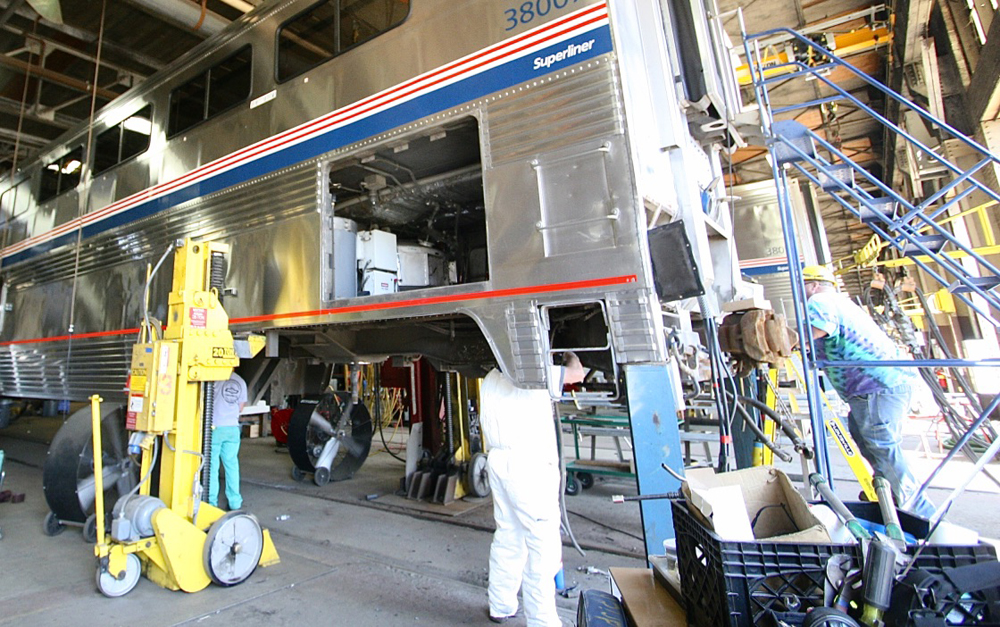
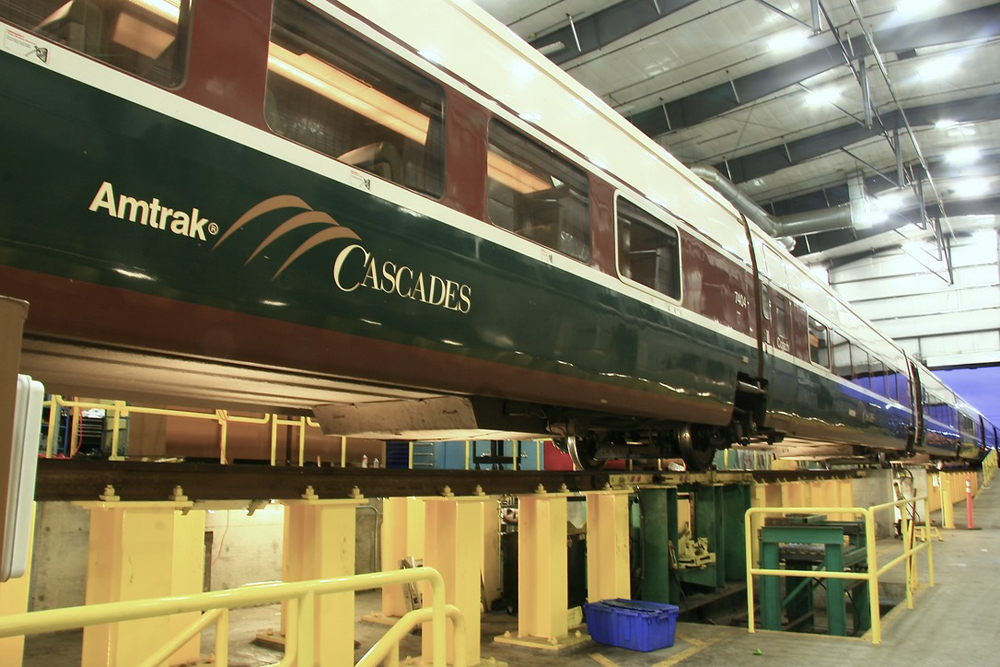
SEATTLE — Amtrak maintenance issues that caused cancellation of Sounder commuter service spilled over into Cascades intercity departures, with buses substituting for Seattle-Eugene, Ore., service because of a shortage of serviceable equipment.
Meanwhile, Amtrak’s eastbound California Zephyr tried to fight its way through a dangerous Nebraska blizzard — and lost.
Those were among the operational issues testing the company during a week that also saw the ouster of its CEO [see “Amtrak CEO Gardner resigns,” Trains News Wire, March 19, 2025].
Four Cascades runs cancelled
In the Pacific Northwest, Amtrak was forced to substitute buses for Seattle-Eugene trains Nos. 503 (departing Seattle at 7:10 a.m.) and 508 (departing Eugene at 5:08 p.m.) on both Monday, March 17, and Wednesday, March 19. The remaining active Talgo trainset, the Mount Jefferson (or its assigned Charger locomotive), was not available for service.
A minimum of seven trainsets are required to protect two Cascades daily round trips north of Seattle to Vancouver, B.C., six between Seattle and Portland, Ore., and two continuing south of Portland to Eugene, Ore. Maintenance cycles were taxed when one of the two Oregon-owned Talgos was removed from service after its cab car was impaled by a tree in a severe storm last November [see “Engineer injured …,” News Wire Nov. 21, 2024]. Repairs have not yet been completed.

Beyond the Talgo trainset, the route now relies on Horizon coaches and Business class/cafe cars that date from 1989. Those were the remaining rolling-stock option following Washington State Department of Transportation’s decision to end its maintenance contract with Talgo in 2020, scrap the Series VI trainsets operating since 1999, and not acquire surplus Wisconsin Series 8 equipment compatible with the Oregon pair. The current situation will continue until new Siemens Aero trains arrive, currently projected for 2026.
When Talgo had the maintenance contract (utilizing Amtrak labor), its permanently-coupled trainsets rotated intact through Amtrak’s Seattle facility in a sequence that ensured periodic maintenance. Now Horizons that encounter problems are routinely swapped out. But the Seattle facility has been further taxed while dealing with questions over documentation of scheduled maintenance that led Sound Transit to pull its Sounder equipment from service [see “Equipment issues improve for Sounder …,” Trains News Wire, Feb. 20, 2025]. Addressing that problem required Amtrak to bring in maintenance workers from as far away as Los Angeles.
Meanwhile, consist information obtained by News Wire show 29 coaches and cafe cars available across seven Horizon sets as of Feb. 23. By March 20 the number was down to 25 cars and six sets.
California Zephyr stymied
Winter managed to exert a final burst of wrath last week in eastern Nebraska when high-wind warning precautions and more than a foot of blowing, heavy snow early on the morning of March 19 stopped the eastbound Zephyr at Exeter, Neb., about 50 miles east of Hastings. Highways were impassable, and BNSF reportedly sent out a rotary plow from Lincoln, Neb., to clear tracks. Rescue locomotives followed. The train was towed later that day back to Hastings, where passengers were given the option to check in to a hotel or ride the train back to Denver. At the Mile High City for a second time, that train was then coupled on to the following day’s eastbound Zephyr, which had been held for clear track from its arrival at about 7 p.m. on the 19th to mid-afternoon of March 20.
The two consists, coupled back-to-back with all four P42s leading elephant style, then departed for Chicago, where the combined train arrived about noon on Friday, March 21. The westbound Zephyr of March 19 and the eastbound March 20 train leaving Emeryville, Calif., were both cancelled, but service on the route is now back to normal.
Another joint operation occurred over the weekend when the northbound City of New Orleans and Saluki, due to arrive into Chicago separately on Sunday morning, arrived together late that afternoon. The City lost two hours between Marks, Miss., and Memphis Saturday night, was delayed another hour at Memphis, then spent five hours waiting at Carbondale, Ill., until 12:20 p.m. That’s when the City and the Carbondale-Chicago Saluki (scheduled out at 7:30 a.m.) departed coupled together. The reasons for the trains’ delays of more than eight and five hours, respectively, were not immediately available.