

KANSAS CITY — You know the story: In November 1939 Electro-Motive FT No. 103 embarked on an 11-month, 83,764-mile demonstration tour on some of the toughest territory that American railroads could throw at the 5,400 horsepower, four-unit locomotive set. In test runs with freight and passenger trains, the experimental diesel-electric proved itself superior to even the most modern steam locomotives. And within 20 years steam was vanquished, making the 103 what Trains Editor David P. Morgan called “the diesel that did it.”
Now, 84 years later, could Canadian Pacific Kansas City’s trio of prototype hydrogen fuel cell locomotives do to the diesel-electric what the 103 did to steam?
CPKC officials believe it’s possible. And they say it’s necessary in order to achieve the railway’s emission-reduction goals.
“We know as an industry, we know at CPKC: The railroads must lead the transportation sector into a low carbon economy,” Justin Meyer, the railway’s senior vice president of engineering and mechanical, said during the CPKC investor day on Wednesday at Kansas City Union Station.
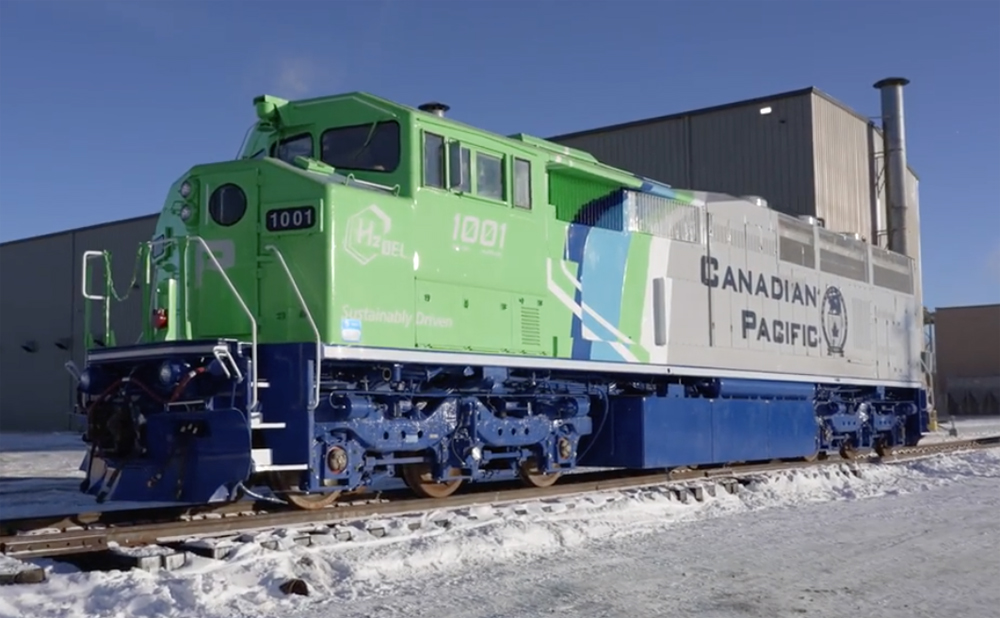
CPKC’s hydrogen-powered locomotives use fuel cells to produce electricity that’s stored in batteries and sent to each unit’s conventional traction motors. The locomotives were the brainchild of Kyle Mulligan, CPKC’s chief engineer of railway technology. He pitched the idea to CP CEO Keith Creel in 2020, and Creel gave the go-ahead to convert a single SD40-2F into the railway’s first hydrogen fuel cell freight locomotive.
“I can’t think of anything that would be more important than being able to create a locomotive that only outputs water as the exhaust,” Mulligan said in a video played at investor day. It took Mulligan and his nine-person team just 11 months to go from concept to a test run of H2 0EL No. 1001. H2 0EL stands for “hydrogen zero-emissions locomotive.”
“It was truly built from the ground up. All of the software is done in house, all of the electrical design and drawings are done in house. The fabrication is done locally. We’re creating an ecosystem of change,” says Mulligan, who is a certified locomotive engineer and conductor. “This project is the chance to change the industry entirely.”
The 1001 and its four-axle counterpart, GP38-2H No. 1002, will complete testing in revenue service in the third quarter and will be handed over to the operating department for daily local and yard service starting in the fourth quarter.
A high-horsepower, AC-traction locomotive, AC4400CW No. 9517, is currently being converted to hydrogen power at the shop of CPKC’s partner, Bilton Welding and Manufacturing Ltd. of Innisfail, Alberta, some 60 miles north of Calgary.
“Our climate goals will not be realized without understanding what we do with our high-horsepower fleet,” Meyer says. “It is that critical because over 90% of our Scope I emissions come from this fleet.”
Scope I emissions, which companies are trying to reduce dramatically in order to limit the impact of climate change, are their direct greenhouse gas emissions.
The AC-traction hydrogen locomotive will produce more than 6,000 hp and is expected to complete movement tests early next year. Then it will be used in coal service, hauling Teck Resources metallurgical coal from its mines in southern British Columbia to Vancouver for export. Teck and CP announced the pilot program last month.
“Those coal trains are 152 cars long and they currently run today with four AC locomotives,” Meyer says. “Our strategy is, once our locomotive is up and running and ready to be tested in service, we’ll pair it with a tender and give it the extra fuel it needs and we’ll begin operating that locomotive with those coal trains.”
Testing in coal service will put the high-horsepower locomotive up against the 2.2% grades, curves, and tough weather of CPKC’s main line through the Canadian Rockies west of Golden, B.C., Meyer says.
Also crucial to the hydrogen fuel cell program: The partnership with CSX Transportation that the railroads announced last week. CPKC will supply conversion kits that CSX will install on low-horsepower units at its former Chesapeake & Ohio locomotive shop complex in Huntington, W.Va.
“Partnering with a Class I railroad is a pivotal point in this project,” Meyer says. “It’s going to allow us to do a few things. One is with a partner like CSX, we will gain their understanding and help on the conversion side with the facilities they have in West Virginia. We bring our technology to them, and working together we will accelerate the number of assets that go into service.”
Getting as many fuel cell locomotives into service as quickly as possible is important, Meyer says. That will allow CPKC and CSX to work the locomotives through all four seasons and in various operational settings. The railroads will gain a better understanding of the locomotives’ performance and what might be necessary to improve their reliability over the long term, Meyer says.
By developing the retrofit kits, CPKC will have the ability to quickly refit its entire diesel electric fleet, Mulligan says. “It’s really exciting to see that there’s a transition path that’s right in front of our eyes,” he adds.
Hydrogen might not be the only solution for reducing or eliminating greenhouse gas emissions from CPKC’s locomotive fleet, Meyer says. But it has several advantages over battery-electric locomotives, because hydrogen fueling is similar to fueling a diesel, he explains.
Both diesels and hydrogen locomotives can have their fuel tanks filled at fuel pads or by tanker trucks, and the hydrogen refueling process takes roughly the same amount of time as topping off a diesel fuel tank. Battery-electric charging takes up to 14 hours and can only be done at fixed locations.
CPKC wouldn’t be able to recharge a battery-electric that ran out of juice while away from a charging station, a fact that would limit their operational flexibility because they’d have to be towed back to a charger. “What options do we have? On the type of railroad we run, an extension cord wouldn’t be able to be run across an operating yard,” Meyer says.
CPKC, like other railroads, has built its fueling, mainline, and yard operations around the diesel-electric, Meyer says. Switching to hydrogen would be an easier transition due to its similar fueling characteristics, he says.
CPKC is using solar power to produce hydrogen at its Calgary headquarters. It also has a separate hydrogen production facility in Edmonton, and has partnered with the Alberta provincial government to fund the second and third prototype locomotives.
— Updated at 3:45 p.m. CDT to correct first name of Justin Meyer, senior vice president of engineering and mechanical.