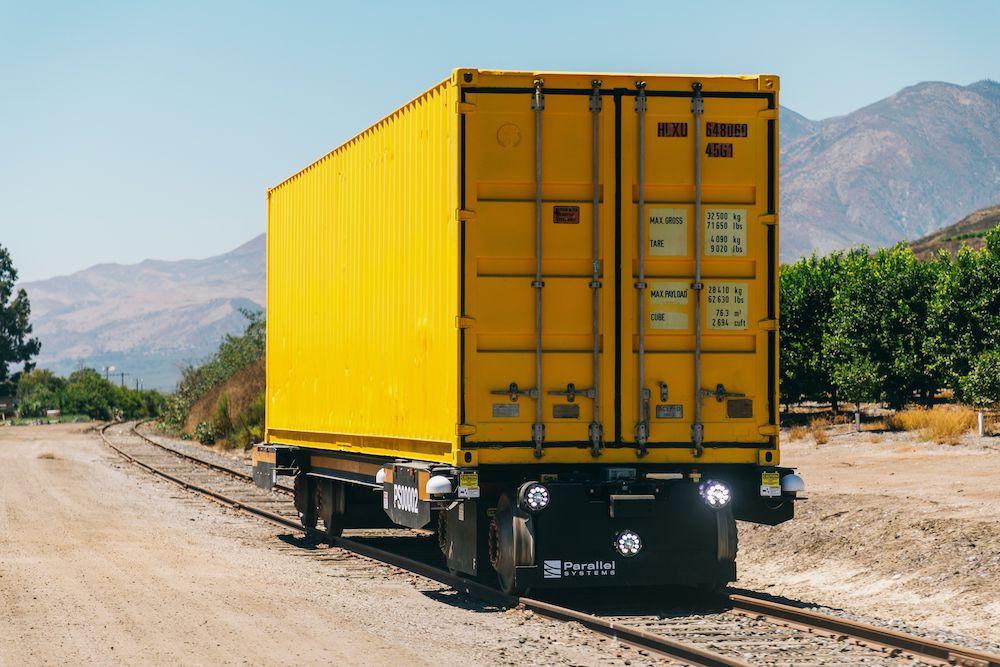
LOS ANGELES – Parallel Systems today introduced its second generation battery-electric autonomous container car system, which the company hopes will see pilot testing on Genesee & Wyoming short lines in Georgia as well as with international customers.
Parallel says the new prototype is undergoing testing to verify the system’s ability to operate on the conventional rail network. The goal, Parallel says, is to allow railroads to operate Parallel vehicles using existing train dispatching and control systems.
“Testing this vehicle generation and supporting systems is a critical step in our product development to inform our commercial product,” Parallel co-founder and CEO Matt Soule said in a statement. “With less than 3% of the 143,000 miles of U.S. railway occupied by active trains at any given moment, there’s immense opportunity to shift freight from the overburdened trucking industry to rail. In addition to addressing the truck driver shortage, converting 100,000 trucking miles to Parallel’s rail zero-emissions vehicles would eliminate up to 175 tons of carbon dioxide from the atmosphere.”

The second generation vehicle includes both autonomous and remote operation features. While initial pilot tests will operate under supervision at all times, the autonomous system will be installed, learning and improving as Parallel further develops its autonomous capability, Parallel said.
Parallel Systems has produced three second generation vehicles, with three more in production and more expected to follow. The vehicles have been undergoing control, telemetry, traction, brake and dynamics testing since November 2022 on Parallel’s Southern California test track. Track-worthiness testing will be conducted with MxV Rail in Pueblo, Colo., next year.
Each Parallel railcar is individually powered and can form platoons of up to 50 cars to reduce energy consumption and efficiently use rail network capacity. The platooning is fully automated: the railcars don’t need to couple or uncouple. They simply move close to each other and then initiate contact through bumpers to form platoons. Once contact is made, each vehicle maintains a set force with the one in front by regulating tractive effort. The small air gap and pushing action through railcar bumpers reduces overall aerodynamic drag of the platoon, improving energy efficiency.

The company says the vehicles will have a range of 500 miles and will be able to recharge in as little as an hour.
Parallel’s second generation vehicle is being built to the following specifications:
- Propulsion system: Battery-electric traction motor powertrain.
- Autonomous system: Fully autonomous, with bi-directional camera-based perception system.
- Payload capacity: Up to 70,000 pounds with a single stack container.
Last month Parallel and G&W short lines Heart of Georgia and Georgia Central sought Federal Railroad Administration approval to conduct a pilot program as early as next year.
Parallel was founded in 2020 by a group of former SpaceX engineers who aim to develop systems to move freight cleaner, faster, safer, and more cost effectively than traditional trains or trucks.
Share this article