

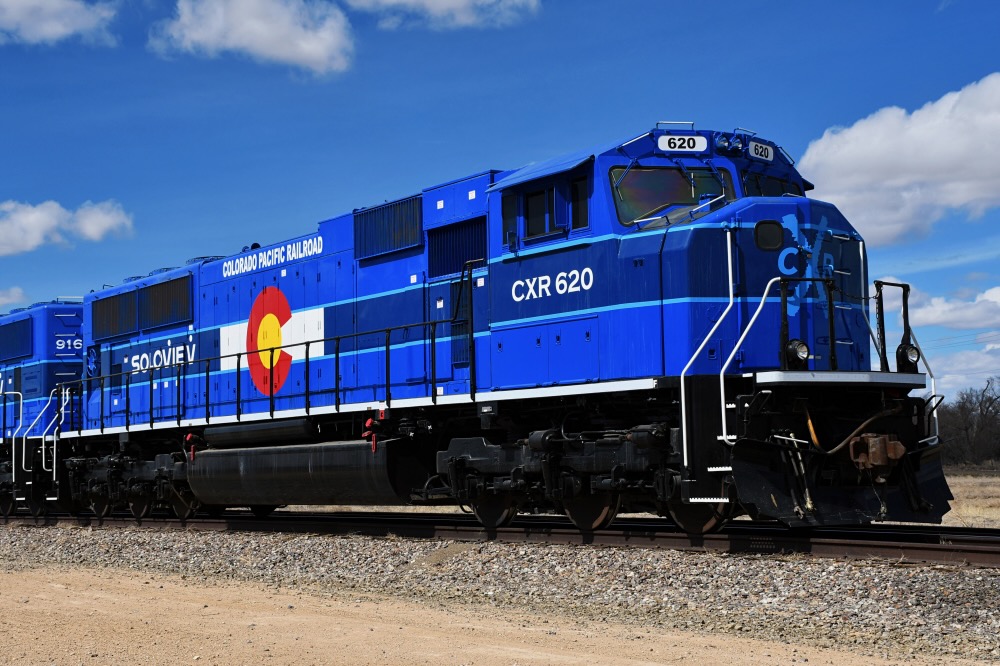
KANSAS CITY, Kan. — Colorado Pacific Railroad and Weskan Grain, two subsidiaries of the Soloviev Group, this week filed a federal court suit that alleges Union Pacific Railroad and regional railroad Kansas & Oklahoma have conspired to prevent westbound grain moves over Colorado Pacific.
The plaintiffs claimed that UP and Watco Cos.’ K&O are using a $500 per car interchange fee to effectively prevent farmers located on the K&O from shipping export grain west over Colorado Pacific to an interchange with UP and BNSF Railway at NA Junction in Colorado. The junction is near Boone, Colo., and about 25 miles east of Pueblo.
Both UP and K&O, one of Watco’s 30 regional and shortline railroads, denied the allegations.
Colorado Pacific bought 122 miles of track in 2018 from NA Junction to an interchange with the K&O at Towner, Colo., about 60 miles west of Scott City, Kansas. The railroad rebuilt the property it calls the Towner line, where no traffic had moved for more than two decades, seeking to move grain from elevators on K&O in the Scott City area, including two Weskan facilities.
The complaint filed in U.S. District Court in Kansas alleges that UP and K&O in 2019 altered a 1997 lease agreement to impose the interchange fee that made westbound moves from elevators on K&O too costly for farmers in the Scott City area. Grain from the Scott City area can move more than 140 eastbound miles over the K&O to interchange with UP at Great Bend, Kan., before it moves west.
“I’m a farmer wanting to get a market for my grain,” said Weskan and Colorado Pacific Chairman Stefan Soloviev in an interview. “We got into the rail business to provide competition so farmers could get competitive prices. They [UP and K&O] have given us no choice. We’ve been fighting this for three years. The lawsuit is the last thing we wanted to do.”
Jake Wahlenmaier, grain elevator manager at Weskan’s elevator in Sheridan Lake, Colo., says the potential for the Towner line is enormous, if the grain traffic could move that way.
“We’d turn that line into the busiest stretch of rail west of the Mississippi,” he said. “We’d be smoking the rail ties.”
Colorado Pacific also has filed at the Surface Transportation Board to contest the interchange fee and support its contention that the other two railroads illegally created a so-called “paper barrier” to block westbound grain moves from the K&O to Colorado Pacific.
“Union Pacific denies the allegations of the lawsuit and will present the facts to the court and Surface Transportation Board who handles these issues,” a UP representative said.
“We do not comment on litigation matters, but as a matter of course we will defend our commitment to the values that define us through the proper legal channels,” said spokeswoman for Watco, based in Pittsburg, Kan.
Soloviev said Colorado Pacific anticipates moving 5,000 carloads of grain this year. Weskan is at capacity at five rail and five truck facilities, and 20 unit trains have been booked for future moves, he added.
“We have to have that western outlet for our grain,” Steven Compton, a Scott City farmer, told Trains. “Transportation is vital. Feed and other costs have gone up, but grain prices are steady. Markets are being compressed. This is about more than money. It’s about the survivability of the farm economy.”
Weskan is part of Soloviev’s grain businesses that provide services such as seed, storage and transportation to farmers. More than a dozen farmers in the Scott City area joined in the suit.
Soloviev Group says it is the 14th largest landowner in the U.S. Its holdings are estimated at 350,000 acres. The New York-based entrepreneur also has businesses including real estate, wind farms, and a resort hotel on Long Island.
Soloviev also controls the Colorado Pacific Rio Grande, a 150-mile railroad in southern Colorado. Several years ago Soloviev sought to reopen the former Denver & Rio Grande’s route over Tennessee Pass to move westbound grain, an effort that included an unsuccessful bid to force UP to sell the line to Colorado Pacific [see “Regulators toss out effort to force UP to sell …,” Trains.com, March 18, 2020]. That effort ended in 2023 [see “News report says Colorado Pacific …,” May 9, 2023].
The suit alleges violations of the Sherman Act that govern anti-competitive practices, said Michael Hershman, CEO of Soloviev Group.
“The allegations are fairly standard for a Sherman Act case,” Hershman said. “What’s different here is that this is David vs. Goliath. It’s very difficult to go against a multi-billion dollar company [UP].”
Soloviev said Colorado Pacific was prevented from bidding on the property that UP owns and K&O operates under the lease that is being challenged in the federal court case. In the interview, Soloviev advanced another reason to seek the change, saying the ability to move traffic directly via Colorado Pacific would eliminate 25,000 moves currently made by truck to get grain from Scott City to where Colorado Pacific can handle it.
— Updated at 6:05 p.m. to clarify item on taking trucks off the road; updated Feb. 2 at 9:55 a.m. to correct title of Jake Wahlenmaier. To report news or errors, contact trainsnewswire@firecrown.com.
Share this article