

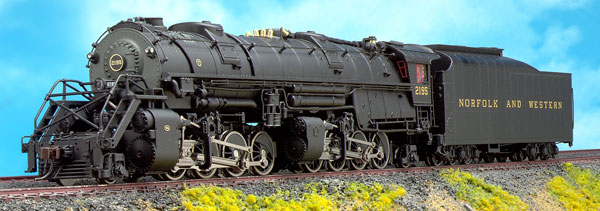
An early start. As a coal-hauler, the N&W began operating a fleet of compound 2-8-8-2s as its standard heavy-duty locomotive in 1912. Mallets were compound engines that used their steam twice: first in the rear high-pressure cylinders and then in the (larger) front low-pressure cylinders. These early 2-8-8-2s were ponderous, slow moving machines that could pull immense amounts of tonnage.
The N&W constantly upgraded the design, and its 2-8-8-2 eventually became the basis for the largest standard-design locomotive developed by the United States Railroad Administration (USRA), the federal agency that operated railroads during World War I.
Postwar development concentrated on the 2-8-8-2s’ efficiency and speed capabilities. The N&W eventually owned 227 of these engines, but the final Y6b version is the specific prototype of this model.
Continued refinement culminated in the construction of 30 Y6bs by the N&W Roanoke Shop between 1948 and 1952. The efficiency of these modern steam locomotives allowed some of them to successfully compete with the diesels until 1960.
A well-proportioned machine. The Precision Craft Models 2-8-8-2 is a handsome model that captures the prototype’s look and proportions. Its major parts are metal with numerous individually applied plastic details. The model’s dimensions match the Y6b scale drawing in the Model Railroader Cyclopedia: Vol. 1, Steam locomotives. All of the drivers are properly spaced, and their scale 57″ diameter is correct.
The coupled engine and tender are 15½” (scale 113 feet) long, so the locomotive will fit on a 15¼” turntable with a little overhang. Three drawbar pin positions provide up to an additional ¼” of clearance for tight-radius operation.
An eight-page User’s Manual, a Function Quick Reference Guide, and a pair of exploded isometric drawings explain how to operate the locomotive.
The die-cast boiler provides plenty of weight for maximum pulling power without using traction tires.
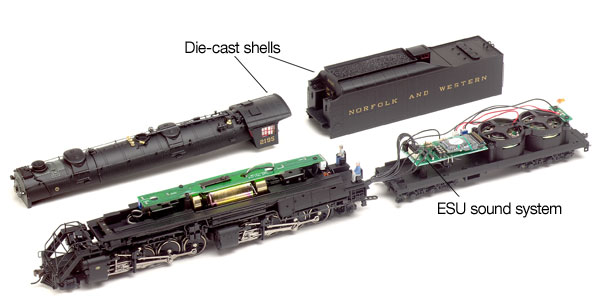
The 2-8-8-2’s chassis follows the pattern we’ve been seeing on other recent model articulateds. A large can motor fitted with a pair of machined flywheels is enclosed in the middle of the boiler just ahead of the firebox. It drives both engines through universal shafts concealed within the boiler.
Each eight-drivered engine has a die-cast metal frame with a gearbox that extends up into the boiler above the third driver. Both engines swivel and rock slightly under the boiler to keep all of the drivers in contact with the rails for maximum traction.
Prototype articulateds have their rear engine rigidly attached to the boiler, while a hinged joint between the engines allows the front engine to swing into curves. This deviation from prototype practice allows the model to negotiate an 18″-radius curve, and it reduces the end overhang. Thanks to close clearances between the boiler and running gear, these modifications are noticeable only on tight curves.
The model includes a huge N&W 22,000-gallon tender that rides on acetal plastic, six-wheel Buckeye roller-bearing trucks.
The Kadee no. 58 scale coupler on the tender is mounted at the correct height. The pilot has a plastic McHenry knuckle coupler mounted about .020″ high. A dummy coupler is also provided for the pilot.
Our sample 2-8-8-2 came neatly painted in a smooth satin black with a realistic graphite color on the smoke-box front. All of the printed lettering was sharp and opaque.
Sound system. The ESU sound and control system is concealed within the tender. Twin 1¼” speakers are mounted face down above the rear truck. A DC Master control unit, which Precision Craft sells separately, allows the operator to use the sound effects during DC operation.
On DCC the sound effects are controlled by the throttle’s function buttons. A toggle action on F5 simulates the prototype’s eight-chuffs-per-revolution starting in simple, or four chuffs per revolution at higher speed in compound operation. The sound quality is good, and the system offers a wide range of adjustments. A reset in CV8 restores the factory settings.
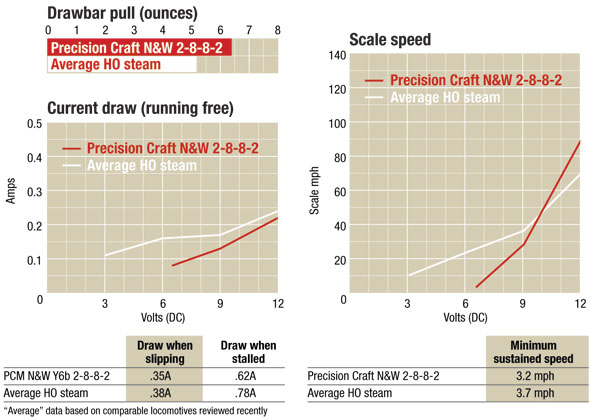
On DC our sample 2-8-8-2 started and ran smoothly at 3 scale mph. It ran well at realistic speeds, producing a drawbar pull equivalent to 89 free-rolling freight cars on straight and level track. On DCC, it began moving on throttle step 1 and ran steadily at 1.4 scale mph, reached a typical 45 mph on step 12, and had a top speed of 78 mph at step 20 and beyond.
Overall, I’m impressed with this 2-8-8-2’s combination of good looks, solid performance, and excellent sound effects.
Price: with automatic dual-mode decoder and LokSound system, $699.99; upgrade-able DC-only version, $599.99; DCC upgrade kit for DC Y6b, with LokSound decoder and speaker, $129.99
Manufacturer
Precision Craft Models
4 Signal Ave.
Ormond Beach, FL 32174
Description
Ready-to-run plastic-and-metal steam locomotive
Road name
Norfolk & Western nos. 2195, 2200, or unnumbered
Brass bell and handrails
Couplers: Kadee no. 58 knuckle coupler on the tender; pilot has a McHenry plastic coupler
Detailed backhead
Die-cast metal locomotive and tender construction
Directional constant lighting
Drawbar pull: 6.4 ounces
Firebox glow
Five-pole can motor with dual turned-brass flywheels
Minimum radius: 18″
Operating cab roof vents
Optional sound and DCC up-grade kit specifically tailored to fit PCM DC models with PCM motherboards
Overall length: 15½”
Painted engine crew
RP-25 wheelsets (in gauge)
Separately applied details
Weight: engine alone, 31 ounces; tender, 12 ounces; total, 43 ounces