

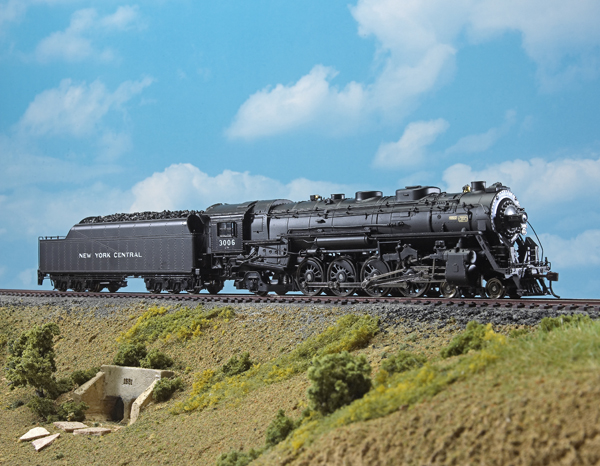
The prototype. The NYC’s steam fleet included 600 Mohawks (4-8-2s were “Mountains” on other roads, but not on the Water Level Route!) in four classes. Those in class L-1 (185) and L-2 (300) built between 1916 and 1929 were freight locomotives. After successful 1939 tests of two modified L-2s in passenger service, NYC ordered 65 new 4-8-2s (class L-3) from the American Locomotive Co. and Lima between 1940 and 1942 to use as dual-service engines (freight and passenger). The class L-3 locomotives had 69″ drivers but the axles were spaced to accommodate 72″ drivers. The last order for 50 dual-service Mohawks (class L-4) from Lima were delivered between 1942 and 1944 and had 72″ drivers. All late Mohawks look similar, and all delivered about 3,800 drawbar hp at 48 mph and had a maximum speed of 80 mph.
Within these classes are many variations, including feedwater heater type. The NYC added smoke lifters to L-3 and L-4 Mohawks starting in 1944. Freight engines had solid bearings on the driving axles and footboard pilots; dual-service locomotives had roller bearings and passenger pilots. Ten L-3 Mohawks had Union Web Spoke drivers, but the rest had Boxpoks. Some L-4 locomotives had Scullin disk drivers, and some Mohawks had mixed sets. All the locomotives had Baker valve gear.
All locomotives had a cover over the piping in front of the cab, but some covers extended to the running board and some did not. The shrouds on the pilot varied. It’s difficult to specify the exact combination of parts on a particular Mohawk without a dated photo.
The late Mohawks hauled freight and passenger trains into the mid-1950s. The Mohawks were retired in 1957, but most reports give 1956 as their last year of active service.
Model construction. All versions of the MTH Mohawk locomotive have die-cast metal boilers and chassis with plastic and metal detail parts. The drivers have metal centers and rims. All drivers are flanged, and the inner sets of drivers can move side to side. The gearbox is on the third axle. The drivers and rods are cleanly cast and the rod finish is excellent. However, the drivers would look more realistic if the axle ends were painted.
Similarly, the engineering plastic lead and trailing trucks are cleanly molded but would look better if painted, as would the axles on the lead trucks. The lead truck is moved forward a few inches compared with the prototype to allow for operation on model curves, but the mechanism looks good, the drivers are on the correct centers, and the brake shoes are mounted in the same plane as the wheel treads. Pickup is via the drivers but not the lead or trailing trucks. A long-shank plastic knuckle coupler is mounted in a small box on the pilot. Finger-style springs center the coupler, but they are visible from the front.
Our review sample depicted an NYC L-3a. The boiler matches prototype drawings in the Locomotive Cyclopedia Vol. 1: Steam Locomotives and the casting is smooth and crisply detailed. The cast running boards have a tread pattern molded into the top. The cab is a highlight, with flush-mounted windows, interior lighting, painted backhead, and painted figures. The drawbar is cleverly designed, with two wires that contact the pin on the tender. There is no wiring harness connecting locomotive and tender. Spacing between the locomotive and tender is longer than prototypical.
The tender features die-cast metal construction with unpainted plastic trucks. Some details are molded in and others are separate plastic or metal parts. The tender features one of the best-looking coal piles I’ve seen.
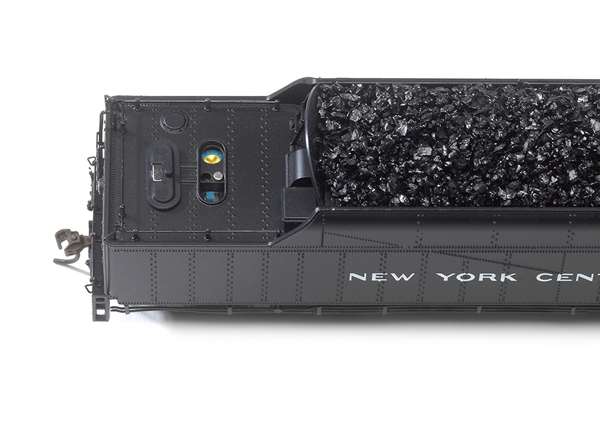
The control and sound system is housed inside the tender with a master volume control and smoke unit on/off switch under the tender’s water hatch. All 12 tender wheels pick up electricity via wipers on the axles. One downward-facing speaker is mounted in the tender floor and a coupler box is mounted at the rear.
MTH has placed a priority on quality sound and reliable electrical pickup. The compromise is that the 14-ounce tender places a load on the engine equal to several cars.
Our sample came decorated in the Central’s post-1940 livery and matches prototype photos. All lettering on the cab and tender is opaque and crisply printed.
Drivetrain. The mechanism features a Canon motor with flywheel, a dogbone-style driveshaft, and a gearbox mounted on the third axle. It ran smoothly and maintained a steady speed even at low throttle settings. We also tested the locomotive with the sound off, and though there was some mechanical whine at high throttle settings, the motor and gearbox were virtually silent at slow speeds.
The third set of drivers has traction tires installed. The MTH Mohawk has an impressive drawbar pull equivalent to 153 HO scale freight cars (or 55 HO passenger cars) on straight and level track.
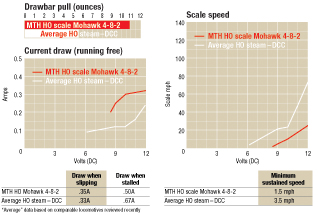
Lights, sounds, and smoke came on at 6.5 volts. At 8 volts, the model crept at 1.5 scale mph. At 12 volts the model ran at 25 scale mph.
Modelers can use a higher voltage power pack to run the Mohawk at higher speeds but should note that voltages above 12VDC can damage lightbulbs and motors in some equipment.
I tested the model in DCC using an NCE Corp. PowerCab. The model operates best using 128 speed steps. The 4-8-2 started moving in speed step 1 at 1.5 scale mph and accelerated to 85 scale mph, very close to the prototype’s 80 mph top speed.
Using an MTH DCS Commander, I adjusted the locomotive’s speed in 1 scale mph increments to a top speed of 85 scale mph.
We tested three Mohawks. After performance tests, including the strenuous drawbar pull and stall tests, followed by a few days of regular operation, the drive shafts of two locomotives slipped within press-fit couplings, rendering the models inoperative. A third Mohawk continues to operate properly, and we repaired one of the slipping drive shafts with cyanoacrylate adhesive (CA).
As of this writing, MTH received only three other Mohawk drive-shaft complaints, but asks that hobbyists with concerns contact its service department directly. MTH will glue the connection on future locomotives.
When using DCC or DCS more effects are available. The model has 29 functions, including the whistle, bell, overall volume level, and passenger service arrival and departure announcements.
The model has only 10 programmable configuration variables, which limits the user’s ability to fine tune features.
You can also use the DCS controller’s thumbwheel to quill the whistle, varying its pitch. The whistle sounds like prototype recordings that I’ve heard.
The MTH Mohawk is a handsome and accurately dimensioned locomotive that offers a wide range of features, including well-reproduced sounds and puffing smoke. Steam fans, especially New York Central steam fans, will enjoy it. – Terry Thompson, publisher, with Dana Kawala, associate editor
Price: $449.95
Manufacturer
MTH Electric Trains
7020 Columbia Gateway Dr.
Columbia, MD 21046-1532
www.mthhotrains.com
Description: Die-cast metal sound-equipped locomotive
Road numbers/classes: New York Central no. 3006 (L-3a), NYC no. 037 (L-3b), NYC no. 3064 (L-3c), NYC no. 3117 (L-4a), NYC no. 3125 (L-4b with smoke deflectors)
Automatically switches between DC, Digital Command Control (DCC), or Digital Command System (DCS) modes
Constant-voltage headlight
Drawbar pull: 10.9 ounces
Engine and tender weight:
2 pounds 1 ounce
Fan-driven smoke unit
Front and rear scale-size magnetic knuckle couplers at correct height
Five-pole skew-wound motor with brass flywheel
Minimum radius: 22″
MTH Proto-Sound 3.0 system operates in DC, DCC, or DCS
NMRA RP-25 contour metal wheels in gauge
Painted engineer and fireman figures
Sprung drivers
User-installed drivers without traction tires