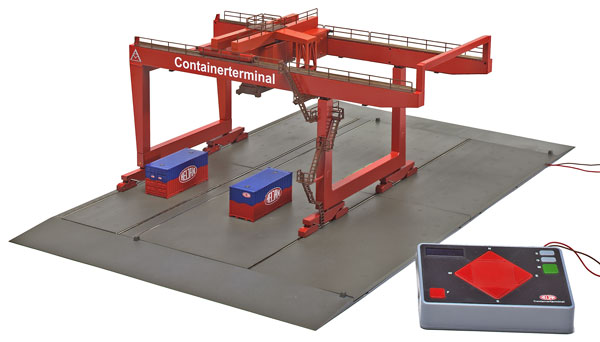
The assembled model features die-cast metal and injection-molded plastic construction and is typical of cranes used in major ports and intermodal terminals worldwide.
Cranes and intermodal. Container cranes vary in size and style, depending on the needs of a port or intermodal terminal. Rail-mounted cranes, such as Heljan’s model, are common in dockside locations where they extend over the adjacent ship.
You can learn more about con-tainer cranes in Jeff Wilson’s book Intermodal Equipment and Operations (Kalmbach Publishing Co., 1999; now out of print). Also, be sure to check out Information Desk on page 26 to learn more about intermodal containers.
The model. The crane is made mostly of die-cast metal with molded plastic details. It stands a scale 48′-6″ tall over the top railings, and the girders are 93′-3″ long. The crane has a 59′-6″ span with 34′-6″ of clearance underneath.
The end girders and vertical supports are spaced 38 feet apart, and the top-lifting “head” doesn’t extend, so the crane cannot handle containers longer than 20 feet.
Four motors operate the crane’s functions to move the gantry for-ward and back along the rails, shift the trolley from side to side on the top rails, raise or lower the hoist, and operate the container turning mechanism. All of these motors operate under DCC, so only two wires go to the crane.
The crane has an eight-piece molded plastic baseplate that measures 13 3/16″ x 22 13/16″. The two bottom panels have factory-installed crane rails. There are also several rows of sockets on the bottom panels, similar to building blocks, that the other six panels (with simulated asphalt) lock on.
The model includes two 91/16″ lengths of HO track. However, the baseplate can accommodate five parallel tracks (four under the crane and one adjacent to it). A track-extension kit is sold separately.
The baseplate’s modular design makes it expandable, and a 9 1/16″ x 13 3/16″ extension set is available. However, the instructions state that if the base is expanded there will be some power loss.
A 16-page instruction booklet contains pictures of the control unit and lists the various buttons (or button combinations) needed to activate the crane’s functions. These functions are labeled in the photo above. Pushing any of triangles will move the crane in the appropriate direction. Holding the function button down works like a shift key to access the second (hoist) movements. The gantry and trolley can be moved simultaneously.
On the right side of the control, three on/off buttons control the hoist spotlight, gantry light, and lifting magnet. In addition, ports on the left and right sides of the control unit are for future use with a joystick or to connect the controller to a computer.
The controller produces DCC commands. A list of adjustable configuration variables (CVs) is included in the instructions. These CVs can be adjusted with any DCC cab capable of programming loco-motives. Most of the CVs adjust the speeds of the various functions.
The crane has nine speed steps that can be programmed for the trolley and gantry motors. Three cranes with different addresses can be operated from one controller.
Moving containers. Each Heljan container includes in its top a thin steel plate. Two flush-fitting nubs of steel are visible on the container roof, but I think the design is a good compromise. If a thicker piece of steel were used, it might strain the winch motor. A dab of paint or weathering will conceal the nubs. Steel plates are available separately for outfitting other brands of containers for use with the crane.
The controller’s commands produced quick responses, and the gantry and trolley moved at real-istic speeds. I lowered the hoist over the first container and activated the electromagnet. A green light-emitting diode (LED) on the hoist lit up to indicate that the magnet was on. I then raised the hoist and moved the container over the car.
Next, I lowered the hoist until the container was in the car before I deactivated the electromagnet and the green LED flickered off.
I repeated the process with the second container, but this time I used the hoist’s rotating feature to rotate the container 180 degrees before I set it down.
Since major ports and intermodal terminals operate around the clock, the Heljan model includes light-emitting diodes (LEDs) under the operator’s cab to illuminate the hoist and six LEDs along the gantry to light the working area. These tiny LEDs produced a surprising amount of light.
A winner. A lot of thought went into the design of this crane, and the easy-to-use controller and wiring make the crane inviting for both newcomers and experienced hobbyists.
Price: $750
Manufacturer
Heljan, exclusively distributed by Wm. K. Walthers, Inc.
P.O. Box 3039
Milwaukee, WI 53201
www.walthers.com
Description
Fully functional plastic and metal container crane
Features
Assembled gantry with operating trolley and hoist
Base plate with factory-installed gantry rails
DCC programming capability
Easy wiring and control
Expandable design
Includes two 20-foot containers with metal plates
Push-button controller
Self-adjusting lift mechanism