

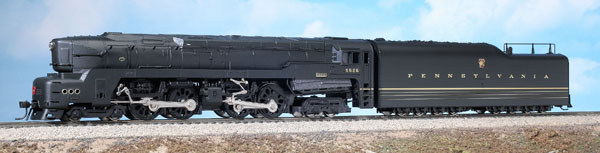
The prototype. Six decades after the last ones ran, the Pennsylvania RR class T1 remains one of the most controversial of all steam locomotives. Baldwin Locomotive Works built two prototypes, nos. 6110 and 6111, for the PRR in 1942. The unusual 4-4-4-4 “duplex-drive” wheel arrangement (two groups of four driving wheels in a rigid frame) was intended to reduce machinery mass and improve steam utilization in a high-speed passenger locomotive. Just as novel was the T1’s external appearance, created by industrial designer Raymond Loewy.
After testing the prototypes, PRR ordered 50 more T1s, nos. 5500–5549. Half were built by Baldwin, half by PRR’s own shops, which also supplied all 50 tenders; production spanned from November 1945 through August 1946. These engines were somewhat less streamlined than the prototypes, having shallower side skirting and blunter noses.
In service, the T1s were capable of amazing feats of speed, easily rushing heavy trains at 100 mph across the flatlands of Indiana and Ohio. But they could be slippery, and developed a reputation for unreliability if not carefully maintained and operated.
Was the design flawed, or were the T1s simply not given a chance to prove themselves? What’s certain is diesels began arriving in significant numbers even as nos. 5500–5549 were being built. Most of the rakish steamers were sold for scrap by 1954.

tender’s water scoop and trainphone apparatus and the engine’s outward-angled side cab windows (the front cab windows are slightly undersized).
The model comes with knuckle couplers on the pilot and tender; T1s nearly always ran with the front coupler in the lowered position, but this feature isn’t supplied with the model.
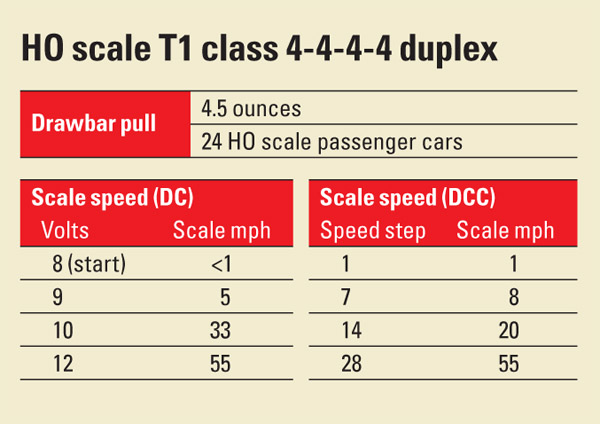
The rear drivers on the second engine have traction tires. This, coupled with the weight of the model’s die-cast metal chassis, provides more than enough pulling power to haul a typical Pennsy passenger consist.
The locomotive tender drawbar has three holes so spacing between the tender deck and cab floor can be adjusted to .4″ (scale 35″), .25″ (scale 21″) and .15″ (scale 13″). Note that the closer cab spacing requires curves wider than the model’s 22″ minimum radius. The model looks much more realistic on curves of 30″ radius or larger.
The BLI T1 has a die-cast metal locomotive pilot that’s scale 4 inches above the rail head. This is prototypical, but the bottom of the metal pilot can touch both rails over uneven track and cause a short circuit. I fixed this issue by placing a thin strip of electrical tape on the bottom edge of the pilot.
Dual-mode DCC. On our DC test track, random sounds of the air pump and steam releases started at 7 volts. I heard the chuffing exhaust sounds as I advanced the throttle and squealing brakes as I decreased the throttle. For those planning to run the Paragon2 T1 on DC power, the manufacturer recommends purchasing its DCMaster Analog Control Module (sold separately for $39.99). This product lets you trigger DCC sound effects and program some configuration variables (CVs). For example, after I programmed the model’s
analog starting voltage, it began moving at 6.5 volts.
On our DCC test track, the sounds started as soon as I entered the locomotive’s factory address of no. 3. I easily reprogrammed this to the locomotive cab number before testing.
The sound system emitted the four chuffs per wheel revolution for each of the two engines. Using CVs it’s possible to program the amount that the two engines are out of synch with each other, which is useful, as the T1s were prone to slipping when starting. A list of all the programmable CVs is included.
User-triggered functions include coupler slack when starting a train and a grade-crossing signal. Out of the box, the bell sounds accurate. There are three whistle sounds to choose from, and after programming CV224 to a value of 2, the whistle had the correct deep tone.
On both DC and DCC layouts, the T1 emits a plume of white smoke that “puffs” in synch with the motion of the drivers. For those who prefer smoke-free operation, there’s an on/off switch under the cab. Function 7 on a DCC throttle or DCMaster also stops the smoke.
In addition to the newly tooled “as-built” version, BLI is also re-releasing the late-version T1 upgraded with the Paragon2 DCC sound system. BLI has done a fine job bringing this unique steamer to life in HO scale.
Manufacturer:
Broadway Limited Imports, LLC
9 East Tower Circle
Ormond Beach, FL 32174
www.broadway-limited.com
Era: 1945 to 1948 (as detailed)
Road numbers: (as-delivered) 5501, 5503, 5516, 5526, 5536. (modernized) 5513, 5524, 5538, 5542, 5549. Unlettered models of both versions also available.
Features
- 5-pole skew-wound motor with brass flywheel
- Die-cast metal chassis
- Dual-mode DCC sound decoder
- Electrical pickup on six drivers and all tender wheels
- Metal Kadee-compatible knuckle couplers at correct height
- Metal wheels in gauge
- Minimum radius: 22″
- Operating smoke unit
- Weight: 2 pounds 5.5 ounces (engine and tender), 1 pound
- 11 ounces (locomotive only)