

The prototype. Electro-Motive manufactured approximately 7,500 Fs, starting with the FT in 1939 and ending with the FL9 in 1960. The F7 was by far the most numerous of the F unit family, with 2,316 A units and 1,483 B units manufactured between 1948 and 1952.
The F7 had the same horsepower (1,500) as its predecessor, the F3, but had a much higher tonnage rating thanks to upgraded traction motors.
The Fs were part of the first wave of diesel locomotives, but just as Fs helped put an end to steam, newer designs soon ended the F’s reign. Sales peaked with the F7, and production numbers sagged as the 1950s progressed. By 1970, most F units had been retired, although a few remained in commuter or short-line service.
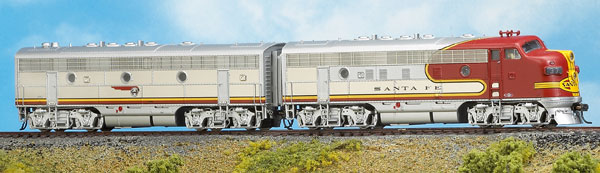
The model. This Broadway Limited model represents a Phase I F7. Phase Is were built between November 1948 and November 1951, and are most easily identified by the distinctive horizontal-slit carbody air intakes that were a holdover from late F3 production. [See the “Modeler’s guide to F units,” in the October 2006 issue of Model Railroader. – Ed.]
Our sample was painted in Atchison, Topeka & Santa Fe’s ever-popular warbonnet passenger locomotive scheme. Santa Fe passenger F7s used a combination of stainless steel body panels and silver-painted steel panels. The model uses a combination of paint and plating to match the panel appearance of the real thing.
The dimensions of the BLI F7 match prototype drawings found in Jeff Wilson’s “Modeler’s guide to EMD’s F7” [Model Railroader, April 2000 issue. – Ed.] The model has excellent detail, including separately applied lift rings, windshield wipers, hand grabs, air hoses, and uncoupling levers. The trailing truck lacks the Santa Fe prototype’s Automatic Train Control pickup shoe.
The A unit has a neatly printed word WATER at the rear corner, and the B unit has it near the middle but there’s no corresponding filler hatch on the B unit. Both models have small unit numbers at the corners. The paint job on our A unit was flawed as its nose herald was printed at a noticeable angle with a slightly fuzzy black separation line. The decoration on another sample looked better.
Performance. We tested the F7 using both DC and DCC control and found the locomotive’s slowest speed was just over 4 mph with a maximum speed of 79 mph in DC. In DCC, the peak speed was 99 mph.
Pulling power was exceptional. The A unit alone delivers a quarter pound of pull to the drawbar, which equals 56 freight cars or 18 passenger cars on straight and level track. Working together, an A-B set should have no problem with a prototype-length train.
The drive train of both the A and B units operated smoothly but was a bit on the noisy side. At higher speeds, the whine increased. We tested another pair, and their mechanisms were noticeably quieter.
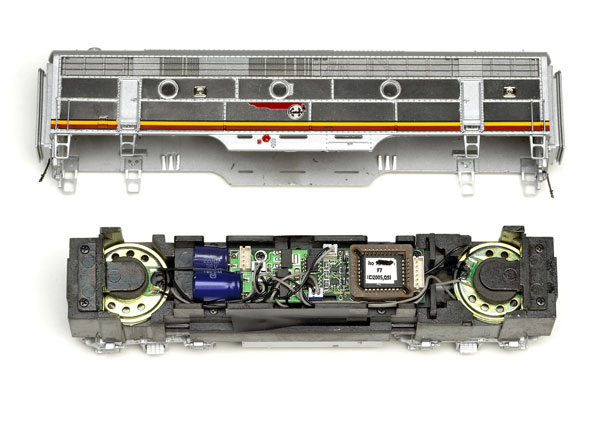
It’s possible to blow the whistle in DC by flipping the direction switch back and forth as the engine proceeds down the track. Quickly toggling the direction switch sounds a short one-note F unit honk, a slow toggle blows the horn longer. To reverse the locomotive, simply bring it to a halt before hitting the direction switch.
Many sound and lighting features and some control settings can be accessed and modified in DC using a somewhat cumbersome reset procedure. The direction booklet packaged with the locomo¬tive has clear step-by-step instructions for those inclined to tinker with the factory settings.
Despite sound and decoration issues, pulling power, detail, and top-shelf electronics were pleasing.
Price: A-B sets, DC only $249.99 to $259.99; sound and DCC-equipped $399.99 to $419.99
Manufacturer
Broadway Limited Imports
4 Signal Ave., Ste. C
Ormond Beach, FL 32174
www.broadway-limited.com
Road Names
Atchison, Topeka & Santa Fe; Baltimore & Ohio; Chicago, Burlington & Quincy; Denver & Rio Grande Western; Great Northern; Louisville & Nashville; New York Central; Northern Pacific; Pennsylvania RR; Southern Ry.; Southern Pacific; Union Pacific; Western Maryland; and Western Pacific
Authentic engine sounds
Blackened NMRA RP-25 contour wheels
Cab interior with crew
Clear window glazing
Die-cast metal frame
Dual-mode decoder and QSI Quantum sound system
Drawbar pull: 4 ounces each
Factory-applied details
Five-pole can motor with flywheels
Kadee magnetic knuckle couplers
Minimum radius: 18″
Reversing constant headlights and signal light