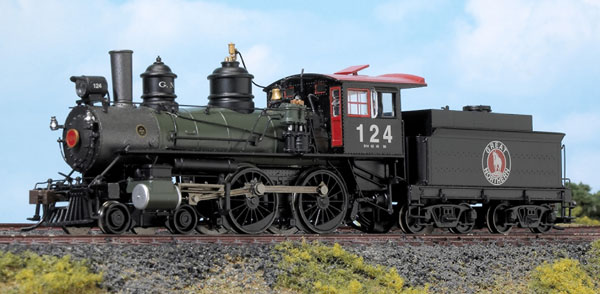
A real American. Locomotives of the 4-4-0 wheel arrangement were named “American” because in the mid-1800s they were the most prevalent type in the United States, as well as one of the
longest-lived. With four drive wheels to provide adhesion and to support a larger firebox, as well as a four-wheel front bogie to stabilize and guide the locomotive into curves and turnouts, the 4-4-0 design solved many of the problems of earlier, smaller steam locomotives. It was particularly adept at achieving relatively high speeds on light track. Dozens of builders made about 29,000 “Eight-Wheelers” in the nine decades following the model’s introduction in 1836.
The need for bigger boilers and fireboxes led railroads to look beyond the 4-4-0 design by the turn of the 20th century. But even as larger locomotives took over America’s main lines, 4-4-0s continued to pull their weight on branch lines and other secondary jobs. Builders kept making them through the 1920s, and older Eight-Wheelers were modernized with new boilers, brake gear, and other equipment. A handful of the newer models stayed on the job through World War II. Bachmann’s model represents one of these modernized 4-4-0s, built by Baldwin in the 1880s and upgraded in the early 20th century.
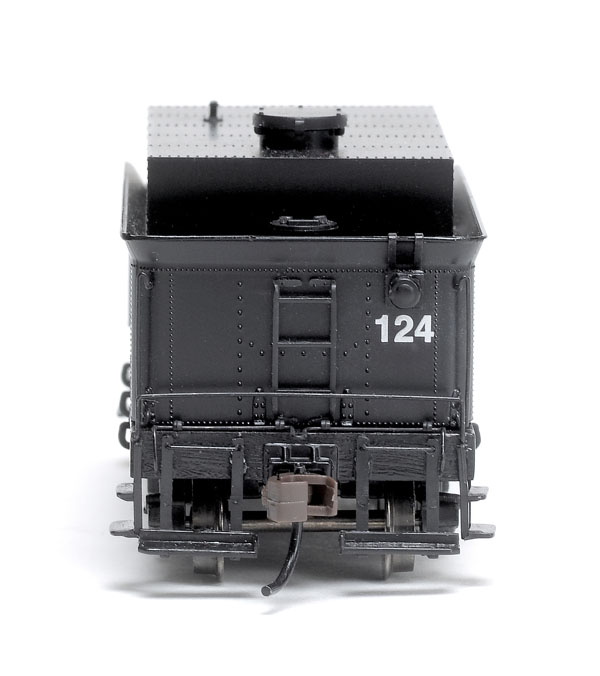
In the sometimes 50-year lifespans of these doughty locomotives, many were rebuilt several times. This could account for the Bachmann model having a conical boiler wider than the straight one in the builder’s diagram. Other discrepancies such as the driver spacing can’t be as easily dismissed. These models should therefore be taken as representations of typical locomotives, not accurate models of particular prototypes.
That aside, the rendering of details on this locomotive is top-of-the-line. Wire and plastic handrails and piping are impressively thin, well-formed, and firmly affixed. The cab features a detailed backhead, opening windows, and painted engineer and fireman figures. Included in the box are replacement boiler domes, spoked pilot wheels, a straight stack, and two variant pilots for those wishing to customize their model.
The paint job is just as good. The green paint on the boiler is smooth and even, as is that on the graphite smokebox and red cab roof. The tiny Baldwin builder’s plate on the smokebox is legible under extreme magnification – nice!
Though Baldwin built the class B-14 4-4-0s in 1882, our sample model represents a later, modernized version. The smokebox plate denotes a 1906 boiler replacement; the Westinghouse cross-compound air pump was a late addition; and the GN’s front-facing “Rocky” herald wasn’t introduced until 1923.
The model is powered by a can motor, linked via a V-belt, driveshaft, and worm gear to the forward driver axle. Power is transferred to the rear driver by the side rods. Also attached to the motor is a cam that synchronizes the sound decoder’s engine chuffs to the wheel revolutions.
Wipers conduct track power from all four drivers. The forward tender truck picks up electricity from the left rail, while the trailing truck does so from the right. All four of the lead truck’s blackened metal wheels are insulated.
The decoder is housed in the tender, along with the speaker, which faces down from the bottom. This means six wires lead from the underside of the cab to the tender, but the hinged metal apron helps hide them from view.
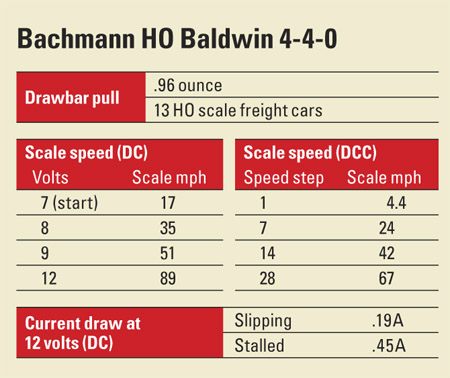
The locomotive ran like a dream under DCC. It started out smoothly at speed step 1, with the engine chuffs perfectly synchronized. You can easily program configuration variable (CV) 25 to select a speed curve that best fits your preferred method of operation.
Under DC, realistic idle sounds began at just over 5 volts (V), but as the voltage increased, the locomotive started making noises as if it were to move – then stopped and restarted, repeatedly. It
occurred using two different modern power packs. The manual suggests
adjusting CV63, the Analog Mode Starting Voltage, but this didn’t fix it.
The locomotive’s sounds evened out at 6.5V, with the automatic whistle, bell, and steam chuff signaling the start of motion. However, the locomotive didn’t actually start moving until 7V, at which point the sound decoder was emitting the rapid, staccato chuffs of a locomotive tearing down the track at full throttle. Under DC, engine sounds are regulated by voltage, not the motor cam. By adjusting CV116 – the Auto Exhaust Rate – I slowed this sound effect down to a realistic four chuffs per wheel revolution.
A sound choice. With DCC and realistic sound, this locomotive is a boon to HO scale modelers of the early 20th century. Bachmann would be smart to start rolling out additional road names. I can’t wait for a Pennsylvania RR version (with Belpaire firebox, please).
Manufacturer
Bachmann Trains
1400 E. Erie Avenue
Philadelphia, PA 19124
bachmanntrains.com
Road names: Great Northern, Baltimore & Ohio, Seaboard, Southern Ry.
Era: 1900s to 1930s (GN version 1923)
Features
- Chemically blackened RP-25 metal wheels, in gauge
- Cog V-belt drive
- E-Z Mate Mark II magnetic knuckle couplers, mounted at correct height
- Five-pole, skew-wound
- can motor
- Interchangeable domes, pilots, and trucks
- Light-emitting-diode headlight
- Removable fuel bunker
- SoundTraxx dual-mode DCC sound decoder
- Weight: 9.75 ounces, 7.25 ounces (engine only)