Bachmann HO USRA heavy 4-8-2 Mountain steam locomotive

Bachmann HO USRA heavy 4-8-2 Mountain steam locomotive

By Angela Cotey | October 1, 2003

| Last updated on November 3, 2020


Reviewed in the October 2003 issue

Bachmann HO USRA heavy 4-8-2 Mountain steam locomotive
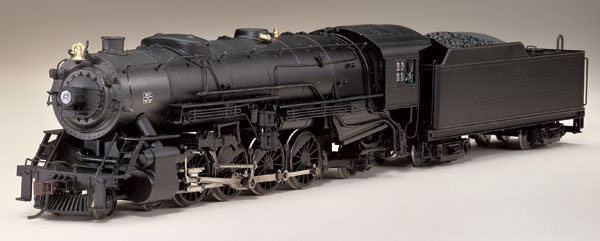
Will fans of HO scale remember 2003 as the year of the steam locomotive? Perhaps – we’ve already seen several outstanding new releases from a variety of manufacturers. Now Bachmann has stepped forward with its second new steamer of the year, a USRA (United States Railway Administration) heavy Mountain.

The 4-8-2 Mountain type was already well-established when the United States Railroad Administration adopted light and heavy 4-8-2 designs in 1918. Like earlier Mountains, the USRA 4-8-2s were intended as passenger power.

Two railroads were assigned heavy 4-8-2s, the C&O and its Appalachian neighbor, the Norfolk & Western. Chesapeake & Ohio engines 135-136 were built by Brooks in 1918, and the 136-137 came from Baldwin in 1919. All were assigned to road class J-2. The N&W’s class K2 engines, nos. 116-125, were delivered by Brooks in 1919. The original appearance of all these 4-8-2s was basically the same, and was as represented by Bachmann’s model no. 82501, except for the tender. (It should have the same 10,000-gallon USRA tender as the Spectrum light Mountain.)

The heavy Mountains did well on both roads and prompted reorders in 1923. Engines 138-139 came to the C&O from Richmond. These additional J-2s continued the USRA appearance, except for having Walschaerts valve gear instead of Baker and a modified cab. In 1924 the C&O renumbered the whole class into the series 543-549.

More of their owner’s practice came out on the N&W copies, nos. 126-137, built by Baldwin and assigned class K2a. They had such typical N&W traits as horizontal-bar pilots, Worthington BL feedwater heaters, and radial-top 16,000-gallon tenders.

Following the arrival of the K2a engines, the K2s gradually received similar equipment.

The C&O engines received a radical modernization around 1930, when they were rebuilt with the “flying pumps” front end, multiple-bearing crossheads (on most engines), Worthington type S feedwater heater systems, modified cabs, and 16,000-gallon Vanderbilt tenders with 6-wheel trucks. This rebuilding is represented by Bachmann’s no. 82503 C&O model, and the J-2s served in that form until their retirement in 1951 and 1952.

Norfolk & Western’s USRA Mountains underwent an even more radical transformation following World War II. The K2s and K2as were given bullet-nose streamlining in the style of the famous class J 4-8-4s.

Under the hood (so to speak)
Mechanically, this Mountain resembles Bachmann’s USRA light Mountain of 1999, but it’s a different locomotive from the rails up. The axles of its lead and trailing trucks, as well as its four drive axles, have brass bearings, and the frame is cast metal. The second drive axle is sprung.

A can motor with flywheel, mounted in the firebox, drives a worm shaft via a short belt. The belt isolates the motor from thrust forces for smoother operation. The rods are metal and do require lubrication because they carry power from the worm gear on the third driving axle to the other drivers. The rods are nicely executed, but the left eccentric tilts to the rear when the rods are down, rather than forward as it should.

Unlike its predecessor, this Mountain has a die-cast metal boiler with dozens of separate details, many of which vary between the six different versions. For example, Bachmann has produced two different sets of running boards, two different smokebox doors, two pilots, and even two different sets of crossheads and cylinders! Thankfully, the well-done exploded-view drawings on the instruction sheet help sort out the many options, so that you can locate which parts are on your version. Unfortunately, some parts on our samples were not mounted squarely, and straightening them would present a substantial challenge.

The boiler includes no provision for a smoke generator, and the boiler and cab castings on our samples are somewhat rough, with rivets that vary in size. The dimensions of the locomotive are, for the most part, within a few scale inches of those of the prototype, with a few exceptions: the drivers are 5″ too small at 64″, and the cylinders are 9¼” wide (USRA) or 11¼” wide (C&O). Also, the cab of the USRA version is too low by 4½”, and the cab of the C&O version is 4½” too short. Aside from the drivers, most differences fall into the “you need to have a ruler to notice” category. I’ve always thought Mountains are especially well proportioned, and this locomotive is no exception.

Depending on the road name, the locomotive comes with one of three different tenders: C&O, Southern Pacific, or long USRA. The C&O tender looks quite nice, with even rivets and excellent wood grain. It matches C&O equipment diagram dimensions quite well save for the tank being 5″ too tall and the rear coal board 83/8″ too short (this board should be round on top). The USRA tender is somewhat less well executed. (We did not examine one of the SP tenders.)

The locomotive picks up electricity via wipers on the tender axles and the drivers, giving six or seven pickups per rail, depending on the tender. Six wires connect the engine and tender.

The tender includes a National Model Railroad Association medium socket for a Digital Command Control decoder; however, this fact is not mentioned in the instructions (one of our samples did include an additional page telling how to install a decoder). For DCC, remove the tender shell, remove the dummy plug from the socket, and insert the plug from your decoder. A red bulb simulates a glowing firebox, and the model comes with crew figures.

Bachmann’s E-Z Mate magnetic knuckle couplers are mounted front and rear, but they droop below recommended height and do not ride level.

The paint on our sample locomotives is somewhat thick in places, and the white trim on our C&O version is not cleanly executed. Some spots of dried adhesive are also visible around the handrail stanchions.

On the rails
Our samples ran very smoothly and quietly right out of the box. The USRA locomotive ran a bit more easily going forward (with a truly remarkable minimum speed of 1.6 mph!) than back, but the difference was slight. The speed at 12 volts was 70 mph – excellent – and the pulling power was a hefty 4.8 ounces, equivalent to 36 free-rolling passenger cars on straight, level track.

Headlights which use light-emitting-diodes (LEDs) are often somewhat blue, but the glow from this one falls somewhere between baby and sky blue.

Overall, our samples of Bachmann’s new Mountain are well designed, smooth running, and powerful locomotives which suffer from some flaws in assembly. We hope that in the near future the firm is able to bring it up to the quality of the work we’ve seen on other recent Spectrum locomotives.

HO USRA heavy 4-8-2

Price: 199.95

Manufacturer:
Bachmann Spectrum
1400 E. Erie Ave.
Philadelphia, PA 19124
www.bachmanntrains.com

Description:
Metal and plastic ready-to-run locomotive with DCC receptacle

Road names:
(*USRA long tender)Chesapeake & Ohio with Vanderbilt coal tender; Illinois Central*; Norfolk & Western*; Richmond, Fredericksburg & Potomac*; Southern Pacific with semi-cylindrical oil tender; painted but unlettered*

Features
Blackened metal wheels
Cast-metal boiler and frame
Directional LED headlight
Drawbar pull: 4.8 ounces
E-Z Mate knuckle couplers
Flywheel drive
Minimum radius 22″
NMRA medium DCC socket

Share this article