The prototype. The 1,000 hp S-2 switcher was Alco’s best selling diesel-electric locomotive ever. Produced from April 1940 to June 1950, Alco sold 1,502 S-2 switchers to railroads across the United States, Canada, and Mexico.
In 1950, the S-4 switcher replaced the S-2 in Alco’s product line. The locomotives were virtually identical. The main spotting difference between the locomotives is that the S-2 rode on Blunt trucks and the S-4 rode on AAR type A trucks.
Early production S-2s had radiator shutter assemblies that were countersunk in the sides of the hood and a circular radiator fan housing on top. Later S-2s had protruding shutter assemblies and square radiator fan housings. For most of their production, the shutters were positioned vertically. S-2s built in 1943 and 1944 had horizontal shutters. Some of the later S-2s had cabs and hoods with welded rather than riveted seams.
Alco switchers ran on Class 1 railroads as well as short lines and in industrial service. Most Class I railroads retired their S-2s in the 1970s. A few examples still operate in tourist service.
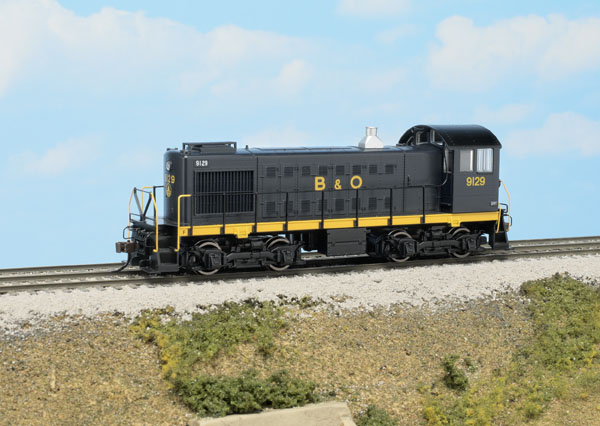
Our review sample is decorated as Baltimore & Ohio no. 9129, which was part of a group of S-2s delivered in 1949 and 1950. The details on the model are well-defined and match photos of the prototype, including the riveted seams on the cab and hood, vertical radiator shutters, and a square radiator fan housing on top of the hood.
All the handrails are separate parts made of flexible acetal plastic to resist breaking. The uncoupling levers are
separate wire parts.
The prototype B&O no. 9129 had a bell and grab irons mounted on the front of the hood. The engineer’s side of the cab had an all-weather window. These roadname-specific details aren’t included on the Bachmann S-2. These could be added by the modeler as part of a superdetailing project using parts from firms like Cannon & Co. and Detail Associates.
The paint scheme and lettering placement on the model match prototype photos of no. 9129 as the switcher
appeared in the 1960s and 1970s. The black paint has a smooth satin finish. The sill and pilot step handrails are correctly painted yellow.
The printing is straight and opaque. There are Alco builder’s plates printed in their prototypical locations on both sides of the cab.
The motor and brass flywheels sit on the frame. Truck-mounted gearboxes transfer power to all four axles.
The DCC decoder is mounted on top of the motor and flywheel assembly. The downward-facing speaker is attached to the frame.
I ran the model through the yard ladder on our club layout. The S-2 didn’t stall, and the sound and headlight
remained constant as the locomotive ran through the turnouts.
Sound effects. The sound quality of the SoundTraxx SoundValue decoder is just as good as the firm’s fully featured Tsunami decoder. The main difference between the decoders is that the SoundValue version doesn’t have as many programming options, such as the equalizer or reverb effects.
On a DC layout, the sounds are automatic and limited mainly to the engine rpm. These effects sound like the recordings of Alco 539 engines I’ve heard.
There are more sound options when running the S-2 with a DCC system. I set the engine rpm for manual notching. That way, I could use function keys to increase or decrease the rpm independent of the locomotive speed.
Though the SoundValue decoder doesn’t support as many functions as a full Tsunami, the important ones are there. I could ring the bell and blow a long or short horn blast, which is useful for prototypical horn signals. Function 8 mutes all the sounds.
The decoder also features functions for dimming the headlights as well as turning them on or off.
This well-detailed Bachmann model does a great job capturing both the sights and sounds of an S-2 yard goat.
Manufacturer
Bachmann Industries, Inc.
1400 E. Erie Ave.
Philadelphia, PA 19124
www.bachmanntrains.com
Era: 1940 to present day
Road names: DCC sound: Atchison, Topeka & Santa Fe; Baltimore & Ohio; Pennsylvania; Union Pacific; and United States Army. DC no sound version: Chicago, Burlington & Quincy; CP Rail; Nickel Plate Road; Southern Ry.; and Western Pacific
Features
- All-wheel drive and electrical pickup
- Blackened metal wheels in gauge
- E-Z Mate Mark II knuckle couplers at correct height
- Five-pole skew-wound motor with dual brass flywheels
- Light-emitting diode (LED) headlights
- RP-25 contour metal wheels in gauge
- SoundTraxx SoundValue DCC sound decoder (DCC sound version only)
- Weight: 8.4 ounces