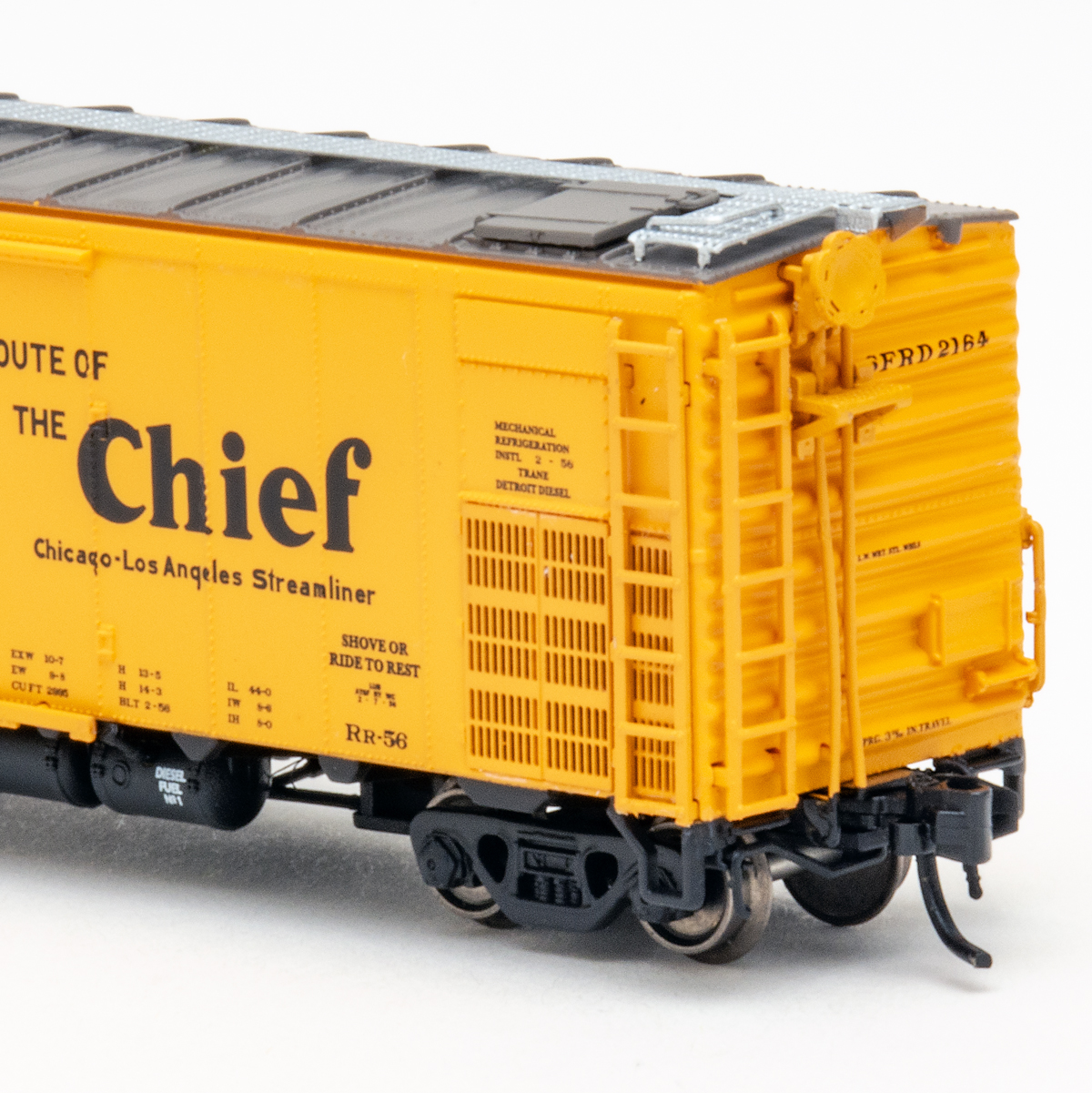
Folks, 71″ is a scale 947-foot-radius curve. While moderately sharp by prototype standards, an N scale train will certainly look good rolling along a curve that broad!
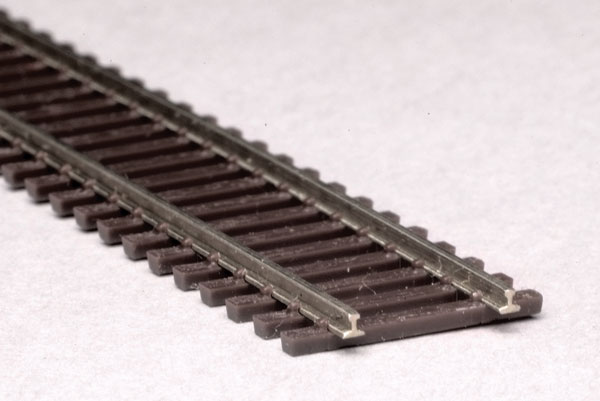
This track has finely cast brown plastic ties with simulated wood grain. The Atlas ties measure a scale 8′-6″ long, 8″ wide, 7″ high, and are spaced on 21″ centers. Prototype wooden ties today typically are 8′-6″ to 9 feet long, 9″ wide, and 7″ high on 20″ centers. As many modelers have learned, properly proportioned ties spaced closer together look better and improve the illusion of distance on our layouts.
Atlas’ code 55 flextrack curves as easily and smoothly as its code 80 counterpart. Some modelers these days are gluing down flextrack. If you still prefer to tack your track to the roadbed or pin it in place to align it, you’ll have to drill holes in the ties. Atlas has started this job for you on the underside of the ties.
The lengths of the turnout ties increase incrementally starting at the fifth tie past the switch rod, reaching a maximum scale 15′-0″ length six ties past the point of the frog. From there the ties revert to standard length. The staggered effect shown in the photo on the next page is a nice touch of realism.
A plastic clip holds the points to the switch rod. There’s no toggle-action locking spring, so you’ll need a ground throw or switch motor to hold the points against the stock rails.
Extra long headblocks are cast as part of the tie strip. You should trim off the headblocks and switch rod after deciding on which side to place your switch stand or switch machine. My one concern about these otherwise well-built turnouts is the wide spacing (scale 39″ center to center) of the headblocks, as it’s a distraction.
The frogs, guardrails, and points are metal castings; the switch points and stock rails are connected internally. The points don’t route power, but the frogs are electrically insulated so you won’t have to cut gaps in front of the frog to prevent shorts.
I tested Model Railroader’s samples by running an Atlas RS-3 road switcher and a Life-Like PA-1 cab unit back and forth without a hitch.
If you decide to power the frog, Atlas includes an easy-to-follow diagram showing how it can be accomplished. You don’t necessarily have to use the Atlas Snap-Relay shown in the diagram, as a single-pole, double-throw switch that moves with the points, like those on a slow-motion switch motor, will do the same job. Atlas also offers an under-table switch machine.
The wire that powers the frog connects to a terminal Atlas has thoughtfully located on the straight side next to the guardrail. Ballast will easily hide this terminal.
Atlas’ code 55 rail joiners are sturdy metal stampings that slip on and off easily. The scale 9″ rail height and cross section is much closer to the prototype 7 5/16″ height of 140-pound heavy mainline rail than code 80 track which scales out more than 13″ tall. Our turnout and flextrack samples checked out with a National Model Railroad Association standards gauge.
Rather than faulting the code 55 Atlas track (as some have done), the incompatibility here is due to wheels that don’t comply with NMRA standards. The best fix is to replace the wheels with low-profile types offered by Atlas, InterMountain, Micro-Trains, or NorthWest Short Line.
Atlas continues to expand this code 55 track line, giving N scalers a terrific new track palette from which to choose.
Prices: See list below
Manufacturer:
Atlas Model Railroad Co., Inc.
378 Florence Ave.
Hillside, NJ 07205
www.atlasrr.com
Description:
Nickel-silver and plastic track
Product list:
Crossings, $6.50 each
Flextrack (30″ length), $2.95 each
No. 5 or no. 7 turnouts, $9.95 each
Rail joiners, 8/$2.25
Rail joiners (insulated), 6/$1.25
Sectional straights, $2.50-$3.95 each
Sectional curves in full and half-section assortments ranging from 10″ radius to 21¼” radius in 1¼” increments, $2.95-$3.95 each
Sectional curves, 30.609″ radius, $3.95 each
Sectional curves, 71″ radius, $5.50 each