

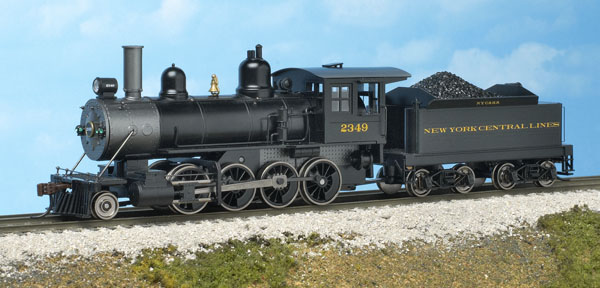
Tracking its heritage. The Consolidation 2-8-0 was one of the most popular steam locomotive types, with more than 21,000 built for common carrier railroads for more than 80 years. Since Consolidations were designed and built by dozens of locomotive manufacturers and railroad shops, it’s not easy to track this model’s lineage back to any specific prototype. However, it has characteristics typical of light Consolidations made by manufacturers like Alco or Baldwin Locomotive Works.
The model’s slim, straight boiler, plain domes, narrow firebox, single cylinders, and Stephenson valve gear place its origin in the latter two decades of the 19th century. But its electric headlight and taillight, as well as the generator mounted just ahead of the cab, are later modernizations, probably added in the 1920s. By that time, a locomotive of this vintage would be relegated to branch line, yard, or transfer service.
According to George Drury’s Guide to North American Steam Locomotives (Kalmbach Books, out of print), the road numbers offered by Athearn belonged to actual 2-8-0s built between 1900 and 1903 by Baldwin, Schenectady, or Canadian Locomotive Co. However, the Daylight-inspired paint job applied to the Southern Pacific model wasn’t developed until the late 1930s and never would have been applied to a freight engine, making this a fantasy scheme. And the Union Pacific didn’t switch to the Gothic tender lettering used on
Athearn’s model until 1937. The other paint schemes are generic, but appropriate to their time periods.
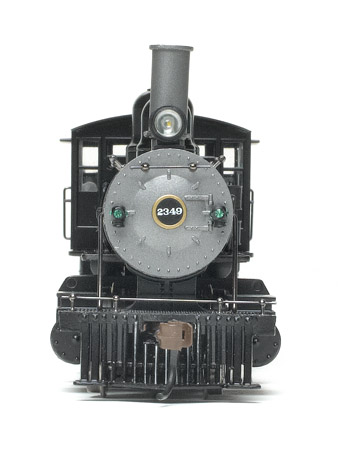
The boiler, smoothly painted black with a graphite smokebox, is a single metal casting, giving the locomotive significant heft. I removed the front truck to give me access to the single screw that holds the front of the boiler to the frame. With that removed, the upper body lifted easily off the frame.
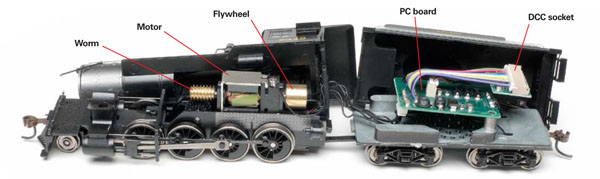
To allow the rigid-wheelbase locomotive to traverse tight curves, the middle two drivers are blind (flangeless). The model has rubber traction tires on the rear set of drivers, which gives it enough pulling power to haul 44 standard 40-foot cars on straight and level track. That’s more than a prototype Consolidation would typically be asked to pull.
The first three drivers pick up electrical power, as do all eight tender wheels.
There are changes to the tender, too. The cast-metal floor, which provides most of the tender’s weight, now has a molded-in recess and sound holes for a round 28mm speaker. The circuit board in the tender has a 9-pin Digital Command Control decoder socket. There’s plenty of space for a decoder.
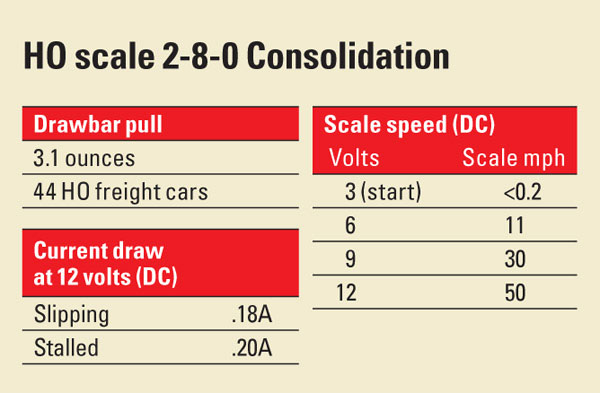
The model is not offered with Digital Command Control. I tested our sample using a Model Rectifier Corp. Tech 4 power pack. The lights responded at under 2 volts (V), shining steadily at 3V. The locomotive also started rolling at that voltage. The drive train’s low-speed gearing was superb. I measured its speed at under 0.2 scale mph.
The model responded smoothly to changes in voltage. When I increased the power to 12V, the model topped out at a scale 50 mph, appropriate for a low-drivered freight locomotive like this one.
Welcome back. Modelers of the steam era in HO scale should be glad to see this popular locomotive make a comeback. Its pulling power and great low-speed performance make it ready for any job, whether it’s heading up a crack freight in the 1880s or working a rural branch line in the 1930s. And though it isn’t modeled after a particular prototype, its utilitarian good looks would make it a great starting platform for a backdating or superdetailing project.
Manufacturer
Athearn Trains
1600 Forbes Way, Suite 120
Long Beach, CA 90810
www.athearn.com
Road names: New York Central, Canadian Pacific, Southern Pacific (Daylight scheme), Union Pacific (three locomotive numbers each)
Era: 1880s to 1930s
Features
- Die-cast metal frame
- Directional lighting
- McHenry knuckle couplers, at correct height
- Open-frame motor with brass flywheel
- Quick Plug for Digital Command Control decoder
- Traction tires on rear drivers
- Weight: Engine alone, 8.5 ounces; with tender, 10.5 ounces
- Wire grab irons