I checked the wheel gauge with a National Model Rail-road Association (NMRA) standards gauge, and made sure the wheels rolled freely with no wobble. Then I used my Micro-Trains coupler height gauge to check the coupler height and make sure the uncoupling pins cleared the tops of the rails.
The cars felt heavy in my hand, and I had read somewhere that they weighed slightly more than the NMRA standard. That’s a good thing. Tank cars are usually too light, and that’s a tough problem to address. The tank is usually made in two halves, top and bottom, and it’s difficult to separate them without damaging the car. If they fight me too hard, I just surrender.
If I do get the halves separated, the bottom half usually holds a weight that fills it almost entirely, meaning any weight you add will be above the center of gravity, and tank cars are top-heavy to begin with, simply because they are cylinders rather than boxes. Anyway, the weight on these cars was fine, so I could put them on the track and start test running, just a few at first, and then adding on gradually.
One problem turned up right away. With the rubber hoses connected between cars, I could run only seven or eight before they began derailing because of the demands that my 18″-radius curves and 2.5 percent grades put on the equipment.
For now I’ll just run the train without the hoses until a solution pops into my head or somebody else’s. I read that Athearn is working on a second run with improved, softer hoses, and I hope they’ll offer them as a separate item for those of us who bought the earlier cars.
Hoses or not, I’m happy to have these distinctive and beautifully modeled cars.
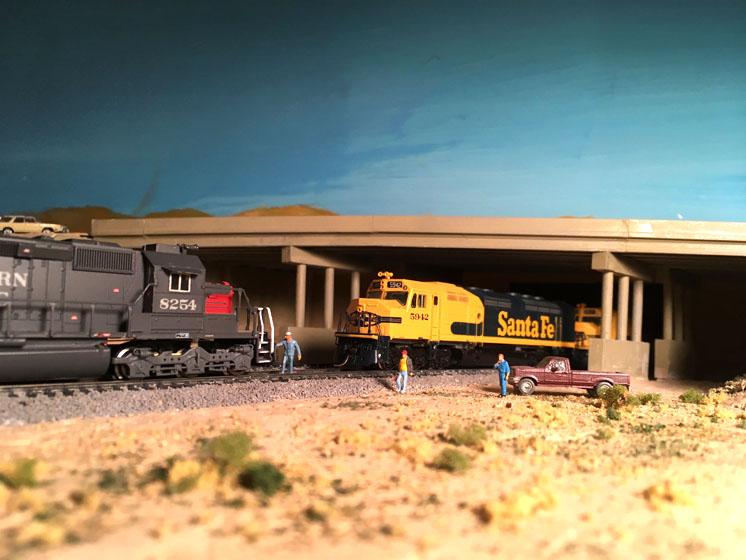
The TankTrain was a signature sight on the Southern Pacific’s Tehachapi Pass in the 1980s, and the spittle would fly all over when the foamers (including me) would come out to watch it negotiate the Tehachapi Loop. I could hardly wait to replicate that sight on my own N scale model of the loop.
The rescue
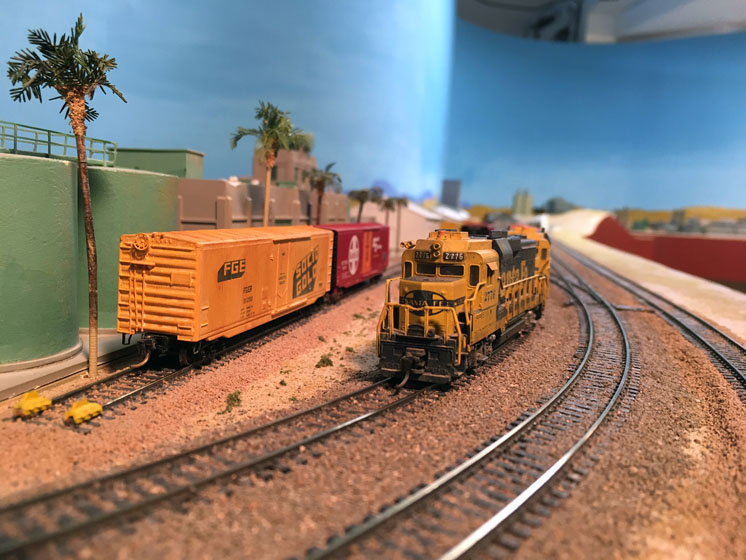
But to get on with my story, I placed six TankTrain cars, along with four boxcars, behind an InterMountain SP tunnel motor and ran them up the pass, through the loop, and almost into Tehachapi before it stalled on dirty track. This surprised me, as I’d cleaned the track there only a few days before.
As it turned out, I had to clean all the track in Tehachapi before I could get through. At Monolith, I went under the freeway bridge and into the helix, which drops the trains 18″ and onto the lower deck. About halfway down the helix, the train stalled.
Now, in my younger days I would’ve dived and rolled under the layout and popped up into the center of the helix. But this was January, and I’d had both knees replaced in August. I’d recovered well, but wasn’t quite ready to crawl on my bionic parts.
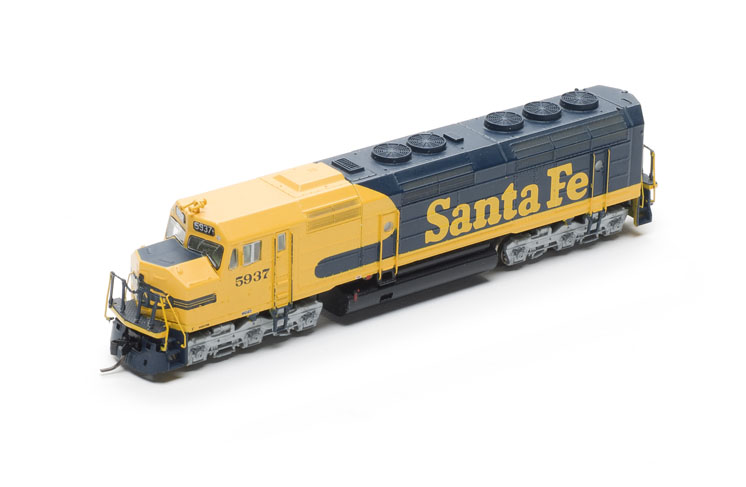
What to do? I peered through my Helixometer (a vertical slot in the fascia) and could see that all the equipment was still on the rails. After mulling it over, I decided to run a pair of Athearn F45s up from the bottom of the helix, couple up, and pull the stalled train out. The F45s were perfect for such a rescue because their wide bodies allow them to be extremely heavy. They’ll plow through most anything.
So up went these brutes, but my troubles weren’t over. The engines wouldn’t couple to the train coming down. After more mulling, I decided to risk shoving the train up the helix, knowing that the engines were plenty powerful enough to slide the dead engine and roll the 10 cars. I took it very slowly, and after a couple of minutes the train was back on the upper deck.
Investigating the incident
I’d made several key mistakes to get myself into this predicament:
• I should’ve tried to figure out why there was so much dirt in the vicinity of Tehachapi. There was grit all over the scenery up there, and I finally concluded it had come from my Shop-Vac, which I’d used to vacuum the track after cleaning it. I’ve noticed before that when I use that tool, dust comes from the exhaust. Maybe changing the bag will take care of it, or maybe I shouldn’t use it in this application.
• I shouldn’t have started down the helix with a single locomotive. As a general rule, I always doublehead on the railroad. It makes life so much easier, a fact the SP figured out years ago. When I would visit in the ’80s, the work train always went out with two SD45s. They didn’t want that train to break down and tie up the line.
• I was impatient. I was so anxious to see those TankTrain cars run around the loop that I got myself in a pickle.