Where body-mounts will make a difference is if you want to back long trains, say a dozen or more cars. The obvious place for doing this would be in a fairly large yard on a fairly large layout. Another instance might be a really major industry on a probably even larger layout. And even in those cases you can get along well – providing the tracks are straight.
The problem with backing long trains with truck-mounted couplers is that we’re shoving the couplers together, causing the trucks to skew and making the wheels want to climb the rails. With body-mounted couplers, the wheels are free to find their own way.
An inconvenient truth
On my layout I wanted to run long trains up 2.5 percent grades on lots of curves, using mid-train helpers. That’s the way Southern Pacific and Santa Fe did it on Tehachapi Loop in 1985, and I’d planned and built the layout to do the same. It’s been years now since I discovered my dream wasn’t working out. The pileups were amazing, about as near a prototype wreck as is possible with models, and involving a dozen cars or more. I was about ready to take a sledge hammer to the layout.

I’d seen HO modelers run helper service with no problems. Why them and not me? The difference had to be that their equipment came standard with body-mounted couplers and our N scale cars came with truck mounts – except for the cabooses. The only solution was body-mounting couplers. A huge task of converting cars lay ahead of me.
The shorty tank car
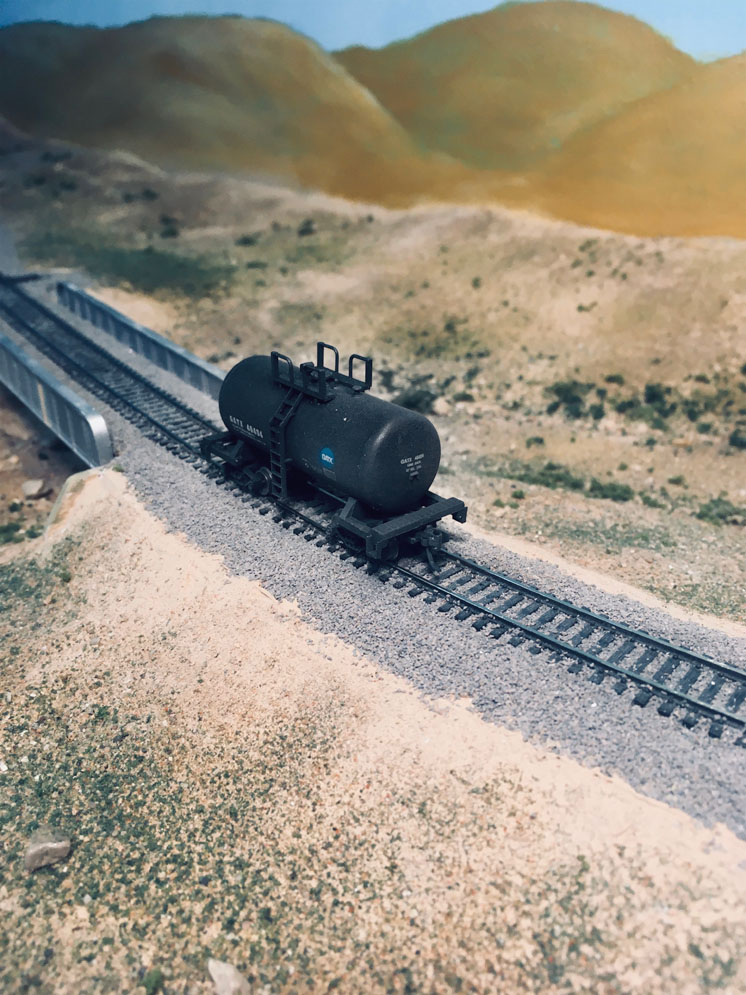
The photo at right shows a shorty tank car that I’ve just converted. It was made some years back by Model Die Casting (MDC), a company Athearn bought in 2003.
You’ll often hear these 28-foot-long cars called “beer cans” because the tank’s proportions resemble those of a beer can. I’ve always liked these cars because they’re so small and just so dog-gone cute (not sorry).
I’ve never known much about what these cars are used for, and I’d bet that many of you don’t either. A cursory search on the internet didn’t tell me much. They were rare and used for very heavy liquid chemicals or for customers that needed a lesser supply of something. I guess that’ll have to do, and besides, on my layout they’re just passing through.
Using Trainworx coupler kits
Like so many tank car models, this one came equipped with truck-mounted couplers, and when you take the trucks off there’s nothing there to support body-mounted couplers. In the past I’d built a support from styrene, then drilled and tapped it for coupler-mounting screws. This was usually a touchy job that required a lot of trial-and-error fitting.
Enter a great N scale innovation, the N scale coupler conversion kits offered by Trainworx. These are one-piece plug-in plastic end frames with a Micro-Trains coupler already built into it. They have two versions. The first is for Ortner 5-bay rapid discharge hopper cars. These are now in the Fox Valley Models line. The second is for Atlas open and covered hopper cars.
I had lots of each car type, and although I’d already converted many the old-fashioned way, the kits allowed me to finish the remainder in practically no time and with much better results.
Fitting out the shorty tanker was easy. All I had to do was file the sides of the adapter down until it fit, then cement it in, using a cyanoacrylate adhesive (CA) gel. Hopefully, these will aid in the process of simplifying body-mounted couplers.