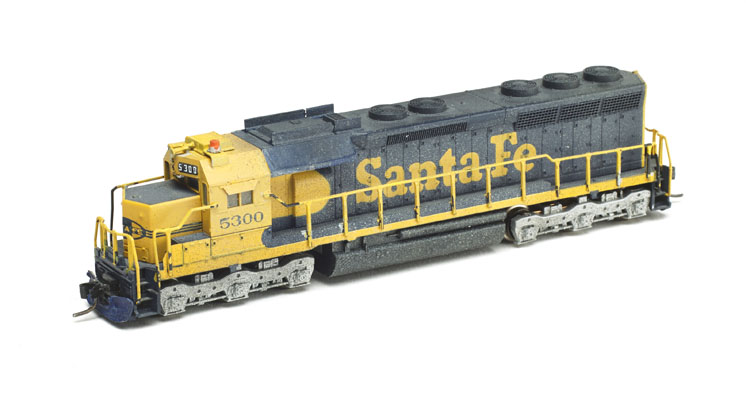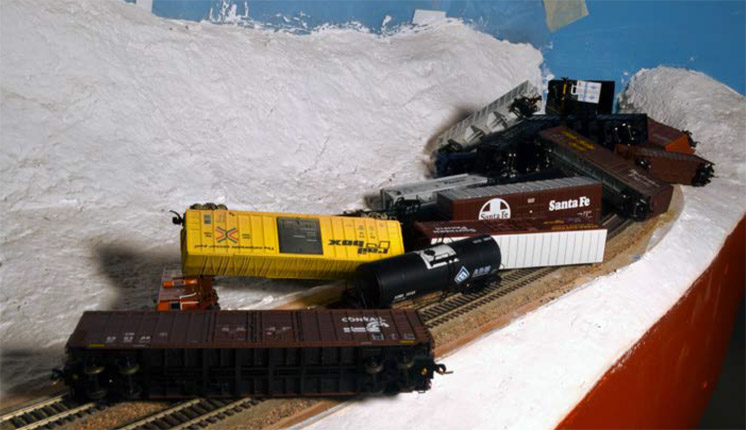
By way of illustration, let me describe the last accident I had on my N scale Tehachapi Pass layout’s helix, which thank goodness occurred a couple of years ago. The 20-car train was being pulled by two Athearn FP45s. About halfway up the 51⁄2-turn helix, the train separated behind the locomotive and started rolling back down, gathering speed quickly on the 2.5 percent grade.
I’ve had runaways on the open layout before, where I had a fighting chance of grabbing a car before the train has picked up too much speed. On the helix, though, there was a hardboard fascia between me and the train. All I could do was grit my teeth and pray. I expected to hear a rain of N scale cars hitting the concrete floor any second.
To my surprise, the cars stayed on the track all the way down, helped by the fact they were in a constant left turn. Once they roared through the portal in the backdrop, though, they’d be turning back to the right, and Newton’s laws and angular momentum being what they are, the train was doomed. I had some luck in controlling the pileup, but four cars left the railroad and hit the floor.
Three of them got off unscathed, but one was damaged beyond repair. Naturally it was one of my prized new Santa Fe covered hoppers from BLMA.
Don’t blame the helix. Those of you who’ve been reading these accounts of my adventures may recall my discussion of the helix and my initial problems with it. But those problems are now behind me. Trains now routinely glide up and down the helix without a hitch. Though the engineering issues are gone, a psychological problem remains.
The run in the helix is about 1.5 scale miles long, and takes about 4.5 minutes traveling at 20 scale mph. Engineers go mad wondering if the train is still moving, and when, if ever, it will reappear.
I have a solution in mind for that, a vertical slot in the fascia so the operators can see their trains as they pass.
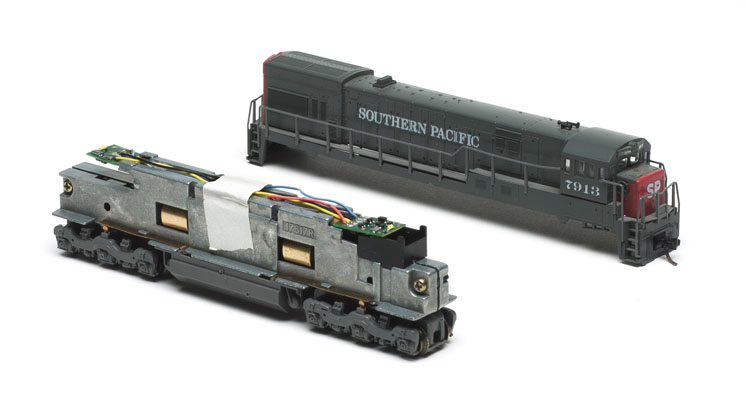
The coupler was the culprit. I’ve learned that the Achilles heel of long N scale trains is usually the connection between the locomotive and the first car. The problem is that the couplers on the locomotives are body-mounted, while those on the cars are usually truck- mounted. When a heavy train hits a curve like in my helix, the side force pulls the car’s truck off the track.
At the time of this accident, I had a hard-and-fast rule: The car immediately behind the locomotive had to have body-mounts. Unfortunately, I hadn’t checked, and sure enough, the lead car on this train had truck-mounted couplers. The problem was compounded by the fact that the locomotive didn’t have Micro-Trains couplers. Since that time I’ve converted all the couplers on that train, and it’s since run dozens of times up the helix with nary a problem. Over the last few years, we’ve seen some new cars come with body-mounted couplers, and I hope this is the beginning of a trend.
I also believe you’re better off to equip all your locomotives and cars with the same brand of couplers. This is especially important for locomotives. My personal choice is Micro-Trains Magne-Matic couplers. Any of my locomotives that will be going up the hill and helix with long trains get converted to M-T couplers before they even attempt the journey.
When we tried running mid-train helpers, we quickly learned that truck- mounted couplers won’t get it done. Now they’re banned from my layout, but they sometimes manage to sneak back on.
Recently the video crew from MR Video Plus came to shoot the layout. (The video should be available on the MRVP site by the time you read this.) Model Railroader contributing editor Andy Sperandeo was backing a long train in the yard when a beautiful orange Illinois Central hopper derailed. He held the car up by one end like a dead fish. “Sure enough,” he said, “It’s got truck-mounted couplers.”
This column originally appeared in the September 2014 issue of Model Railroader – Ed.