

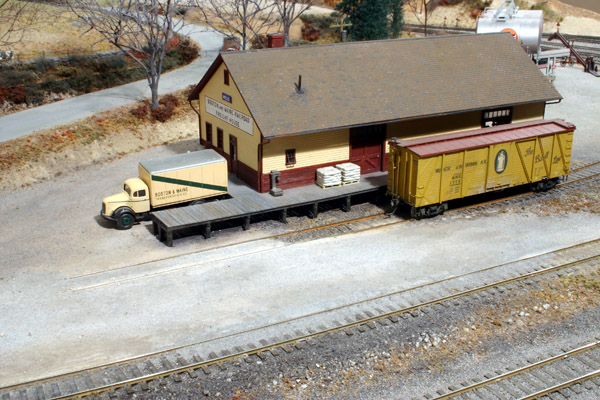
Gravel-covered siding. Gravel from an adjacent lot can mix with ballast on a siding. Paul partially covered this siding (lower right) at the freight house on his home layout. He embedded the rails of the spur (at left) into the parking lot.
On some secondary lines the space between the ties is filled with dirt to form a simple grade crossing or gravel lot. I added a gravel lot to the spur on my diorama. The following technique is less messy than using plaster alone.
First I cut pieces of cardboard to fit the space between the rails and the approaches to track. You could also use foam board or styrene. I built up the area where the lot crosses the tracks to a height slightly below the railhead to ensure that locomotive wheels wouldn’t lose electrical contact. I also allowed about 1/16″ on each side of the cardboard for flangeways. Then I attached the cardboard to the track and scenery with white glue.
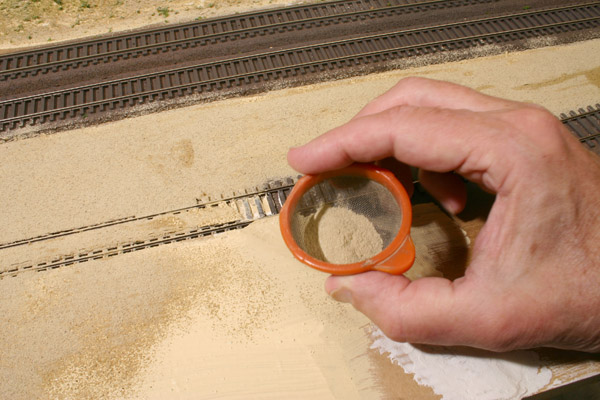
On his diorama, Paul built up a gravel lot using layers of cardboard. He used real powdered dirt as ground cover for the road surface.
I blended the edges of the cardboard to the scenery base using plaster. Once the plaster dried, I painted it and the cardboard with tan latex paint. Then I sprinkled the wet surface with fine dust that I collect from a dirt road near my home. I used ground foam to model a few random weeds.
After all of the scenery had dried, I cleared the flangeways with a utility knife. Then I lightly sanded the gravel lot to simulate tire tracks from vehicles crossing the tracks.