

Whimsy was at work.
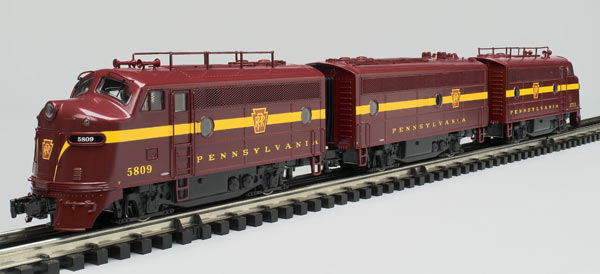
Fast-forward a few decades and you have another situation where the engineers of cute and whacky have been busy, and they have cranked out a product unlike any you’ve seen running on three rails, the mini-F unit that Ready Made Trains by Aristo-Craft has dubbed “The Beef.”
First announced back in 2006, this O gauge model had a few elements in mind – it was small and promised something new for an operator running a traditionally sized layout. Second, it was whimsical in that it looked like part of a shell placed on a single truck in some roundhouse backshop. Third, it was offered as an inexpensive alternative to high-dollar trains.
Well, a lot has transpired since 2006, but interest in this model has not waned in the least.
Opening the boxes
Back in 2006, we had a prototype of the Beef in the office for photos for Product News. My memory was a bit fuzzy, so I had the images printed out so I could have them handy for when the models came out of the box, to gauge any obvious external differences.
Envision this as the old tooling for a K-Line E8 diesel, and then cut it in two. That, in a nutshell, is the origin of this model. Breaking a larger locomotive in two tidy sections and then mounting it on a motorized chassis.
This product was originally offered as being sold separately as an A or B unit. When I opened the shipping carton I found boxes for an A-A set and a separate-sale B unit.
Generally, there is a satisfactory level of cast-in detail on both the A and B units. Keeping in mind that a streamlined diesel shell has fewer detail points than a road switcher possesses, this model captures the look quite well. On the noses you’ll find rivet, louver, seam, and hatch detail as well as cast-in simulations of uncoupler arms and air lines on the pilot.
Add-on details are where this basic model shines. Along the sides of the A and B units are see-through screens. You’ll find grab irons by the cast-in nose hatch as well as above each windshield. There are add-on window wiper arms, too. Grab irons are placed at the doors and the corners of the A and B units.
Up top, you find large antennas (on the Pennsylvania RR A units only) mirroring the Pennsy’s early radio-telephone antenna system. Horns are above each cab, and you’ll find see-through screens and radiators (with separately applied fan blades). You will also notice the add-on lift rings.
At the rear of the B unit you’ll find appropriate stacks where the passenger train steam system would be located. The models all have flexible rubber diaphragms.
The powered locomotive cab has two crew figures, and the cab doorways open. The unpowered cab unit lacks crew figures (but then you wouldn’t have two figures in both cabs at the same time anyway).
Application of paint and other decorations, such as the builder’s plate, was first rate. Of special note was where the yellow stripe went over the portholes that possess a cast-in hinge (as if you could open the window outward).
If there were going to be a smudge or flaw, this would have been the spot. But they were clean and crisp as though a little 1:48 scale painter worked his spray gun magic on the model.
On the test track
This is truly a smile-evoking model. The only way it could have generated more chuckles would have been to have Donald Duck at the throttle!
Each locomotive (powered or unpowered) has two pickup rollers approximately 2½ inches apart. A tether electrically connects all units. None of the units has traction tires.
The units are connected through a thin wire tether. You can run a single powered A unit or an A-A, A-B, or A-B-A combination of your choice.
The low-speed average for this conventional-mode only locomotive was 5.5 scale miles per hour. Our high-speed average was 94.9 scale miles per hour. Running with two powered units, the drawbar pull was 1 pound.
Motor operation was generally quiet and smooth. There was a bit of roughness running in the lower speed ranges, but it wasn’t terribly distracting and didn’t disrupt the fun.
The powered cab unit has a headlight and cab illumination. When the direction is changed, the headlight goes off. The unpowered A unit and the powered B unit did not have lighting, which was a bit of a surprise. I’d expected directional lighting changes.
The unpowered A unit has an electronic horn that is more of the door buzzer school than a digital re-creation of an actual locomotive horn.
It is quite loud and distinctive, and it fills the square.
The Beef mini-F is a clever product. By having locomotives that are, to steal a line from a Halloween candy bag, “fun sized” rather than full sized, it adds an interesting visual element to any layout large or small.
Beefs look great at the head of a few freight cars or a gaggle of short passenger cars. The fact that these are available in a variety of road names expands their appeal even more.
Ready Made Trains gets two thumbs up from me for creativity and for injecting fun back into the hobby with these well-made locomotives.
Features: Dual motors in powered units, digital horn in unpowered units, metal couplers