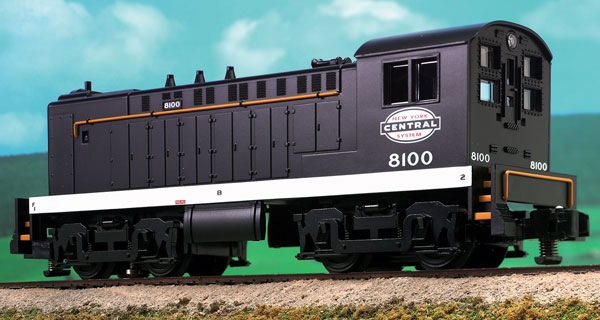
The original model was loosely based on the Baldwin VO-660 design, a 660-horsepower locomotive, of which only 142 were sold in North America from 1939 to 1946.
The Flyer diesel’s realm tended toward lower-priced sets.
The model
The Baldwin has a simplified body that does a fairly good job at capturing the look of the prototype’s outline. The plastic shell is clean and crisp, and the hatches and hinge detail along the hood – while not as intricate as many O gauge models, fills the bill. I liked the columns of vents running just below the roof.
The Baldwin has a few add-on pieces, like handrails along the hood and simulated uncoupler arms on the pilots. You’ll also find a horn on the rooftop.
The face of the cab was a bit Spartan, but a trip down the hall to the Kalmbach railroad library showed that the face of the cab of the model pretty much looks like that of the prototype. The windows looked a bit smaller, but I found all the key detail points present.
The model has a metal frame and a pair of beautifully executed die-cast metal trucks. Both of the couplers are operational.
Cosmetically, I have only two minor bones to pick. First is the lack of handrails on the pilot decks, even if they were just at the corners (as on some real locomotives). The void just makes the Baldwin look odd.
Second, the fuel tanks are just flat sections, not full or even partial representations. I can envision a fuel tank section snapping off someday, knowing how I grab locomotives.
Painting was first rate, the finish was smoothly and delicately applied. The New York Central’s “cigar band” logo was well done, and the typeface for the numbers captured the look of the Central. There were also some nice additions, such as “fuel” and “A” and “B” annotations on the body.
On the test track
Our low-speed average was 31.5 scale mph. I thought this was a bit high for a contemporary S gauge diesel, particularly when compared with modern S gauge diesels by American Models and S-Helper Service. For example, we recently tested an American Models U25B that had a low-end speed of 18 scale mph and an S-Helper Service F7 that clocked in at 8 scale mph.
Our high-speed average was a swift 99.7 scale mph. Drawbar pull for the 1-pound, 8-ounce diesel locomotive was 14.6 ounces.
The locomotive motor was a bit loud, but not abnormally so. One truck on our sample locomotive had three traction tires mounted on it (I suspect a fourth was supposed to be there), and the locomotive was able to dig in and pull whatever train I put behind it on my S gauge home layout.
The lighting was nice, and I thought that the directional-lighting feature added quite a bit to running the engine.
In retrospect, the new Flyer Baldwin is a pretty “high concept” locomotive – taking a vintage Flyer piece, upgrading it, and offering it to the S gauge community. But that’s also a risk, since a 50-year-old locomotive is now competing in the areas of price, features, and appearance with far newer products.
All of that puts the new Flyer Baldwin at a disadvantage. But for dedicated American Flyer operators, the Lionel-produced Baldwin switcher is a taste of the familiar without any of the concerns of running a 50-year-old locomotive.