Industrial switchers are usually operated by firms with less demanding tonnage requirements than a regular railroad, notably large factories, grain elevators, and gravel pits. In the postwar era there were several players selling small industrial locomotives to replace aging fleets of second- and third-hand 0-4-0s and 0-6-0s. While the giant locomotive builders often cataloged smaller prime movers for odd jobs, industrial switchers were really in the realm of smaller outfits.
Firms like the Davenport Co. of Davenport, Iowa; H. K. Porter of Pittsburgh, Pa.; Whitcomb of Rochelle, Ill.; and Plymouth Locomotive Works of Plymouth, Ohio, served this market.
The model
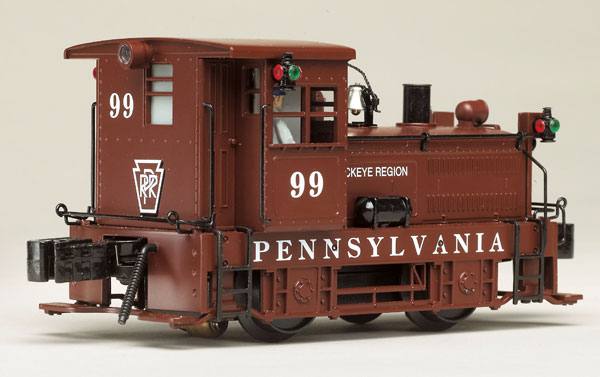
In the modern O gauge world, there’s a product void when it comes to these small industrial switchers. About as close as we’ve come have been models like the K-Line Alco S-2 or the oversized GE 44-tonners offered by Lionel and Williams. K-Line is now putting the industrial switcher on the map with its model of a Plymouth switcher, which we gauge to be a model of a 10- or 20-ton engine.
The first thing you’ll notice when you take this model out of the box is the heft. Heft? Yes, heft. The 41/4-inch-long shell (17 feet in O scale) and frame are made of die-cast metal.
The locomotive weighs 1 pound, 4 ounces. While I’d bet that the power unit beneath this rig is similar to the one propelling the K-Line Coca-Cola Polar Bear handcar, the Plymouth’s extra weight is welcome.
This diminutive switcher is big on details, including vents for the motor, a smokestack, a bell (with lanyard), and four illuminated marker lights (red fore and aft, green to the sides). This also may be the only locomotive I’ve seen priced at under $100 that has simulated uncoupler arms!
Speaking of couplers, the model comes with die-cast metal dummy couplers installed, but poke around the box and you’ll find two metal operating couplers ready to be installed.
The operating couplers, however, stick out noticeably farther than the dummy couplers to allow the “thumbtacks” below to clear the edge of the locomotive frame. The Plymouth is cataloged in several road names – Pennsylvania, Milwaukee Road, Union Pacific, Peabody Coal, New Hope Valley, and a special Baltimore & Ohio edition as a fundraiser for the B&O Museum.
On the test track
While this Plymouth certainly doesn’t have a Hemi engine under the hood, I was still smiling after I finished its performance testing. The low-end speed average was 6.2 scale mph, and the high-end speed average was 50 scale mph. As far as grunt goes, this model averaged a tiny .02 ounces of drawbar pull.
So what does that number really mean? We put the K-Line switcher on one of our home layouts, and it could pull as many as six modern-era (Atlas O and K-Line) refrigerator cars before its wheels began slipping.
This is okay. In the real world, no one ever put a Plymouth on a 100-car coal train.
Inside, the Plymouth sports a pair of pickup rollers 21/4 inches apart and a switch to lock out the reverse unit. The K-Line model also comes with a bottle of smoke fluid.
Yes, this baby has a smoke unit. You’ll get an output worthy of a small gasoline motor or a smallish diesel prime mover. A smoke on/off switch is mounted on the frame.
While many of today’s locomotives are equipped with command control and sound systems, the tiny Plymouth is too small; there’s no horn either.
The K-Line Plymouth is a neat little locomotive that meets my expectations for a small switcher and exceeds my expectations for fun.