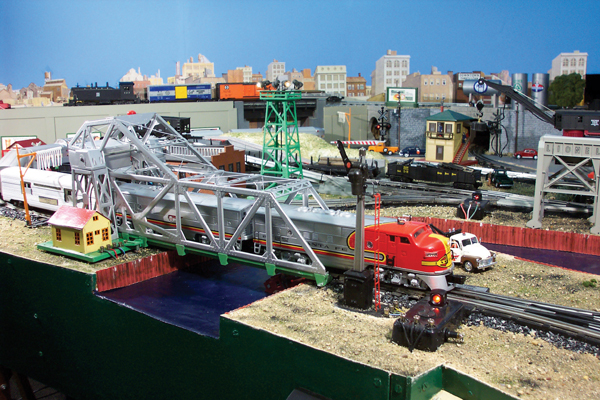
A consistently smooth-running railroad depends on regular maintenance. John Grams and Terry Thompson share seven essentials that will help your locomotives and rolling stock perform over the long haul. William Zuback photo
Better operation starts with regular maintenance
Locomotives and rolling stock are pretty durable in the O and S gauge hobby, but even the best performers in your fleet will benefit from regular inspection, cleaning, and oiling.
A consistently smooth-running railroad depends on regular maintenance. John Grams and Terry Thompson share seven essentials that will help your locomotives and rolling stock perform over the long haul. William Zuback photo
Here are seven of our most essential maintenance basics. Most of these tips are one-evening projects, and some take even less time. Give them a try and your toy train empire will operate better, whether it’s small or large.
1. Check coupler shanks and coupler springs
On postwar Lionel rolling stock, make sure that the shank holding the coupler is straight and level. You don’t want couplers that droop or are twisted. While you’re checking those parts, look at the coupler springs as well, both those on the knuckles and those holding the plates.
2. Lubricate and oil engine
L = lubricate, O = oil
Most locomotives don’t require a lot of maintenance, just periodic cleaning and lubrication. Pay special attention to the ends of the motor armature and to the ends of the axles. Put a little grease on any exposed gears. If you have a steam locomotive, put a little oil on the side rod screws also.
3. Check pickup rollers
William Zuback photo
If your locomotive runs sluggishly, check the pickup rollers to make sure they’re clean and rotate freely. Then spray contact cleaner inside the roller and apply a small drop of lightweight oil at the ends. While you’re at it, be sure to check the wires from the pickups to the locomotive or tender. On pre- and postwar locomotives, check the motor brushes and commutator plate also.
4. Check wheel gauge
William Zuback photo
Even toy train wheels can come out of gauge. If you have a car that derails frequently, especially at switches, check the gauge using a set of calipers. Look for bent axles as well, because they can also cause poor operation. An easy way to check this is to make sure all wheels are touching the rails when the car or engine is sitting on the track.
Postwar wheels rotate on a fixed axle and the wheel centers can wear over time, causing the car to wobble. These wheels can be replaced with good-condition originals. Reproduction postwar-style wheels are also available from Lionel parts dealers.
5. Oil axles
William Zuback photo
Oil your axles (lightly!) using plastic-friendly hobby oil. This is especially important for steam locomotive lead and trailing truck axles, but don’t forget to oil your postwar rolling stock axles. Modern acetyl plastic axle bearings seldom need lubrication.
6. Clean the wheels
William Zuback photo
Wheels roll better when they’re kept clean. Modern angled wheels seem to stay cleaner than postwar-style wheels because the new wheels tend to clean themselves on curves, but even they will get dirty eventually. Clean wheels with a cotton swab or cloth dipped in a mild solvent or light lubricant like WD-40 and then dry the wheels. For really stubborn cases, you may need to first scrape the wheel with a screwdriver.
7. Check E-units
Dirty E-units can cause a lot of headaches, but taking an E-unit apart is a job best left to experts. We use a contact cleaner and protectant in a can. Brands include CRC and DeoxIT. Just be sure to wear eye protection (it’s a fairly high-pressure spray), keep the spray away from painted areas, and wipe up excess cleaner.