As an entity with 50-plus years under its belt, Amtrak now has plenty of its own history, in addition to that of the trains it took over as of May 1, 1971. Thus, it probably should not have been a total surprise when Amtrak launched a through train service in November 2024 between Chicago and Florida by combining the Chicago-Washington, D.C., Capitol Limited with the Washington-Florida portion of the Silver Star, it used the Floridian name for this service.
The Chicago-Florida route had been bereft of service since 1979, when Amtrak’s original Floridian was discontinued as a result of the Carter administration eliminating a number of long-distance trains. In reality, the original Amtrak Floridian — part of the “Day One” Amtrak route system when it took over what was left of the South Wind — suffered from host-railroad track problems that dictated multiple re-routings. There was even a brief combination with the privately operated Auto-Train, whose northern terminal at Louisville, Ky., was on the Floridian’s route.
With this as background, it would be useful to examine what service on this route was like in the era from the late 1930s until the 1971 formation of Amtrak. As we will see, a major part of the story involved an overall daily service between the Windy City and the Sunshine State, albeit with a trio of all-coach trains that ran every third day. Up until the late 1940s, these did not include sleeping cars, which continued to be handled on existing schedules.
The first of these began in 1939, making the daily Miami-Jacksonville portion on Florida East Coast Railway as the Henry M. Flagler, named for the founder of the FEC. When this routing proved to less than successful, its Budd stainless-steel cars — coaches, diner, and tavern lounge observation car — were re-assigned to the Chicago-Miami market via what was known as the “Dixie Route” utilizing Chicago & Eastern Illinois south to Evansville, Ill., followed by the Louisville & Nashville to Atlanta, and the Atlantic Coast Line via Atlanta-Waycross, Ga., before returning to FEC “home rails” at Jacksonville.
This train originally was to be named the Dixie Streamliner but instead entered service as the Dixie Flagler in December 1940. In the same month, it was joined by two other all-coach streamliners, the Pennsylvania Railroad-sponsored South Wind, along with the Illinois Central’s entry, the City of Miami.

The South Wind also utilized Budd stainless steel cars, but the Pennsy opted to paint them in the Tuscan Red “Fleet of Modernism” scheme the railroad had adopted in the 1930s for new streamlined equipment. This train utilized Pennsy rails between Chicago and Louisville, where it was handed off to the L&N, which then handled the train to Montgomery, Ala., via Nashville. In Montgomery, the Atlantic Coast Line took over for the run to Jacksonville and all three trains ran from there to Miami on FEC.
The final participant in this trio, the Illinois Central’s City of Miami opted for smooth-side passenger cars from Pullman Standard, and was, by a wide margin, the most colorful of the lot, with a livery featuring green, orange. and crimson trim; its EMD E6 diesel featured a green “bow wave” motif on the sides and front of the locomotive. Its route took it from Chicago to Birmingham on the IC, where the Central of Georgia took over as far as Albany, Ga.; at that point, the ACL was responsible for the lap to Jacksonville, followed by the trek to Miami on FEC.
The all-coach configuration continued on all three trains through the World War II years and into the early postwar era. In 1949, sleeping cars were added, at first standard heavyweight prewar cars, followed by lightweight streamlined cars in the early 1950s. The City of Miami was completely lightweight by 1950, while the Flagler added some lightweight sleepers in 1951, and the Wind was all lightweight by the summer of 1953.
A more significant development occurred in December 1954 when the Dixie Flagler made its final run south, replaced by the “new” Dixieland, now operating with all lightweight equipment. It would last only until October 1957, after which it was no longer possible to depart Chicago on the C&EI for Florida on a train that had sleeping and dining car service.
Following this, the two remaining participants began running the City and the Wind on an every-other-day basis. By this time, rail passenger traffic was declining significantly, and the advent of the jet airliners in the late 1950s would only exacerbate this. Still, both trains continued to offer full service and, beginning in the late 1950s, dome cars were added to the winter season runs through the late 1960s. Initially this involved dome sleepers leased from Northern Pacific; the IC eventually would acquire dome coaches from Missouri Pacific, to be used on both the City of Miami and the City of New Orleans.

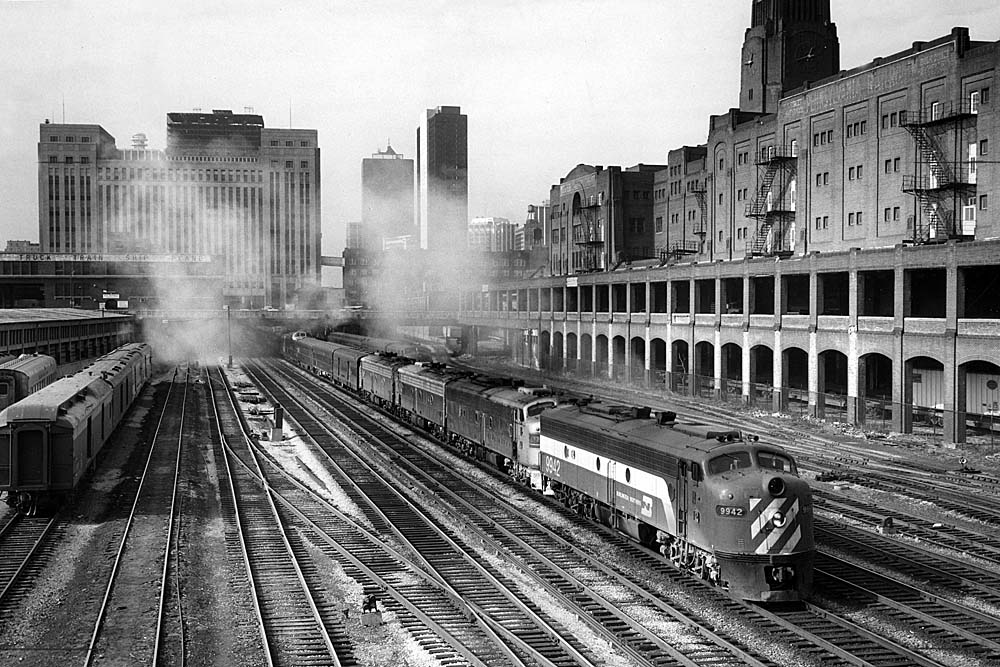
While the City of Miami made it all the way to the advent of Amtrak on May 1, 1971, although the observation cars had been removed in 1969, the South Wind did not fare as well. As of November 1969, it was no longer a through train to and from Chicago; passengers had to connect in Louisville with a separate Penn Central train with coaches and a buffet lounge car. In addition, on the L&N, the South Wind was merged with the Pan American between Louisville and Montgomery.
Finally, it should also be noted that there was another routing for Chicago-Florida passengers during the period covered here, using another Midwestern gateway to the south: Cincinnati. This involved both the New York Central and Pennsylvania Railroads on the north end, while the partners south of Cincinnati went via Southern Railway and L&N, respectively.
The PRR/L&N combination operated the Southland and focused on the west coast of Florida in the postwar years. While this was shown as a through train from Chicago, in reality this was essentially through sleeping cars on the Pennsy’s Chicago-Cincinnati overnight trains in each direction. In addition, there were through cars from Detroit, operated on PRR/Wabash joint Chicago-Detroit trains, and connecting with the Southland in Fort Wayne, Ind. When these services were discontinued in 1949, these through cars shifted to a Baltimore & Ohio routing between Detroit and Cincinnati. In any case, as of December 1957, the Southland was discontinued south of Atlanta, ending any participation in the Midwest-Florida market.
The NYC/SOU partnership concentrated on the east coast of Florida, and over the postwar years operated through sleeping cars on both the year-round Royal Palm as well as the seasonal New Royal Palm. The latter train was the last winter-seasonal Midwest-Florida train on any route; it lasted until April 30, 1955.
Through sleeping cars were operated between a number of Midwestern points and Florida, including Chicago, Detroit, Cleveland, and Buffalo. When the New Royal Palm commenced service, it ran as a separate through train with coaches, sleepers, and the observation lounge car on the NYC between Cincinnati and Detroit. As late as the winter of 1958, the “regular” Royal Palm boasted through sleeping cars and a coach between Detroit and Miami, as well as a sleeper between Cleveland and Miami.