

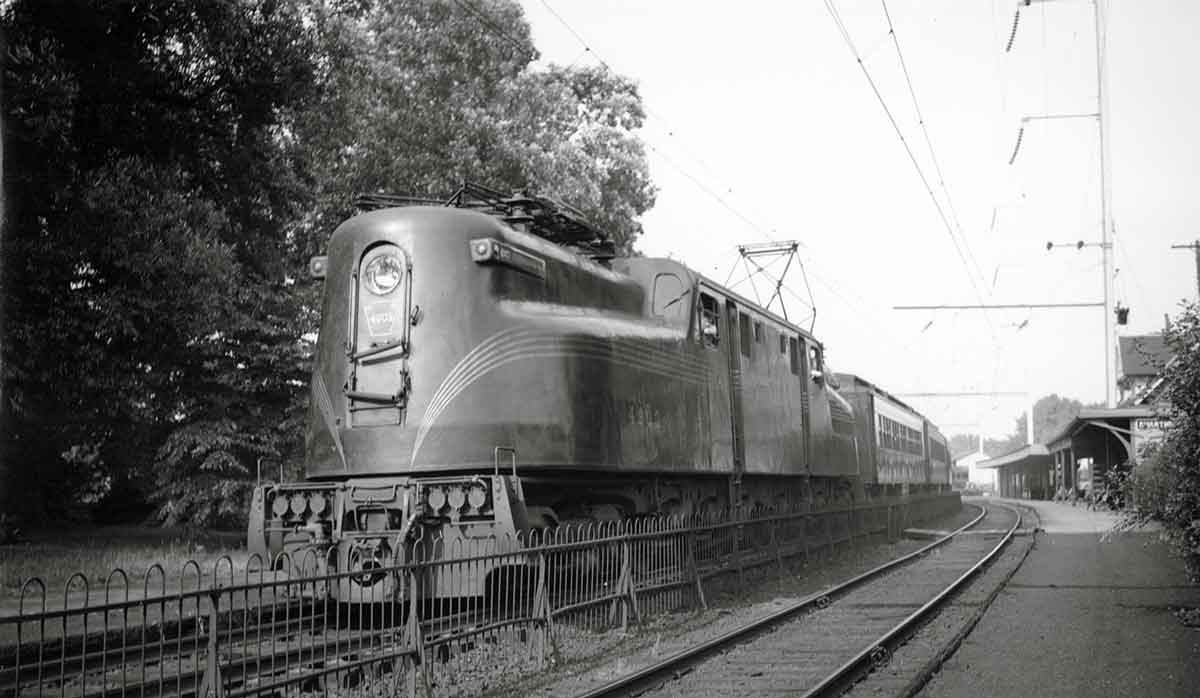
GG1 4903 heads a westbound rush-hour commuter train at Swarthmore, Pa., sometime during World War II. A mainline motor like this was a rarity on PRR’s West Chester Branch.
George Gillespie
As were many railroads during the busy World War II years, the Pennsylvania Railroad was hard-pressed for equipment. Many of us remember seeing locomotives and cars in strange places all over the country. A thrilling example of this for me was PRR’s use of GG1 electrics in commuter service on its line out of Philadelphia to Media and West Chester, Pa.
We can recall those wonderful motors speeding from New York to Washington or Harrisburg with the Congressional, Broadway Limited, Silver Star, etc., and the hourly New York–Philadelphia “clockers.” The Gs could also be seen in mainline freight service. But to find them on a branch line that normally hosted only multiple-unit cars and small steam engines was unheard of.
My first sighting of a G at the Swarthmore station followed my friend Bus Blundin’s question, “Did you see the GG1 on the 5:42 train yesterday?” I had heard a G horn around that time, but passed it off as having come from the main line to Washington, a mere 2 miles from our house. However, I made sure to be at the station the following afternoon — with my camera.
Why were the GG1s being used on the West Chester line? With gas rationing and the subsequent increase of commuter traffic, there just weren’t enough M.U. cars to accommodate the need. So the PRR brought in locomotive-hauled cars, including some from the Pennsylvania-Reading Seashore Lines that were not needed during the off season, and even some old wooden coaches.
The Media/West Chester trains operated out of underground Suburban Station in Philadelphia, so steam power was out of the question. Instead, the call went out to the reliable GG1. This combination of locomotive power and the odd coaches was used on two outbound late-afternoon schedules and two morning inbound trains.
Bus and I often speculated how the Crum Creek trestle just west of Swarthmore carried the weight of these heavy locomotives. If you stood at creek level, you could see the base plate of one of the piers rise and fall a good inch and a half even as a relatively light M.U. train crossed.
As a 15-year-old, it was very impressive to stand on our humble commuter platform and touch one of those great electrics. I’ve often thought of the GG1 as my No. 1 locomotive. Not a surprise, I guess, considering the initials we share.
We can recall those wonderful motors speeding from New York to Washington or Harrisburg with the Congressional, Broadway Limited, Silver Star, etc., and the hourly New York–Philadelphia “clockers.” The Gs could also be seen in mainline freight service. But to find them on a branch line that normally hosted only multiple-unit cars and small steam engines was unheard of.
My first sighting of a G at the Swarthmore station followed my friend Bus Blundin’s question, “Did you see the GG1 on the 5:42 train yesterday?” I had heard a G horn around that time, but passed it off as having come from the main line to Washington, a mere 2 miles from our house. However, I made sure to be at the station the following afternoon — with my camera.
Why were the GG1s being used on the West Chester line? With gas rationing and the subsequent increase of commuter traffic, there just weren’t enough M.U. cars to accommodate the need. So the PRR brought in locomotive-hauled cars, including some from the Pennsylvania-Reading Seashore Lines that were not needed during the off season, and even some old wooden coaches.
The Media/West Chester trains operated out of underground Suburban Station in Philadelphia, so steam power was out of the question. Instead, the call went out to the reliable GG1. This combination of locomotive power and the odd coaches was used on two outbound late-afternoon schedules and two morning inbound trains.
Bus and I often speculated how the Crum Creek trestle just west of Swarthmore carried the weight of these heavy locomotives. If you stood at creek level, you could see the base plate of one of the piers rise and fall a good inch and a half even as a relatively light M.U. train crossed.
As a 15-year-old, it was very impressive to stand on our humble commuter platform and touch one of those great electrics. I’ve often thought of the GG1 as my No. 1 locomotive. Not a surprise, I guess, considering the initials we share.
First published in Spring 2010 Classic Trains magazine.
Learn more about railroad history by signing up for the Classic Trains e-mail newsletter. It’s a free monthly e-mail devoted to the golden years of railroading.