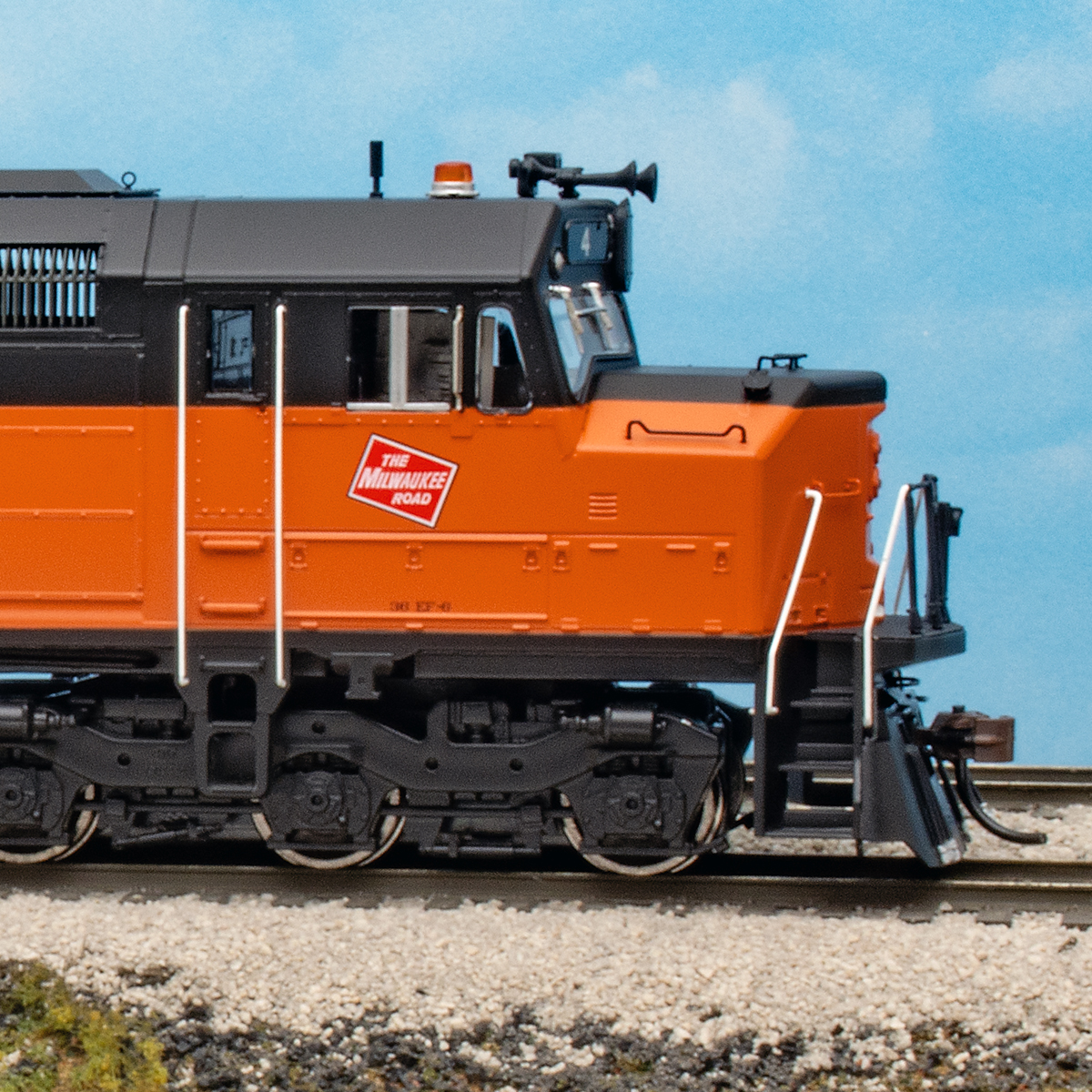


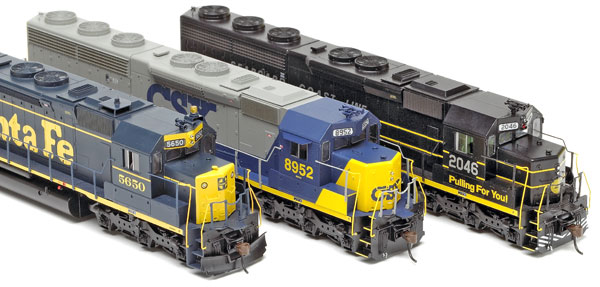
Introduced in 1972 with an upgraded 20-cylinder diesel engine, the 3,600-hp SD45-2 was the successor to the SD45 but was easily distinguished from it because the Dash-2’s longer radiator lacked the earlier model’s distinctive flare.
During the two-year production run EMD sold only 136 SD45-2s, but the units were the muscle machines of the era. A standard SD45-2 weighed 368,000 pounds but could be ballasted to as much as 420,000 pounds. However, the big locomotive’s appetite for fuel and its higher maintenance costs held EMD’s SD45-2 sales in check.
Prototype plans of the SD45-2 were published in the Simmons-Boardman 1980 Car and Locomotive Cyclopedia. Athearn’s new model matches the dimensions shown in these drawings.
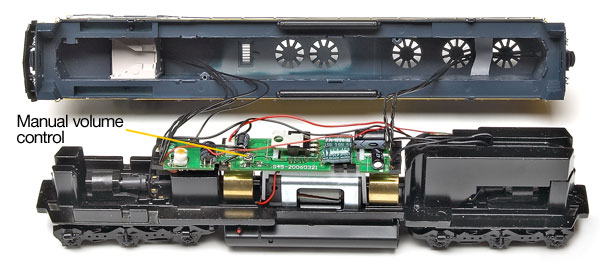
This new Genesis locomotive follows Athearn’s proven mechani¬cal design, with some new elec-tronic features. A Roco five-pole motor with turned-brass flywheels is mounted in a heavy, die-cast metal frame. The motor is dynamically balanced for smooth perfor¬mance. Acetal plastic shafts and universals drive both trucks.
The three-axle trucks have the correct off-center middle axles, and they’re driven by a worm and set of spur gears enclosed in each gear¬box. The wheelsets match the National Model Railroad Association standards. They have nickel- silver wheels with RP-25 contours. The drivers are mounted on split axles, so all 12 wheels pick up current through contacts wired into the unit’s printed circuit board. The sideframes are excellent plastic castings.
A separate cast-metal weight fits on the top rear of the frame and holds the speaker.
Athearn uses three different body shells to provide prototype-specific details for each road name. A separate casting includes the pilots, corner steps, and textured running boards. A variety of hand-applied plastic and wire detail parts further customize each model. The cab includes an interior.
Two flathead screws hidden above the trucks attach the mechanism to the body. The coupler boxes slip through the pilots, and a single screw holds each box in place.
Our samples were smoothly painted with sharply defined color breaks. The printed lettering includes many tiny but readable safety labels and builder’s plates.
A small (1 5/8″ x 3¼” x ½”) battery-powered, handheld radio transmit¬ter with numbered push buttons controls the sound functions during DC operation: 1-turn bell on or off; 2-sound the horn; 3-activate a coupling crash; 4-activate a standing air release, or a brake squeal when moving; 5-activate or turn off the dynamic brake whine; 6-switch headlight on or off.
These buttons also program the sounds, and some functions include audio confirmations. The programming choices include 15 different horns, 8 bells, coupling sounds (on or off), a variety of bell ringing rates, and a system on or off for use if the model is run as a second unit. There’s a manual volume control on top of the PC board, but the body shell must be removed to reach it.
On DCC, these models use 20 functions (F0-F19) to control a wide range of sounds, and the double-click F0 toggles the sound system on or off. In addition, there are 37 configuration variables (CVs) that can be used to adjust both the sound and DCC control settings as desired. In case of an error, the dual-mode decoder may be easily reset to its factory default settings.
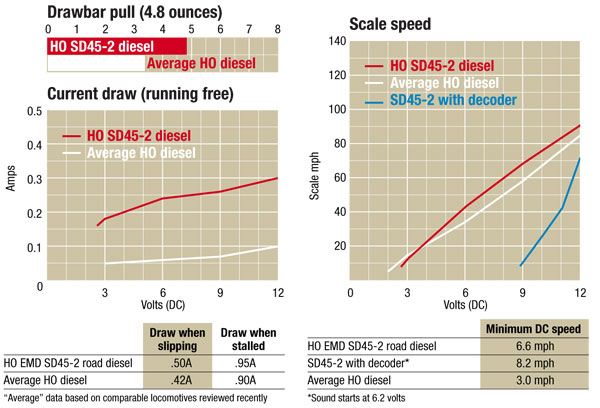
In common with most dual-mode sound decoders, this system requires 6 volts to start the sound system in the DC mode, so the motor control is squeezed into the top half of the throttle settings.
On the default settings, the dual-mode model needed more than 8 volts DC to start at 10 mph, but with some programming adjustments we were able to reduce its starting speed to a more realistic 4 mph.
The radio controls make it easy to operate the manual sounds, but I really like the automatic changes in the super-charged EMD 645 engine sounds responding to the throttle.
On DCC the engine sounds began at idle, revved up on throttle step 1, the unit began creeping slowly on step 2, and it reached 66 mph at step 14. At full throttle (step 28), it hit 150 mph, so CVs can be adjusted to yield a more reasonable speed range.
Overall, I’m impressed with Athearn’s new SD45-2. It’s a good-looking and powerful locomotive with excellent details. I especially like having the sound option for DC operators as well as those using DCC.
Price: SD45-2 with dual-mode decoders and sound, $239 each; DC versions $139.98; ATSF Bicentennial units are $244.98 or $144.98
Manufacturer
Athearn Inc.
1550 Glenn Curtis St.
Carson, CA 90746
www.athearn.com
Description
Plastic and metal ready-to-run diesel locomotive
Road names (three unit numbers in each paint scheme with or without sound, two Bicentennial numbers): Atchison, Topeka & Santa Fe (1972 original, yellow warbonnet, or Bicentennial); Clinchfield; Conrail; CSX; Erie Lackawanna; Seaboard Coast Line; and undecorated (four different versions)
Automatic dual-mode sound decoder for DC or Digital Command Control (DCC)
Cab interior, flush window glazing, sliding side windows
DC models include an NMRA-recommended 9-pin DCC decoder socket
Die-cast metal chassis
Directional, constant lighting
Drawbar pull: 4.8 ounces
Factory-applied prototype-specific details
Five-pole balanced Roco can motor with dual flywheels
McHenry scale-size magnetic knuckle couplers mounted at the correct height
Minimum radius: 18″
Weight: 22 ounces