

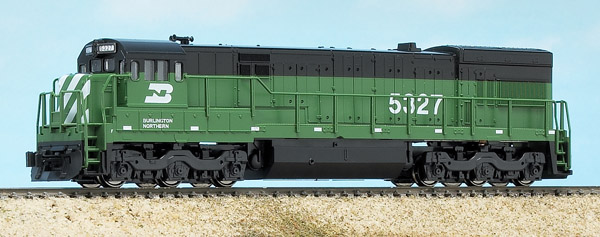
All work, no glamour. To counter Electro-Motive Division’s six-axle SD40 and SD40-2, General Electric in 1966 fitted its pug-nosed “U-boat” chassis with a 3,000-hp, 16-cylinder FDL-16 engine. Though this engine racked up complaints about its reliability, production backups for EMD’s SD40s kept U30C sales high. Six hundred units were sold, more than half of those to the Union
Pacific and Burlington Northern. Many were assigned to hauling coal and other heavy freight drags. A few rebuilt units are in revenue service today.
Twenty-one railroads owned U30Cs, and Kato’s N scale version is available painted for its two largest owners – the BN and UP. Two unique schemes are also offered, BN’s American Revolution Bicentennial unit and the United States Department of Transportation.
Kato also offers the model painted in a blue-and-yellow Atchison, Topeka & Santa Fe freight warbonnet scheme. The AT&SF didn’t have any U30Cs, but it did have 20 2,250-hp U23Cs. Though U23Cs strongly resemble their heftier cousins, Kato’s model bears the U30C’s eight tall engine access doors on either side of the long hood, two more than on the U23C. Santa Fe modelers lamenting the lack of an N scale U23C on the market might not mind the discrepancy, but it’ll likely bother the rivet-counters.
Two details on the model’s shell – the low front radiator air intake and the lack of a fairing in front of the radiator section – mark it as a locomotive from late in GE’s U30C production run.
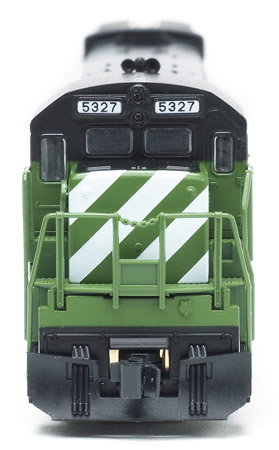
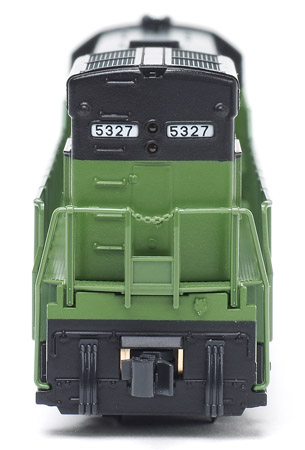
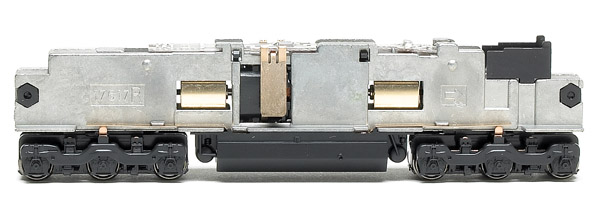
Though no manufacturer has yet announced a decoder specifically for this model, Train Control Systems recommends its K1D4-NC drop-in decoder, originally made for other Kato diesels. This is a motor and lighting decoder only, as there’s no obvious spot in the cramped mechanism for a speaker. Space for a small speaker could be milled out from the weight inside the fuel tank, but more space would need to be milled out for a separate sound decoder.
Surface-mount light-emitting diodes on the lighting board illuminate the front and back headlights and number boxes. Lighting is directional, which isn’t prototypical, and the number boards also go dark when the engine is running the opposite direction.
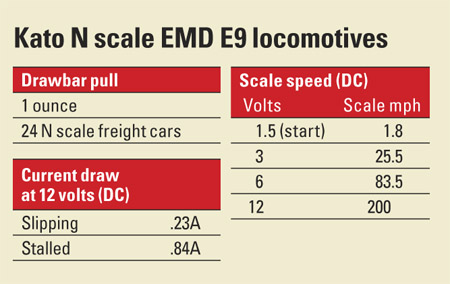
A General Electric specification book in our library lists the prototype’s top speed as 64 mph, appropriate for a heavy freight hauler. Our model bettered that scale speed at less than 6V. By the time I got the power pack up to 12V, the model was flying down the track at 200 scale mph! Such high-speed gearing reduces the model’s useful speed range and makes the locomotive harder to control.
Welcome back. The return of Kato’s N scale U30C is a welcome event. The body tooling, sharp paint job, and upgraded mechanism make it a fine model.
Kato’s first release of an N scale U30C, back in 1990-91, included units wearing the livery of the Chesapeake & Ohio (Chessie), Delaware & Hudson, Pennsylvania RR, Rock Island, Seaboard (ex-Atlantic Coast Line), and Southern Pacific. Between them, these railroads owned at least 89 of these locomotives, so Kato would be smart to offer these road names again. More N scale modelers should have the chance to add this smooth-running locomotive to their railroads.
Manufacturer
Kato USA
100 Remington Road
Schaumburg, IL 60173
katousa.com
Road names: (two road numbers each unless noted) Burlington Northern; Atchison, Topeka & Santa Fe (U23C); Burlington Northern “Bicentennial” scheme (one number); Union Pacific; United States Dept. of Transportation (one number)
Era: 1966 to present
Features
- All-wheel drive and pickup
- Chemically blackened metal wheels, in gauge
- Directional light-emitting-diode headlights and number boards
- Five-pole skew-wound motor with dual brass flywheels
- Flexible acetal plastic handrails
- Kato magnetic knuckle couplers, at correct height (with modeler-installed trip pins)
- Prototypical truck sideframes
- Weight: 4 ounces