

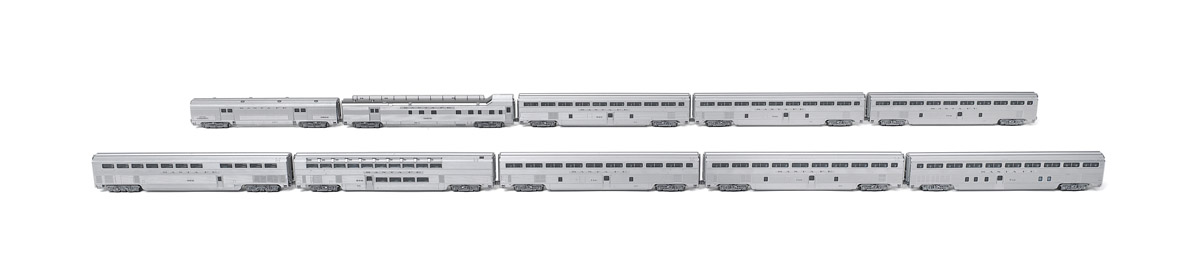
Prototype. The El Capitan was an all-chair-car train that ran on the Santa Fe main line from Chicago to Los Angeles. Launched in 1938, the El Capitan provided passengers a less expensive option to the railroad’s all-Pullman Super Chief.
In 1956 the Santa Fe re-equipped the El Capitan with Hi-Level cars, including coaches, diners, and lounges, built by the Budd Co. With floors eight feet above the rails, the Hi-Level cars gave passengers a better view and a quieter ride.
The two-level coaches were the same length as a standard height coach, but could carry 68 or 72 passengers. (A standard height car carried 48.) While the top level of the coaches was dedicated to passenger seating (or dining room or lounge compartments in those car types), the lower level was used for baggage, air conditioning, and other equipment. A kitchen occupied most of the diner’s lower level.
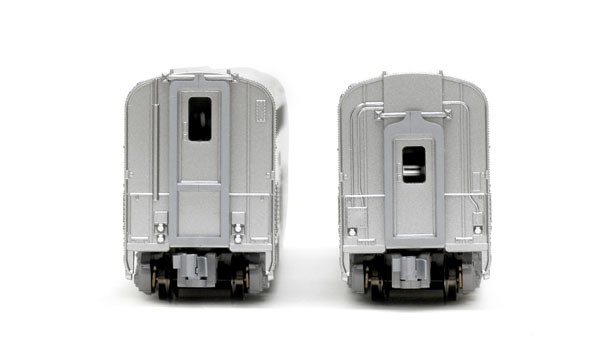
The Santa Fe combined El Capitan and the Super Chief trains beginning in 1958, although the two trains continued to run as separate consists during the summer and Christmas seasons. The trains ran until the advent of Amtrak in 1971. The Hi-Level cars inspired the Amtrak Superliner cars that still serve in long-distance trains today.
The 10-car and 2-car sets provide enough cars to model a typical El Capitan consist from 1956 or 1957. Kato also sells an N scale Super Chief passenger set and F7A and B units in Santa Fe’s red warbonnet scheme (See the April 2006 Model Railroader for a review of the Kato N scale Super Chief set and F7 diesels), so you could also model a later combined Super Chief/El Capitan consist from 1958 through the 1960s.
All the window arrangements, fluting, vent placement, and other molded detail on the N scale cars match prototype photos. Kato equipped the diner with the correct six-wheel trucks. As on the prototype, all the other cars have four-wheel trucks. The injection-molded truck sideframes are crisply detailed and painted silver.
The silver paint on the models’ body shells is especially well done. The finish is metallic enough to do a convincing job of simulating stainless steel. All lettering and car numbers match prototype photos. All the window gaskets are correctly painted black.
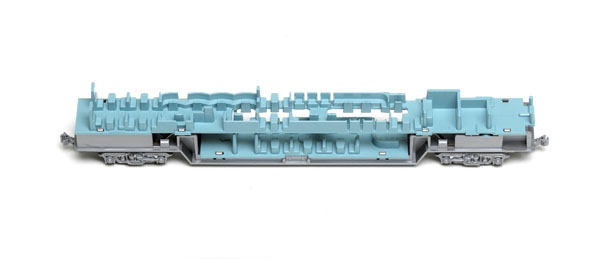
In each car there’s a metal weight between the interior floor and the chassis. Most of the cars are 1/4 ounce too light according to National Model Railroad Association RP-20.1. The baggage-dormitory car is 1/2 ounce too light.
All the cars are equipped with Kato magnetic knuckle couplers, but the trip pins must be installed by the modeler. The cars couple with .060″ between the diaphragms. The N scale El Capitan ran smoothly around the 11″ radius curves of our Salt Lake Route layout.
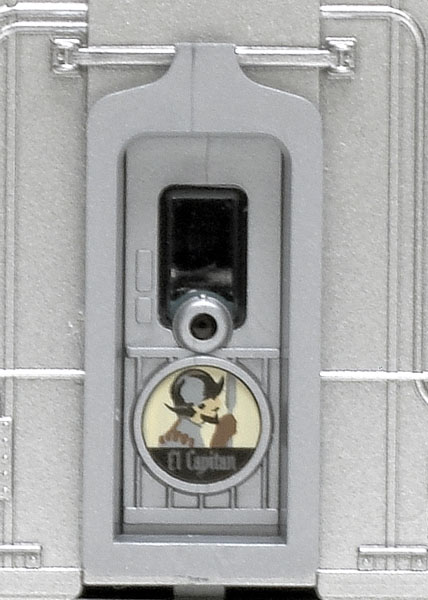
The factory-installed lighted drumhead tail sign and marker light are two of my favorite features. The tail sign is colorful and well-rendered and the marker light is a red light-emitting diode (LED). All the cars have metal contacts on the trucks, and Kato sells interior lighting kits that use white LEDs. The manufacturer’s suggested retail price for the kits is $10 for one or $50 for a set of six. The tail sign, marker light, and interior lights work on DC and Digital Command Control layouts.
Enough Kato Unitrack sections are included with the 10-car set to display all those cars, the 2-car add-on set, and a pair of F7 diesels. Detailed inside and out, El Capitan in N scale is a great-looking model of its famous prototype.
Price: $250 (10-car set), $50 (2-car add-on set)
Manufacturer
Kato U.S.A. Inc.
100 Remington Rd.
Schaumburg, IL 60173
www.katousa.com
Features
Illuminated tail sign and marker light on observation car
Kato magnetic knuckle couplers at correct height
Low-profile metal wheels in gauge
Minimum radius: 11″
Nine Unitrack 93/4″ straight
sections and one 2″ straight
section with bumping post
Weight: 11/4 ounces (Hi-Level cars), 1 ounce (baggage and dormitory cars)