

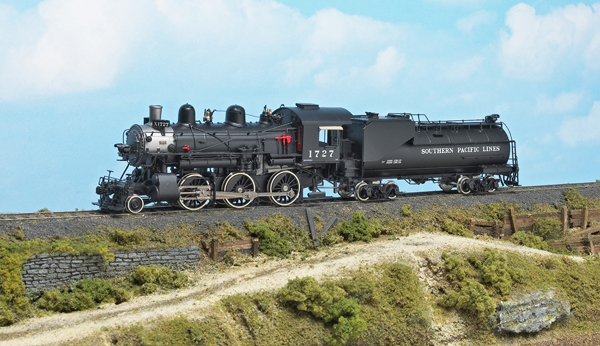
Prototype. Most of the class M-6 2-6-0 Moguls began their careers as class EF Vauclain compound 2-6-0s delivered by Baldwin between 1901 and 1903. By the mid teens the railroad converted all the locomotives to single-expansion cylinders and reclassed them M-6. Many also had their boilers replaced.
For most of their careers, the M-6 Moguls hauled light freight trains or switched yards. Most of the SP 2-6-0s served into the 1950s, including class M-6 no. 1727, which is on display in Dunsmuir, Calif.
I couldn’t find any published prototype drawings of an M-6. However, the model’s wheel spacing and driver diameter match Southern Pacific equipment diagrams from the Kalmbach Publishing Co. Library files. Dome placement, piping, and other details matched prototype photos of SP class M-6 no. 1727.
Sunset also sells an M-9 Mogul, which uses the same boiler, tender, and running gear as the M-6 but has some detail differences.
Details and paint. The Sunset model is built primarily of brass. All external piping, sand lines, injectors, air pump, and other boiler-mounted appliances are separately applied metal parts. A cord runs from the bell ringer to the cab.
The locomotive cab interior features a detailed backhead with painted valve handles and water sight glass. The roof vent opens and closes. The folding cab apron has etched diamond tread. There is clear glazing in the front and rear cab windows.
The M-6 has a removable scale-size dummy coupler on the pilot. Although not included, an operating coupler could be installed. Some filing may be necessary to widen the coupler pocket.
The 100-C-4 Vanderbilt tender is also well detailed, with separately applied handrails and simulated wood grain on the tender deck. All the tender water hatches open.
The lettering on the locomotive and tender is opaque and straight. The Harriman classification data under the cab number is readable under magnification. The SP lettered its locomotive tenders with “Southern Pacific Lines” from 1913 to 1946. The tender is lettered for a water capacity of 10,060 gallons.
Mechanism and electronics. The model has a die-cast metal frame with the brass boiler and cab mounted on top. A five-pole skew-wound motor inside the boiler is connected to a gearbox driving the second driver axle. The metal side rods turn the other drivers.
All the drivers are sprung to keep them in electrical contact over uneven rails. However, the pilot is only eight HO scale inches above the railhead. Though this is a prototypical distance, if the brass pilot touches both rails, a short circuit will occur. You may wish to file the bottom of the pilot to increase the clearance or glue styrene under the pilot to prevent shorts on uneven track.
The Mogul doesn’t have traction tires but has a drawbar pull equivalent to 35 HO freight cars on straight and level track. However, the locomotive stalled when hauling a train half that size up a 1.5 percent grade. If you run the M-6 on hilly routes, you may want to try Bullfrog Snot traction-tire maker (reviewed in the May 2009 issue of MR).
A six-wire cable connects the QSI Quantum sound decoder and downward-facing speaker in the tender to a plug under the rear of the locomotive cab.
Sounds and lights. At rest the model’s QSI Quantum sound decoder has random automatic sound effects including the air pumps, dynamo, and injector.
Using a DC power pack, you can trigger sounds such as the whistle and bell, and program features such as the volume level and momentum. A QSI Quantum Engineer (sold separately) makes it easier to operate and program the model on a DC layout.
In forward the Mogul’s headlight shines, and in reverse the headlight dims and the backup light shines. The sound of four chuffs per wheel revolution is synchronized to the motion of the drivers. As the locomotive starts moving in DC mode there’s also the separate hiss of the open cylinder cocks until the locomotive exceeds 12 scale mph.
In DCC the model supports 13 functions, including function 7, which turns the open cylinder cock sound on or off. Other functions include the whistle, bell, and coupler crash. Function 9 lets you increase the intensity of the chuffs when you advance the throttle, while keeping the locomotive’s speed constant. This is useful for simulating the locomotive
working extra hard climbing a grade.
The QSI Quantum sound decoder features many programmable configuration variables (CVs), including setting the locomotive’s long address and adjusting the volume levels of individual sounds. An extensive DCC user’s manual that includes a complete list of CVs is available on the Web at www.qsisolutions.com.
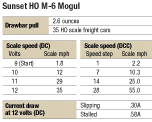
I tested the model in DCC using an MRC Prodigy Advance that delivers 16.4 volts to the track. In speed step 1 the model crept along at 2.2 scale mph and accelerated to a top speed of 55 scale mph in speed step 28. You can set the QSI decoder to 128 speed steps for finer control, especially at lower speeds.
With realistic sounds and loads of detail, the Sunset HO M-6 would look great working an Espee branchline layout.
Price: $699.95 (DCC), $649.95 (DC)
Manufacturer
Sunset Models Inc.
37 Fourth St.
Campbell, CA 95008
www.3rdrail.com
Versions: (all Southern Pacific, three road numbers each)
M-6 lettered Southern Pacific Lines, M-9 lettered in post-1946 livery
Features
9-pin DCC plug (DC version)
Dual-mode Digital Command Control (DCC) sound decoder (DCC version only)
Electrical pickup on all drivers and tender wheels
Five-pole skew wound motor
Minimum radius: 18″
Operating magnetic knuckle coupler on rear of tender at correct height (Scale-size dummy coupler on pilot)
Metal RP-25 contour wheels in gauge
Weight: 11 ounces (engine), 16 ounces (engine and tender)