

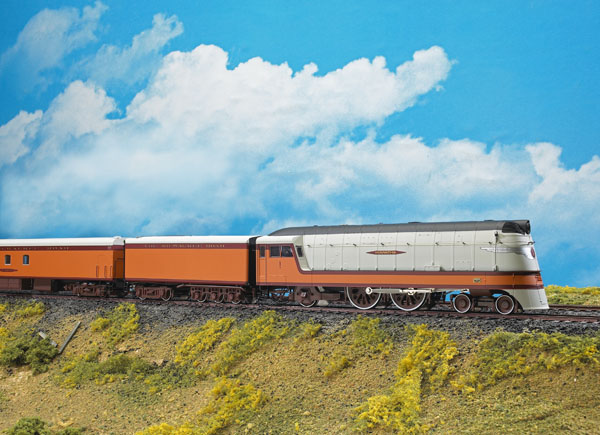
Each model in the set is a faithful HO scale reproduction of its prototype. The locomotive is easy to convert to Digital Command Control as well as a DCC sound system.
Built for speed. 410 miles in 390 minutes was the performance touted by the Chicago, Milwaukee, St. Paul & Pacific RR (Milwaukee Road) on May 29, 1935. On that date the Milwaukee debuted the Twin Cities Hiawatha. The two new streamlined trains operated between Milwaukee and Minneapolis-St. Paul.
The shrouded 4-4-2 steam locomotives built by Alco to haul the Hiawatha trains were among the largest and most powerful Atlantic types ever built. These locomotives, nos. 1 to 4, were designated class A by the Milwaukee Road. During a test run in 1935, one of the locomotives reached a speed of 112.5 mph, which was the fastest recorded speed for a steam locomotive at that time.
The Milwaukee’s chief mechanical officer Karl F. Nystrom designed the passenger cars and their trucks. The cars were built by the Milwaukee Road’s car shops in Milwaukee, Wis. Even though the train averaged speeds of 75 mph, and often reached 100 mph or more, the cars offered passengers a smooth and comfortable ride.
The Twin Cities Hiawatha proved so popular and profitable that the Milwaukee Road ordered new equipment after only 16 months of service. When these new cars were delivered some of the original 1935 equipment was sent to serve in the Northwoods Hiawatha and the Chippewa Hiawatha.
Fox Valley Models’ 1935 Hiawatha set includes class A no. 1; a Tap Cafe; coaches nos. 4419, 4428, and 4439; parlor car Minnewawa; and beaver-tail observation car Wenonah. Two additional coaches, nos. 4401 and 4437, are available separately for $64.95 each. Fox Valley Models also sells an N scale model of the train.
The dimensions of the locomotive and all the cars in the set match drawings in The Milwaukee Shops Present: Hiawatha First of the Speedliners (Milwaukee Shops, Inc.).
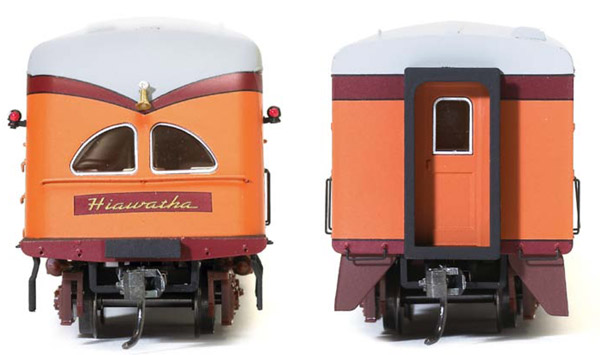
The cab windows have clear glazing. The cab interior has some white painted gauges, but no crew figures. If you’d like to add figures, a diagram is included that shows how to remove the cab.
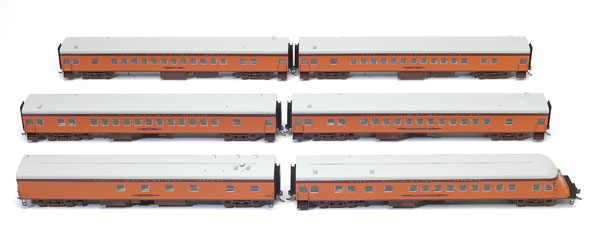
The cars have clear window glazing and separately applied hand grabs and roof vents, as well as some underbody detail. A horn and non-functioning markers adorn the observation car.
The plastic car diaphragms aren’t sprung. There’s an unptototypical six scale inch gap between the diaphragms when the cars are coupled.
The well-detailed Nystrom trucks are molded in maroon plastic. The parts would look better if they’d been painted.
The passenger car body shells are press fit. I easily removed the body shell by using a small flat bladed screwdriver to disengage the four locking tabs on each car side. A die-cast metal weight is sandwiched between the interior floor and the chassis of each car.
Removing a car shell reveals an interior with wall and seat details molded in yellow plastic. All the floor plans of the models match prototype diagrams.
You could easily add figures to the passenger car interiors. The cars’ trucks don’t pick up track power. For interior lighting you could use a battery-powered system like that sold by Rapido Trains.
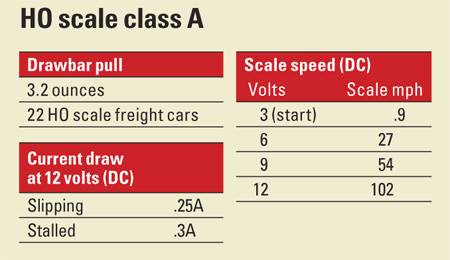
The headlight turned on at 3 volts and turned off when the model’s direction was reversed, which is unprototypical.
The flywheel-equipped motor is inside the locomotive boiler. A worm gear shaft from the motor transfers power to a gearbox tower on the rear driver axle. The siderods transfer power to the front driver axle.
There’s a six-wire connection between the locomotive and the six-pin socket
on the printed-circuit (PC) board in the tender. After removing the screw hidden under the press-fit oil hatch on top of the tender, it’s easy to lift off the tender shell.
The tender has plenty of room for a DCC decoder. The PC board is mounted on a metal weight that’s attached to the tender’s plastic chassis. I removed the jumper from the PC board’s eight-pin DCC socket and installed a Train Control Systems DP5 motor decoder. If you want to install a sound decoder, you’ll need to remove six screws and lift off the weight to reveal an indentation for a 9mm deep, 27mm diameter speaker. A hole for a speaker wire is drilled in the weight. If your decoder comes connected to a speaker, you’ll need to un-solder the speaker, thread the wire through the hole, and then re-solder the wire to the speaker. The chassis has sound holes underneath the speaker housing.
With the decoder installed I ran the model on our DCC-equipped layout. The locomotive hauled all six passenger cars around a 26″ radius curve and up a 2 percent grade at 50 scale mph.
The locomotive’s rear drivers have traction tires, which add to its pulling power. However, since only the front drivers and the tender wheels pick up track power, the locomotive’s headlight flickered briefly as it ran forward through a set of yard turnouts.
The FVM Hiawatha is a great-looking HO model of its prototype.
Manufacturer
Fox Valley Models
P.O. Box 1970
Des Plaines, IL 60017
www.foxvalleymodels.com
Era: 1935 to late 1940s
Locomotive features
- Eight-pin Digital Command Control socket
- Electrical pickup on four drivers and all tender wheels
- Flywheel-equipped motor
- Weight: 1 pound 41⁄2 ounces;
- 1 pound (engine alone)
Car features
- Metal RP-25 contour wheelsets in gauge
- Minimum radius: 22″
- Operating knuckle couplers at correct height
- Weight: 5 ounces per car