

To keep that freight moving east, the railroad also received 65 4-6-6-4 Challengers from Alco in the early 1940s through World War II. These locomotives were improved versions of the Challengers first developed by UP and Alco in the 1930s.
The Challengers and Big Boys were simple articulated locomotives. (The term “simple” refers to both front and rear engine using high-pressure steam, unlike a slow-speed “compound” or “Mallet” type that recycled the exhaust of one set of high-pressure cylinders into larger low-pressure cylinders.) The improved Challengers could reach passenger train speeds of 80 mph. A Big Boy produced its maximum 6,290 hp at the fast freight speed of 41.4 mph.
The UP’s adoption of turbine-electric and diesel-electric locomotives shortened the careers of both Big Boys and Challengers. However, several examples of each steam locomotive type have been preserved. Challenger no. 3985 remains part of UP’s historic steam fleet and is the largest operational steam locomotive in the world. It’s also been recently announced that UP plans to restore Big Boy no. 4014.
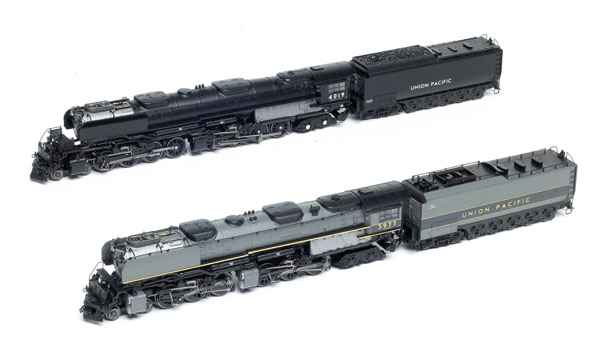
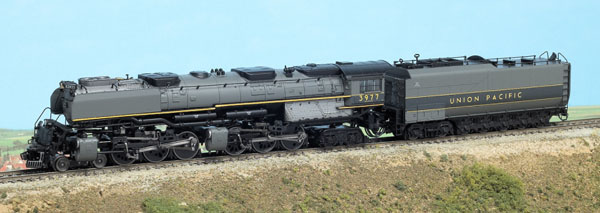
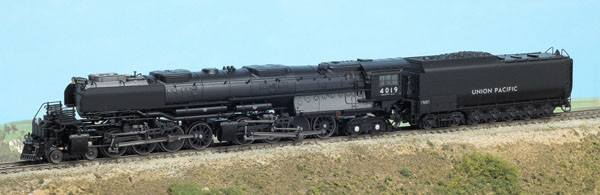
The model. As noted in the earlier reviews, the plastic models match drawings in the Model Railroader Cyclopedia: Vol. 1, Steam Locomotives (Kalmbach Publishing Co.). The main discrepancy between the model and the prototype involves the articulated frame. On prototype articulateds the rear engine was rigidly attached, and only the front engine moved from side to side on a hinge between the rear cylinders. On the Athearn models both the front and rear engines swivel to allow the locomotives to negotiate tight curves.
Rivet seams and boiler bands are cleanly molded on the plastic boilers. Separate parts include the whistles, handrails, and safety valves. There’s clear glazing in all the cab windows.
The lettering is straight and includes the correct Harriman classifications under the cab numbers on both locomotives. Challenger no. 3977 features the 2-tone gray paint scheme that was correct for its prototype between 1946 and 1951 when it worked in passenger service on the UP Northwest District.
A drawbar and wiring harness permanently connects each locomotive and tender. The decoder and a downward- facing speaker are housed in the tender.
New sound system. Impressive considering its 15mm speaker, the N scale Challenger and Big Boy sound almost as good as their SoundTraxx equipped HO scale cousins. To my ear the chuffs and the whistle are an improvement over those of the first MRC-equipped releases and sound more like prototype recordings I’ve heard.
On our DC test track, the sounds came on at 5.5 volts, including the air compressor. Effects on a DC layout are limited – 4 exhaust chuffs per wheel revolution as I advanced the throttle, and I heard squealing brakes when I decreased the throttle. The bell sounded when each locomotive moved under 5 scale mph.
The earlier MRC-equipped versions included a 6-button remote for triggering sound effects on a DC layout. The SoundTraxx version relies on the power pack’s direction switch to trigger some effects. I triggered a grade-crossing signal by quickly flipping the direction switch when the locomotives moved forward. Whistle signals sound when the locomotives move forward (two blasts) and backward (three blasts). I found these less useful, since on the prototype the engineer would sound the signal before a locomotive was in motion. These automatic effects can be shut off, but to do so requires a DCC system or DC sound controller like the MRC Tech 6.
The SoundTraxx decoder has 10 user-triggered functions instead of the 28 available on the MRC decoder. The most useful sound functions are still there, including the bell, whistle, and coupler crash. There’s also an injector effect and a water-stop sequence. Many of the function keys can be remapped according to the user’s preferences.
When I turned on the headlight (function 0) I heard the whine of the generator. This effect was a bit loud in comparison to the other sounds, but not to worry. One of the most useful features of the SoundTraxx decoders is that it allows the modeler to control virtually every aspect of the locomotive sound. The volume level of each sound effect is adjustable. There’s also a 7-band equalizer and reverb control.
Function 9 triggers squealing brake sounds and can slow a train when configuration variable (CV) 61 is programmed. This train brake feature is useful for slowing down a train with a lot of momentum programmed into it. The braking rate is adjustable, but if it’s set too high, the function acts as no more than a second emergency stop button.
The free downloadable instruction manual available at www.athearn.com/dcc has programming tips and lists all the supported CVs.
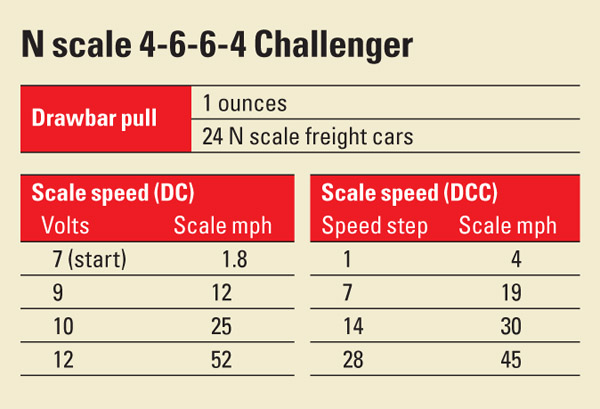
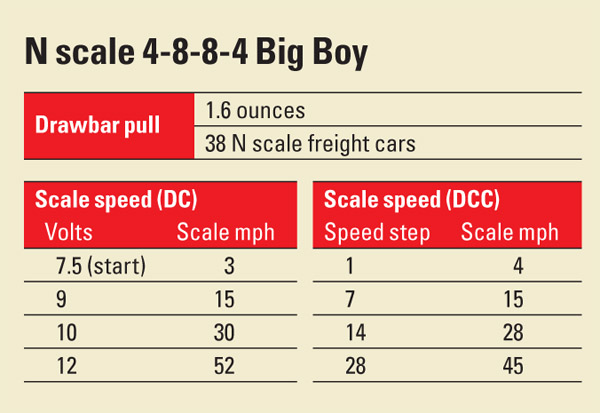
As you can see in the charts on the right, both models performed well in DC and DCC speed tests. The top speed is lower than that of the prototypes but is fast enough for most model railroads.
The Athearn models were impressive the first time around. The SoundTraxx decoder is a welcome enhancement and brings the Big Boy and Challenger to life in N scale.
Manufacturer
Athearn Trains
1600 Forbes Way, Ste. 120
Long Beach, CA 90810
www.athearn.com
Era: 1946 to 1951 (Challenger, no. 3977 as painted and detailed) 1941 to 1959 (Big Boy no. 4009)
Road names
Challenger: Union Pacific (2-tone gray or black, multiple road numbers), Clinchfield; Denver & Rio Grande Western
Big Boy: Union Pacific (multiple road numbers)
Features
- Dual-flyweel-equipped motor
- Electrical pickup on 8 drivers (Challenger) or 12 drivers (Big Boy) and 10 tender wheels
- Operating headlight and backup light
- SoundTraxx DCC decoder
- Magne-Matic knuckle coupler on rear of tender at correct height
- Minimum radius: 11″ (15″ or greater recommended)
- Traction tires on first drivers of front engine and last drivers of rear engine
- Weight of engine and tender: 6.7 ounces (Challenger), 7.7 ounces (Big Boy)