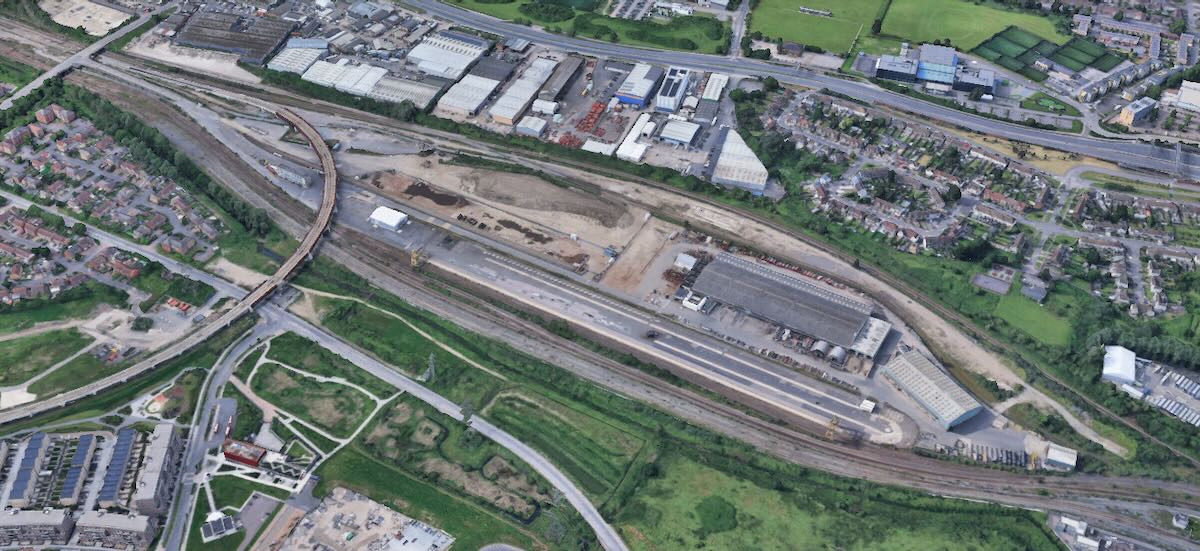
McKEES ROCKS, Pa. — CSX Transportation has closed its Pittsburgh-area intermodal terminal, which opened in September 2017 as the last major element of the National Gateway Initiative double-stack clearance project.
CSX touted the terminal’s ability to allow shippers in western Pennsylvania to shift freight from highway to rail. It initially served 40 destinations under the railroad’s hub-and-spoke intermodal strategy.
But hub-and-spoke was scuttled a few months after the Pittsburgh terminal opened as CSX aimed to reduce costs and boost intermodal profitability under then-CEO E. Hunter Harrison.
CSX funded construction of the $60 million intermodal terminal. It was the final component of the $850 million National Gateway project, which used a combination of federal, state, and CSX funding to raise clearances on the former Baltimore & Ohio main line linking the Midwest with points on the Mid-Atlantic.
The 70-acre terminal built at a former Pittsburgh & Lake Erie yard had a capacity of 50,000 lifts annually.
CSX in March reached an agreement with Shell to lease the terminal, which will be converted to a storage-in-transit facility, the railroad says.
Shell is building a massive petrochemicals complex 30 miles northwest of Pittsburgh. The ethylene cracker in Potter Township will produce 1.6 million tons of polyethylene annually.
The plentiful supply of cheap natural gas is driving increased plastics production in North America. Rail-hauled plastics traffic is expected to grow 3% annually over the next decade.
Plastic pellets typically are shipped in covered hoppers. On average, CSX earns more than five times as much revenue from a carload of chemicals than it does from an intermodal container.
Revenue for containers originating and terminating in Pittsburgh would be lower than the CSX average, however, because of relatively short hauls to and from the Steel City, which is less than 500 miles from Chicago and under 250 miles to Baltimore.
CSX’s intermodal network simplification, which resulted in low-volume Chicago interchange moves being made by rubber tires instead of steel wheels, likely contributed to the demise of the Pittsburgh terminal, intermodal analyst Larry Gross says.
“Pittsburgh would have been a different story if everything east-west was not grounded in Chicago for rubber tire crosstown,” he says. “Then length of haul would not be an issue and there would surely be enough traffic to support it. But once the western railroad’s traffic is grounded in Chicago, then the remaining move effectively becomes Chicago-Pittsburgh, 460 miles. They could make it work if they wanted to, but obviously the profit margin was regarded as inadequate.”
CSX’s network also was not well-suited to divert north-south truck traffic to intermodal to and from the Pittsburgh area, he notes.
“It would have been interesting if they had tried to support the terminal with a mixed train strategy,” Gross says. “Put the intermodal into the precision mixed train network and provide low-cost, slower but reliable transit times.”
CSX says it can serve Pittsburgh via other intermodal terminals.
“CSX continually reviews its system and makes regular service adjustments to meet evolving business needs. Customer shipments through the area will be rerouted to other lanes providing efficient, reliable intermodal service on the CSX network,” the railroad said in a statement.