

A local station agent-operator was the railroad’s representative who worked in the station. As the title implies, a small town agent-operator usually wore two hats. As an “agent,” he took care of the company’s financial business, selling tickets, arranging freight and express shipments, billing the customers, receiving payments, making bank deposits, and maintaining financial records. The “operator” (originally known as a telegrapher or telegraph operator) handled the operating paperwork related to train movements for the dispatcher. In busy locations, this job was often separated into two positions.
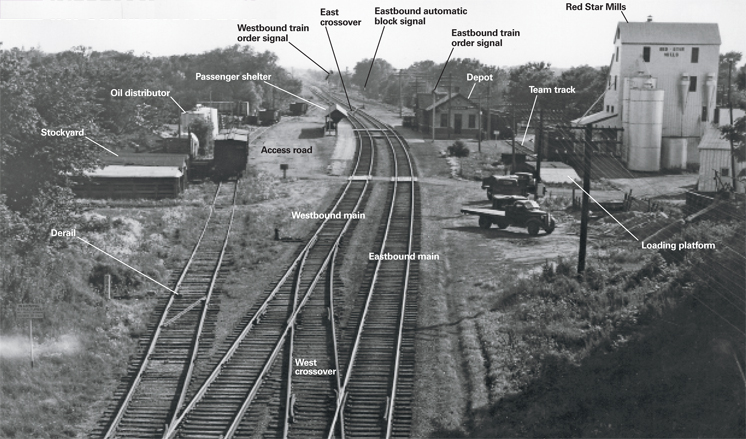
Corning, Iowa is a small town located on the former Chicago, Burlington & Quincy’s main line between Chicago and Denver. In railroad terms, it’s on the Creston Division at milepost 413 east of Omaha, Neb. According to a 1955 CB&Q employee timetable, this portion of the main line was double track, with a passenger speed limit of 79 mph and a freight maximum of 50 mph. The photo above, taken in the early 1950s, captured many typical features.
The depot was located on the south side of the tracks with a short passenger platform on the north side. According to the timetable, 16 first-class passenger trains passed through Corning daily, but only two had potential stops. It’s interesting to note that the night train had a scheduled stop when the depot was closed, but the daytime train had a conditional stop while the depot was open and the agent was present to flag the train for passengers.
In this double-track territory, CB&Q trains operated on the right-hand track following timetable and train order rules. Automatic block signals helped maintain the spacing between trains. One of these automatic block signals is just beyond of the east crossover. The eastbound and westbound train order signals (semaphores) are located on each side of the main tracks.
A double-ended siding diverges to the left from the westbound main. A derail with an angled safety rail is just beyond the switch. A pair of stockcars are spotted at a small stockyard, with an oil distributor just beyond. The far end of the track has a couple of gondolas with a pile of ties alongside. Crossovers were located at each end of the depot area. With appropriate permission from the dispatcher, a local freight could run around cars, or use the opposite main track to clear a scheduled train on this busy route.
A second double-ended siding loops behind the depot to serve as a team track where trucks can handle small shipments. An unloading platform was provided adjacent to the grade crossing.
The Red Star Mills elevator looks like it was one of the town’s largest customers. A driveway passes beneath the delivery canopy, while a loading spout angles down to load boxcars spotted on the adjacent team track.
The timetable also notes that Corning had another important feature that isn’t in the photo. It had a siding, 132 cars long, between the main lines in the straightaway just west of town. Manually operated turnouts at both ends allowed trains to enter this middle siding from either end “as the way is seen to be clear.” Then spring switches at the opposite ends allowed a train to depart from the passing siding and return to its proper main line without stopping.
Agency work
The agent regularly contacted his customers to inform them of arriving loads and gather orders for empty cars. He also inspected any empties that had been released by a customer and filled out a car condition report. He called his car orders in to a car distributor at a nearby yard so an appropriate car would be reassigned or sent out in the next day’s local freight. Later on, the agent made up a switch list so the local’s conductor would know what work needed to be done in town.
Meanwhile, he checked on any outbound loaded cars, closed the doors, applied the door seals, and prepared the waybills and other paperwork needed to get the cars picked up and on their way.
In short, the small town agents were the railroad’s primary salesmen. A good one was a major asset to the company and his customers, but someone who didn’t care usually didn’t last long.
For more information on modeling this era, see Model Railroader’s special issue How to model railroads of the 1950s. – Ed.