

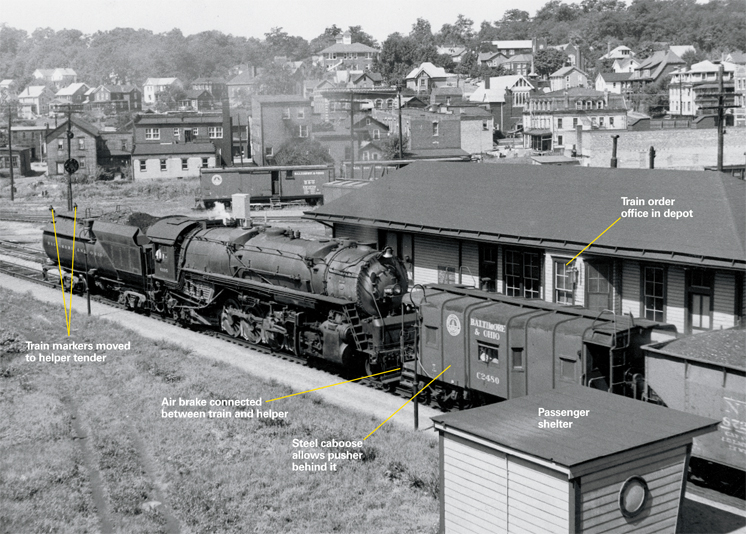
The lead engineer handled the train’s air brake while each helper engineer had an independent brake for just his engine. Two long blasts on the lead engine whistle (––) told the helper to release its brakes and proceed. The helper engineer repeated the two long blasts (––) in response and opened the throttle to push in the slack. Looking back, when the lead engineer saw or felt the slack bunch, he opened his throttle and began pulling the train. As the train moved along, the load was divided between the two so the lead engine was pulling the front portion and the helper was pushing the remainder.
The lead engineer controlled the train’s speed by how hard he was pulling, although most freight helpers moved relatively slowly. During the trip, the helper engineer paid close attention to how hard his engine was working and adjusted the throttle to maintain a steady push on the cars ahead. He also kept a close watch on his train line (air brake) pressure gauge.
A single whistle blast (o) indicated the lead engineer was going to stop, and a drop in the train line’s air pressure indicated a brake application was in progress. At that point, the helper engineer gradually reduced his throttle to keep working some steam to lubricate the cylinders, and then shut it off as the train slowed to a smooth stop.
Most railroads had specific safety rules covering the operation of a helper engine ahead or behind the caboose. In general, pushers could operate behind steel cabooses and wood cars that had heavy steel underframes. However, many of the older wood cabooses just weren’t built to handle the extreme forces of helper service, so any helper engine had to be cut in ahead of them.
Interested in modeling the steam locomotive era? Check out Detailing and Upgrading Steam Locomotives, available now on shop.trains.com! – Ed.