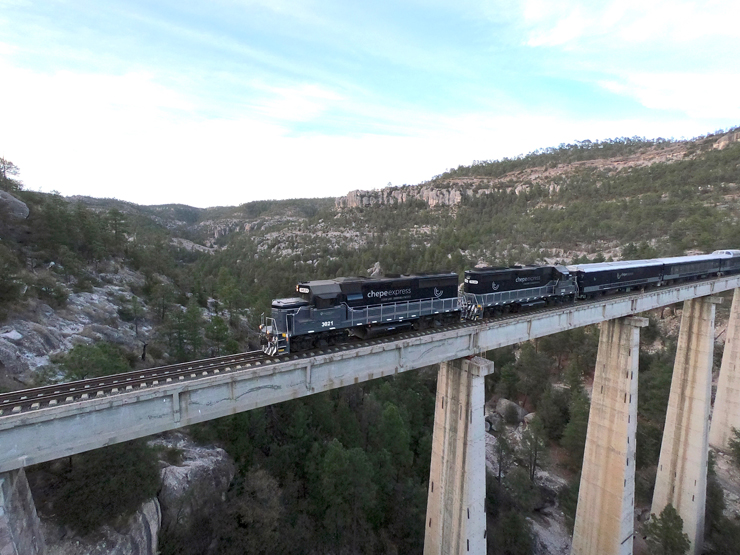
CHIHUAHUA, Mexico — The morning sun lights the glowing cliff walls of Las Barrancas del Cobre, viewed through panoramic windows on the newly refurbished Chepe Express as it winds through Mexico’s scenic Sierra Madre mountains. The Ferrocarril Chihuahua al Pacífico, better known as the Chepe, has served locals and attracted tourists to the Copper Canyon since 1961, but this luxury train is aimed at upmarket travelers.
“Last year we started remodeling a new set of cars,” says Rosalva Delgado Quiñonez, general manager for tourism at Grupo Mexico, which owns FerroMex, Mexico’s largest railroad. The new service debuted May 17, 2018 and served about 19,000 riders last year.
The Copper Canyon comprises six canyons in the state of Chihuahua, the deepest of which drops nearly 6,200 feet. Together, they are larger and deeper than the Grand Canyon. The region is home to indigenous communities, colorful towns, and rugged adventures, but for many, “The train is the main attraction,” Delgado Quiñonez says.
The full route, served now only by the Chepe Regional train, runs 406 miles from the inland city of Chihuahua to Los Mochis on the Gulf of California. The Chepe Express covers the most scenic 248 miles, from Creel to the coast. Along the way is the sharply-descending El Lazo loop, the horseshoe-curved La Pera tunnel, and the Chinipas bridge soaring 335 feet over its namesake river. Further west, the Agua Caliente Bridge over Rio Fuerte is the longest on the line at 1,637 feet. Tunnel 86 cuts more than a mile through bedrock.
The best place to view these wonders is from the last of the train’s six cars. Named Terraza, its rear end is full-width, full-height glass. The rear half of the car is lined with a bar-height counter and stools, ideal to sip a cocktail while taking in the landscape.
Ron Austin, who rode the Chepe Express with a friend last September, tells Trains News Wire, “After the sun came up and it started to get warmer, especially as we started our descent from the mountains, the staff lowered the windows on the Terraza car.” They spent most of their time there, “having drinks and enjoying the open-air views.” Train staff kept up “a running commentary of the sights we were passing that was both entertaining and informative,” Austin adds.
Two snack and drink bars serve passengers in the Terraza. The train also carries a bar car, which offers sofa-style lounge seating, high-tops, and seating at the marble-top bar. Expansive windows provide clear views.
The dome car, named Urike after the deepest canyon on the route, is the dining car. Menus range from eggs and burritos for breakfast and lunch to chicken, steak, and fish for dinner. Tables are available on both levels, and Austin took advantage of dining in the dome. Two coaches and baggage car complete the consist.
Executive-class passengers enjoy more legroom, complementary snacks and drinks, and access to the Terraza car. They also get first dibs on seating in the dining car. Since the total trip time is just 9 hours, no sleeping accommodations are available, and few people ride straight through.
The lure of a journey through the Copper Canyon encompasses local culture, art, and food. Passengers are encouraged to plan stopovers along the way. A typical trip would begin at Creel, a town of 5,000 set nearly 7,700 feet up in the Sierra Tarahumara. It’s the gateway to the Copper Canyon, replete with religious sites and indigenous crafts, and surrounded by pine forests. Western hotels and good restaurants welcome visitors.
The first stop west is Divisadero. It offers breathtaking views and can be the jumping-off point for outdoor adventure. Thrill-seekers will enjoy a zip line, rappelling down a cliff, or an ATV ride. Hikers can head out on marked trails.
A nearly 2-mile-long cable car ride offers magnificent views of the canyon and horseback rides are available. Indigenous families welcome visitors to learn about their culture.
At the end of the day, guests relax while watching the sunset from the restaurant at the Hotel Divisadero Barrancas.
El Fuerte, 7 hours further, makes for another good stopover. This colorful colonial town along a river clusters hotels and restaurants around a historic plaza. Known for its seafood and river delicacies, El Fuerte is one of the towns that draw foodies to the train. “You can make a gastronomy tour,” says Delgado Quiñonez.
At the western terminus is Los Mochis, a city of 250,000 reputed to be home to the best seafood in northern Mexico. Wildlife enthusiasts can visit a nearby dolphin sanctuary or view a rocky island used as a haul-out by seals and sea lions. Sinaloa Park is a hotspot for birders, as are Divisadero and El Fuerte.
The Express runs year-round, alternating daily with the Chepe Regional service, which mainly serves locals. Chepe Express passengers need a different ticket for any portion of the route they ride on the Regional train, which can be arranged when reservations are made.
Delgado Quiñonez says they rely on social media and press coverage to promote the Chepe Express, and work with tour operators, travel agencies, and hotels. In conjunction with Mexican government tourism agencies, they participate in trade shows and magazine advertising. But, she says, “the best promotion is mouth to mouth.”
The busiest travel times are the two weeks surrounding Christmas and Easter, and July through August. During the rainy season — July to November — rivers run strongly, waterfalls are dramatic, and landscapes are deep green. March through June is generally dry. Winter brings cold and a chance of snow in the higher elevations.
Reservations should be made at least four months in advance for travel during the high season, and because hotels are limited in Creel, Divisadero, and El Fuerte, planning ahead is important. A one-way executive (first) class ticket on the Chepe Express is 6,000 pesos, or about $300. Tourist class is 3,743 pesos or just under $200. Fares and schedules are subject to change. More information is available at the Chepe website, which has Spanish and English versions.
“The Chepe Express is a fantastic experience,” Austin says.