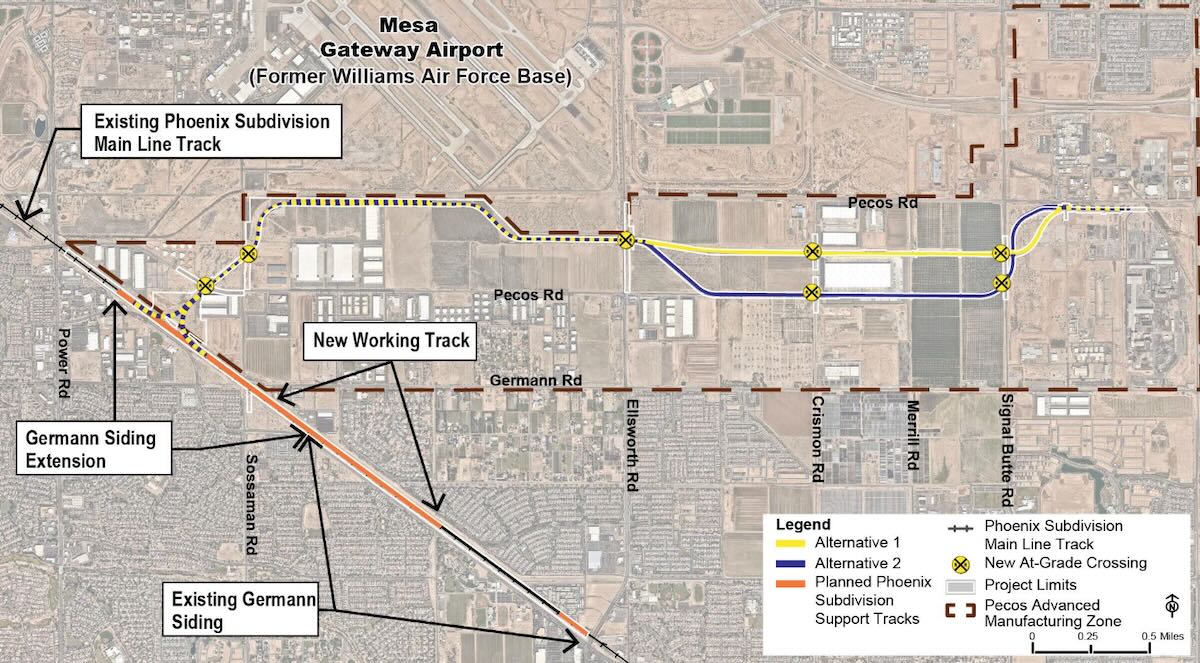
WASHINGTON — The Surface Transportation Board on Friday, March 13, approved Union Pacific’s plans to build 6 miles of new rail line in Maricopa County, Ariz., a project that had been delayed because of concerns over damage to archaeological sites along the right-of-way.
The Pecos Industrial Rail Access and Train Extension project, or PIRATE, will connect UP’s Phoenix Subdivision to an industrial park, the Pecos Advanced Manufacturing Zone, near Phoenix-Mesa Gateway Airport. A steel micromill that would be served by the line has been open since October 2023.
Last month, the STB’s Office of Environmental Analysis determined that its earlier environmental assessment for the project remained valid and issued a Final Environmental Assessment, which determined the project would not have significant environmental impacts. It also recommended actions to mitigate any impacts [see “Proposed Union Pacific branch …,” Trains.com, Feb. 27, 2026]. The board’s unanimous decision accepted the OEA’s analysis and exempted the project from a full environmental impact statement.
“While UP’s posture and conduct during the course of this proceeding have raised serious concerns, the board concludes that, based on the record, the proposed construction and operation of the Line qualify for an exemption under section 10502,” the STB wrote in its decision. “The transportation merits of UP’s petition are unopposed.”
Union Pacific, which has repeatedly expressed frustration over the regulatory delay, welcomed the board’s action.
“We’re pleased with the decision,” the company said in a statement to Trains, “and look forward to continuing to closely work with the STB and local community to make sure the project is implemented in a way that honors the area’s culture.”
Board review of the project, which dates to June 2022, was paused in August 2023 after the Tohono O’odham Nation requested it be placed on hold to assess the damage along the right-of-way [see “Regulators pause environmental review …,” Sept. 1, 2023]. UP said then that landowners adjacent to the railroad property had entered without permission, and the damage was from construction unrelated to the rail line. The railroad asked those landowners to halt work on UP’s property, hired security, and fenced its land.
Little movement followed, and UP pressed the board for action on the project in October 2024 [see “Union Pacific seeks update …,” Oct. 3, 2024]. It and steelmaker Commercial Metals Co. also requested a decision late that year [see “Union Pacific and steelmaker urge STB …,” Dec. 19, 2024].
In between those requests, the board, during Robert Primus’ tenure as chairman, sought additional information from UP and took the railroad to task, saying it needed to “respond with greater clarity and accuracy.” [See “Regulators scold Union Pacific …,” Nov. 14, 2024]. Primus had the harshest words, saying the matter was “another example of UP’s inability to adhere to the board’s guidelines and provide timely and appropriate responses to board orders.”
Primus was fired by President Donald Trump in August 2025; his lawsuit to regain his position is pending. Since his firing and the earlier retirement of former Chairman Martin J. Oberman, the board has operated with three members rather than its full complement of five.
— To report news or errors, contact trainsnewswire@firecrown.com.
Share this article