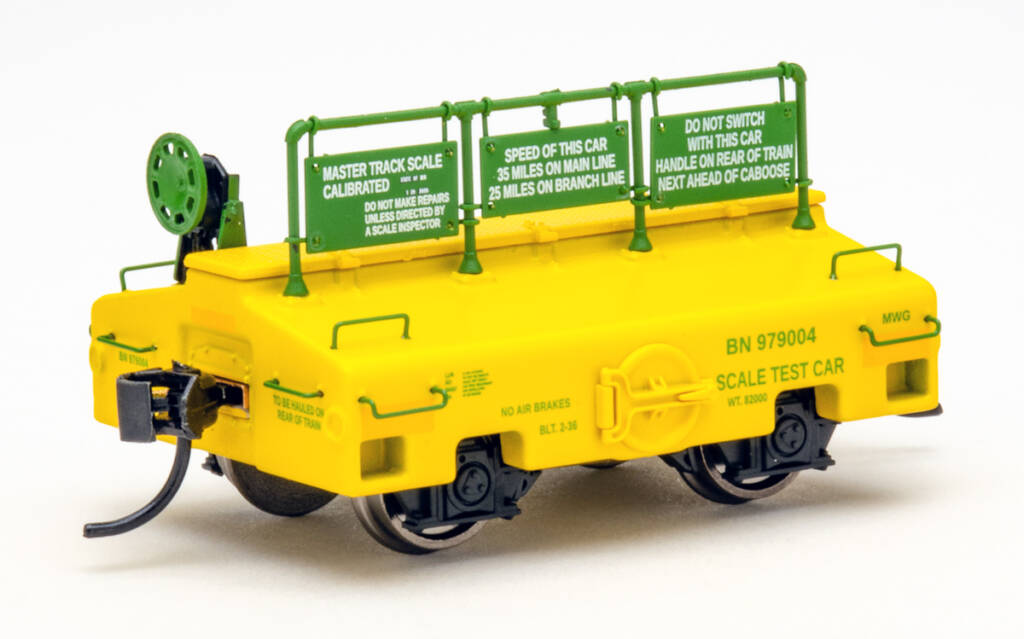
A scale test car was recently released by Wm. K. Walthers Inc. The HO scale model, part of the manufacturer’s Proto range, features die-cast metal construction, prototype-specific details, and Proto-Max metal couplers.
Prototype history
Scale test cars are used in the calibration of track scales found at on-line customers. The WalthersProto model follows the lines of a prototype test car developed by American Car & Foundry and the Pennsylvania RR in the 1920s.
The heavy, short-wheelbase cars don’t have air brake equipment, so they require special handling. In the caboose era, they were put between the caboose and last car of the train. Speeds are reduced to between 25 and 35 mph when a scale test car is present in a train. Some railroads put scale test cars on flatcars for transport between locations to avoid these speed restrictions.
The sample we received is decorated as Burlington Northern 979004. The full-size scale test car was built in February 1936. The 90-year-old car is still in service on BN successor BNSF Ry.
Model features
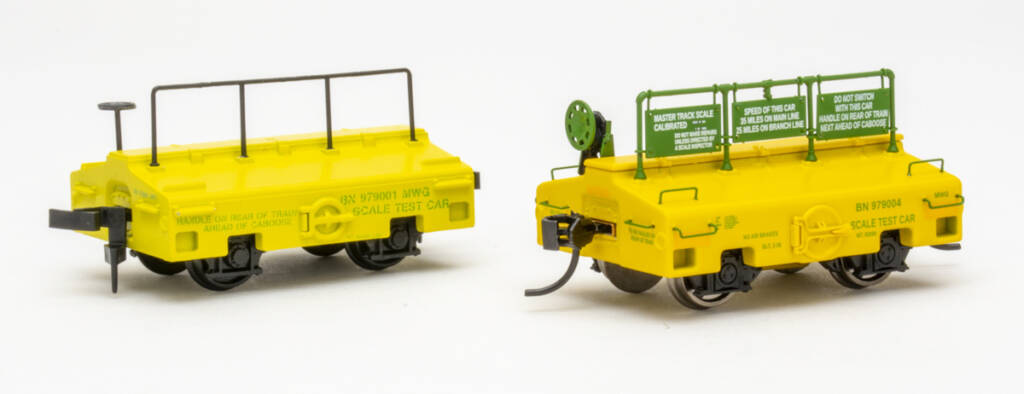
The WalthersProto scale test car shouldn’t be confused with the injection-molded plastic kit that the manufacturer released back in the 1990s [A review of that model can be found on page 45 of the June 1994 Model Railroader. — Ed.] The new version has a die-cast metal body, which accounts for much of the car’s 2.7 ounces of weight. It also has factory-installed wire grab irons and 33″ metal wheels.
I appreciated that the WalthersProto model doesn’t have one-size-fits all details. The car is offered with two different hand brakes, two different top access doors, and three different side access doors. The BN car we received is equipped with a power hand brake, replacement top cover, and round side doors with a release latch bar.
As someone who owned the kit version of the scale test car back in the 1990s, I was thrilled that the BN car (and many of the road names offered in the initial release) has photo-etched brass placards. The lettering matches prototype photos from 2008 through 2010.
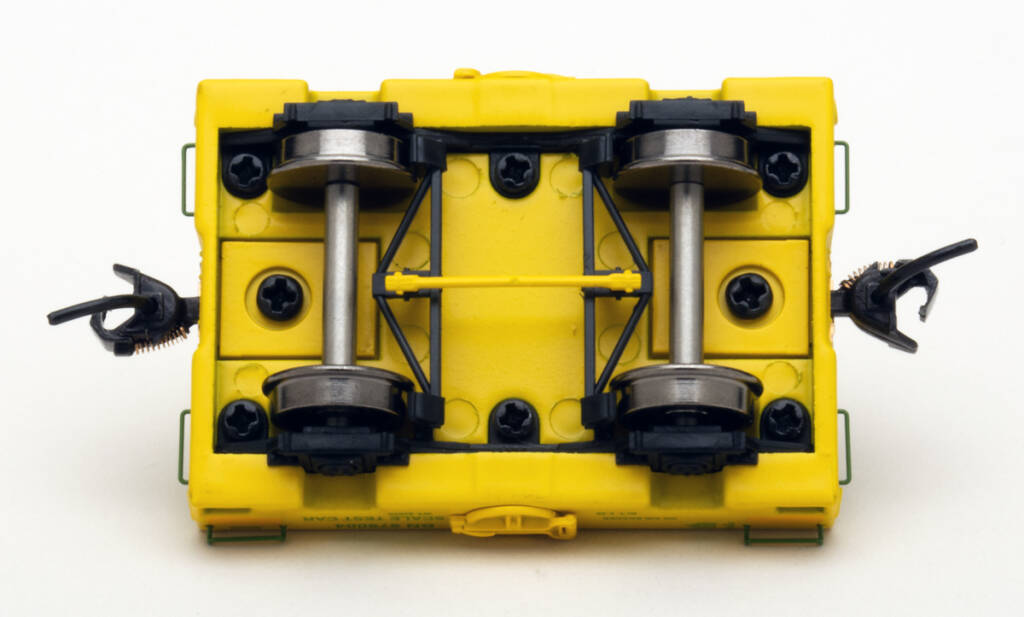
Underneath, the car has a pair of plastic wheel pedestals, both attached with three screws. Perpendicular to the pedestals are plastic brake beams with brake shoe detail. There’s also a freestanding truck brake lever.
A double-sided 8-1/2 x 11 sheet included with the model has a brief history of the car and exploded-view diagrams showing the various parts.
Model vs. prototype
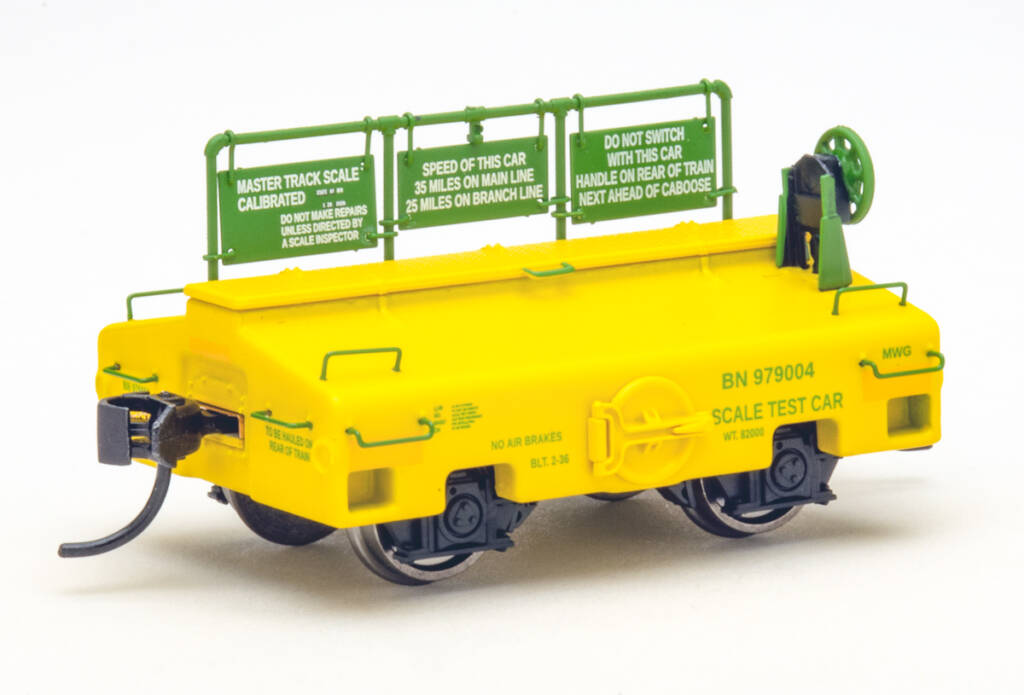
Our review sample is neatly decorated in BN’s yellow and green paint scheme. The paint is smooth and evenly applied, which isn’t always an easy task with light colors like yellow.
For the most part, the details match prototype photos. The power hand brake should be rotated 90 degrees clockwise so it’s parallel to the side of the car. There should also be a pair of extra grab irons on the left side of the car. I didn’t see the small green handle for the top access door in prototype images.
The model lacks uncoupling levers. Stencils on the car ends that read To Be Hauled On Rear Of Train should say To Be Hauled In Rear Of Train.
Drawings of the scale test car were published in the 1937 Car Builders Cyclopedia of American Practice (Simmons-Boardman Publishing Corp.) The model’s major dimensions match published data.
To see how the car performed in an operating layout environment, I put it ahead of the caboose in a train on our Winston-Salem Southbound. The model ran without issue, navigating a No. 4 turnout and 30-degree crossing.
The WalthersProto scale test car is a huge leap forward from the kit offered more than 30 years ago. Die-cast metal construction, prototype-specific details, and metal wheels and couplers bring this car up to modern standards. Whether just ahead of a caboose on the local, loaded on a flatcar, or spotted at an industry with a track scale, this diminutive car will certainly be an attention getter.
Facts & features
Price: $56.98
Manufacturer
Wm. K. Walthers Inc.
5601 W. Florist Ave.
Milwaukee, WI 53218
walthers.com
Era: 1920s to present (varies based on paint scheme)
Road names: Burlington Northern, Archer Daniels Midland, Canadian National, Chessie System, Conrail, data only, Rock Island, and Union Pacific.
Features
• 33″ metal wheelsets, in gauge
• Body-mounted Proto-Max metal couplers, at correct height
• Weight: 2.7 ounces, .8 ounces too heavy per National Model Railroad Association Recommended Practice 20.1