BERN, Switzerland — The Swiss Federal Office of Transport has announced new regulations for freight wagons in the country. The new regulations include measures such as minimum wheel diameters, more frequent maintenance schedules, and optimized wagon inspections. Operators and fleet owners have until the end of 2025 to comply with the new rules.
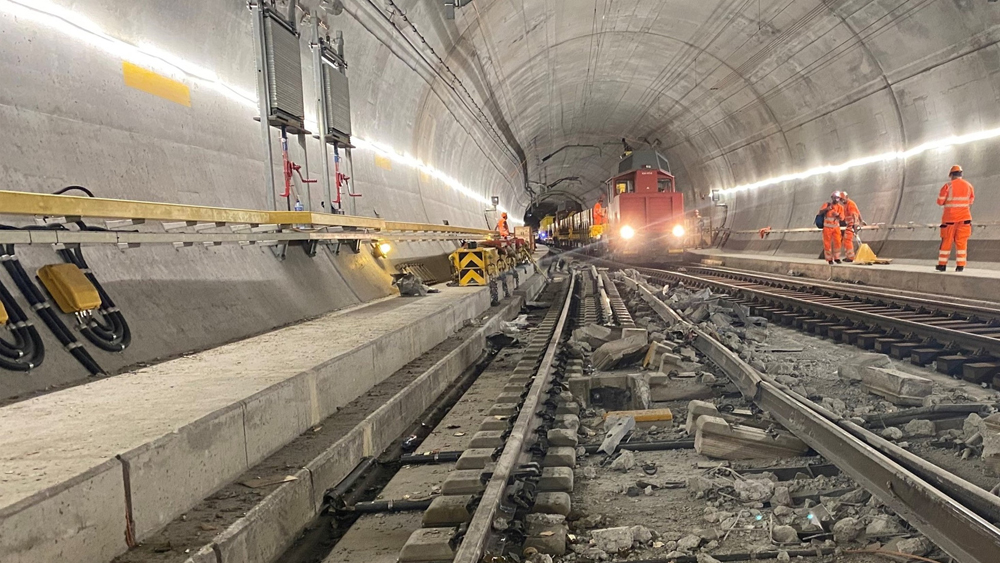
The regulations are based on recommendations from the Swiss Transportation Safety Investigation Board following its investigation of the Aug. 10, 2023 Gotthard Base Tunnel derailment. The derailment caused significant damage to the tunnel, closing the trans-Alpine route for nearly 13 months.
Significant provisions in the new regulations include:
Minimum wheel diameter will be 864 mm (34 inches). The broader European standard is 860 mm (33.86 inches).
Wagons will now be technically inspected more frequently with the interval reduced to 50,000 km to 200,000 km (31,068 to 124,274 miles) depending on type of brakes and wheel diameter. Inspections are to include a visual wheel test, a percussion test to detect defects, and a check for damage and overheating.
A valid technical inspection certificate must be maintained to verify regulation compliance before a wagon is operated in Switzerland.
Wheels that have overheated will now have a colored strip applied indicating the thermal stress.
Train drivers will receive instructions on handling practices that will minimize the risk of wheels overheating.
The new regulations are designed to improve rail safety, says the FOT. Wagon owners, however, fear excessive compliance costs and freight moving away from rail to trucks.
The International Union of Wagon Keepers (UIP), a leading industry association, warned that the regulations could lead to a European rail freight traffic meltdown, citing the added costs wagon owners will incur. UIP has described the new requirements as shocking, stating that they could lead to significant economic disruption and added costs for wagon owners. Verband Private Eisenbahnen-Innungen (VPI), a German wagon-owners group, estimates costs could add up to “hundreds of millions annually.”
Verband der verladenden Wirtschaft (VAP), the Swiss wagon-owners’ association, agreed, calling the new regulations as wrong and dangerous. VAP, while stating safety is a top priority, also argued that the regulations may move freight traffic from rail to road, resulting in supply chain bottlenecks.
Concerns have also been raised that the new rules focus solely on freight wagons and do not include infrastructure. The STSB’s report stated failed infrastructure did play a role in the Gotthard Base Tunnel incident. Additionally, wagon owners have expressed concern that the Swiss regulations were enacted unilaterally without discussion across its borders. The European Union Agency for Railways (ERA) already has guidelines for mitigating the risk of broken wheels. Switzerland’s new regulations disregard these measures, raising concerns about the potential for fragmentation within the European rail network, says Travel and Tour World in a recent report.
It is certain that both regulators and wagon owners will be monitoring Swiss rail traffic to gauge the impact of the new rules as the Dec. 31, 2025, implementation deadline approaches.
Share this article