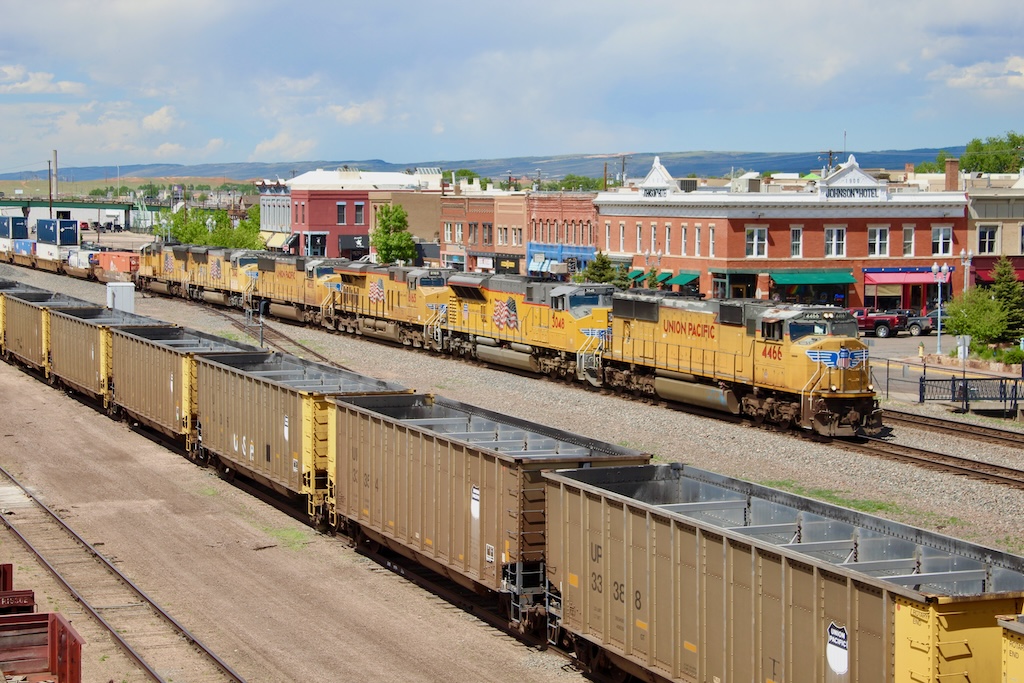
OMAHA, Neb. — Union Pacific will launch faster domestic intermodal service next month linking California’s Inland Empire with Chicago.
UP says the new high-priority Z-train service between its Inland Empire Intermodal Terminal and Global 2 in Chicago will be up to 20% faster “than current industry options,” with a transit time of just over three days.
“As we continue expanding IEIT, this service will deliver consistent, reliable, and truck-competitive transportation, challenging the norms of over-the-road shipping and competing head-to-head with team driver truck services,” Kenny Rocker, UP’s executive vice president of marketing and sales, said in a statement.
A BNSF spokesman says the railway’s fastest Z-train schedules from San Bernardino, Calif., to Chicago are 49 hours.
UP’s new trains will launch on Sept. 3, initially offering service five days per week. The hotshots will run on the LA&SL from the Inland Empire to Salt Lake City, and from there to Chicago via the Overland Route.
The faster schedule is among several UP has launched since Jim Vena became CEO in August 2023. UP has slashed transit times by two days for its premium domestic Z trains that link Southern California with Chicago. It also took a full day out of the Eagle and Falcon Premium service that links Mexico with Chicago and, via Canadian National, Detroit and points in Canada.
UP opened the Inland Empire terminal in 2021 with a capacity to handle 45,000 lifts per year. The terminal, adjacent to the West Colton hump yard, has since been expanded to 120,000 annual lifts.
The Inland Empire terminal location is key for UP. Containerized imports are trucked from the ports of Los Angeles and Long Beach to Inland Empire warehouses for transloading into domestic containers before riding the rails to inland destinations.
The West Colton terminal is within 10 miles of most of the 625 million square feet of warehouse space in the Inland Empire. Previously, UP’s nearest terminal in the Los Angeles Basin was 37 miles away at City of Industry.
By reducing the dray distance, the Inland Empire Intermodal Terminal reduces customers’ costs and allows UP to compete more effectively with BNSF’s busy — and much larger — San Bernardino intermodal terminal just a few miles away. San Bernardino handles more than 2,000 containers per day, or more than 730,000 annually.
Share this article