

COOS BAY, Ore. — The Oregon legislature has approved $100 million in funding for the Port of Coos Bay project to develop a new ship-to-rail container terminal, the port announced this week.
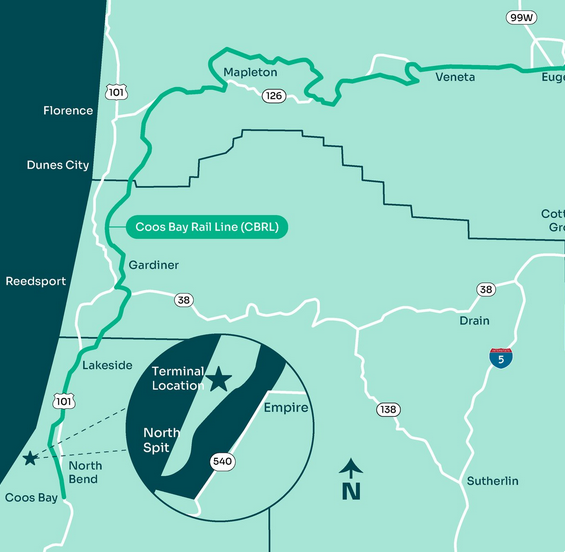
The Pacific Coast Intermodal Port would see containers loaded directly from ships on to trains, which would then move via the port’s Coos Bay Rail Line to Eugene, Ore., where they would interchange with Union Pacific for delivery to Midwest destinations. The new facility, with a projected capacity of 2 million TEUs, or 20-foot-equivalent units, also involves dredging the Coos Bay Federal Navigation Channel to accommodate larger ships and extensive upgrades to the 134-mile Coos Bay Rail Line.
The project has previously received some $58 million in federal funding, including a $25 million Infrastructure for Rebuilding America, or INFRA, grant from the Department of Transportation [see “Coos Bay, Ore., port receives …,” Trains News Wire, Oct, 19, 2024]. The development of the new 175-acre terminal is a partnership between the Port of Coos Bay and Kansas City-based NorthPoint Development.
“This project is about building something real and lasting — not just for the region, but for the working people of Oregon,” Chad Meyer, CEO at NorthPoint Development, said in a press release. “It reflects the power of public-private collaboration, and we’re grateful for the confidence the Legislature has placed in us. Together, we’re bringing modern logistics capacity to the South Coast in a way that benefits the entire country.”
The intermodal port is projected to generate more than 2,600 construction jobs, 2,500 permanent direct jobs, and as many as 8,000 jobs total, while potentially generating more than $59 million in annual income tax revenue for the state.
Share this article