
CSX operations chief says transformation remains on target NEWSWIRE

CSX operations chief says transformation remains on target NEWSWIRE

By Bill Stephens | July 12, 2017

| Last updated on November 3, 2020


Get a weekly roundup of the industry news you need.

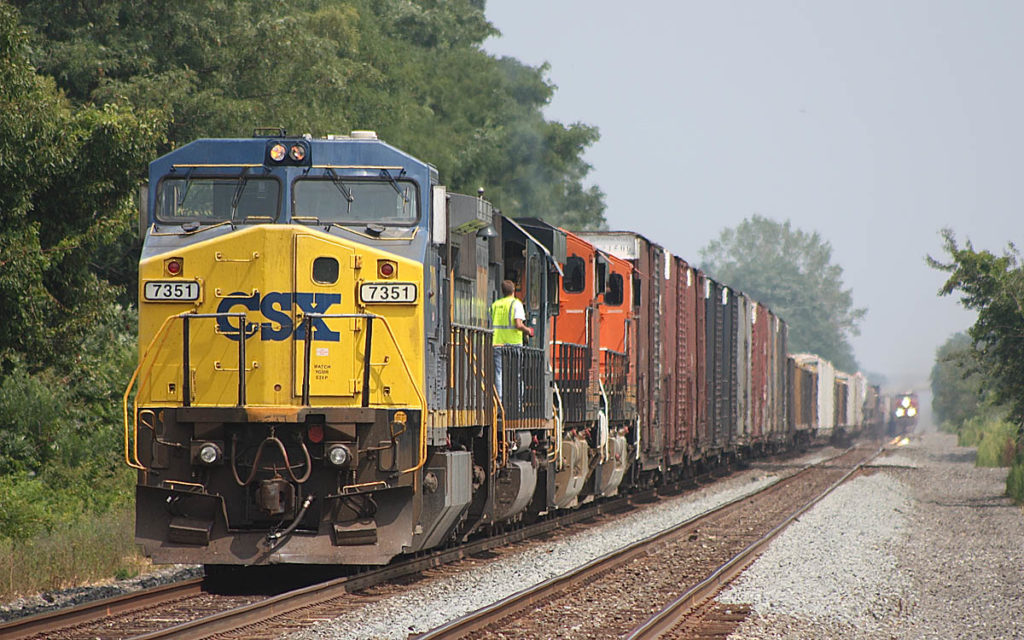
CSX_7351
A lower priority train waits out the passage of a group of higher priority trains rolling through a work zone near North East, Pa., in August 2010.
Marcus W. Stevens
JACKSONVILLE, Fla. – The implementation of precision scheduled railroading continues to drive operational improvements at CSX Transportation, even if the results are not reflected in weekly performance figures.

CSX’s terminal dwell increased 8 percent in June, while average train speed decreased 4 percent, according to metrics the Class I railroads are required to report to federal regulators.

But what the performance measures don’t show, Chief Operating Officer Cindy Sanborn tells Trains News Wire, is how CSX has slashed transit time by reducing the number of times cars are handled en route.

“What you don’t see are the cars that used to go into that terminal…but don’t go into the terminal anymore,” Sanborn says.

So although dwell may have inched upward to 26 hours, when a car is handled just once en route – instead of twice – it is still arriving at its destination a day faster than before. That reduces costs for shippers, Sanborn says, particularly those who can reduce the size of their private car fleets as cycle times improve.

CSX has cut transit time by nearly a day for scheduled merchandise loads since E. Hunter Harrison became CEO in March. The railroad says it’s also providing more consistent service, with on-time arrivals up 36 percent between March and early June.

CSX won’t release current on-time performance figures until next week as part of its quarterly earnings report. But Sanborn says on-time performance has held steady. As of June 10, 89 percent of trains departed on time, while 79 percent arrived on schedule.

Minimizing car handling is one of the central elements of precision scheduled railroading. Converting seven of the railroad’s dozen hump yards to flat-switching facilities is part of the sweeping changes CSX is making to its operating plan.

The goal is not necessarily to shut down humps, but to speed transit times. “That’s the real mission,” Sanborn says.

Previously, road trains would pick up blocks of traffic bound for the nearest hump yard, where the traffic would be classified.

Now, Sanborn says, only traffic that needs to go to the hump or former hump yard is set off there. Locals still pre-block traffic for the nearest hump yard, but they also build blocks for additional destinations. Road trains then pick up those blocks, which are then block-swapped or switched closer to their ultimate destinations.

The result is faster, more consistent transit times, Sanborn says. “We’ve made a lot of progress,” Sanborn says.

But she cautioned that the improvements won’t necessarily come at a steady pace and that it’s not possible to extrapolate from week-to-week or even month-to-month changes in metrics like velocity and dwell. “We’re not going to see a straight line in measurements,” Sanborn says.

“You’ll find there will be bumps in the road,” she adds, noting that’s to be expected when changes are rolled out. “They don’t always go exactly as you want.”

The operations team then tweaks the plan a time or two to work out any kinks, Sanborn says.

CSX remains in the early innings of implementing precision scheduled railroading.

The operations team is currently focused on balancing daily traffic flows, partly by shifting some unit train traffic into merchandise service. The goal is to operate the same number of trains in each direction on every corridor, Sanborn says. This improves locomotive and crew utilization by reducing deadheading moves. It also allows CSX to provide daily service.

The railroad continues to refine its operating plan in an effort to move the same amount of tonnage on fewer trains, which cuts costs and reduces congestion.

Tilford
Newly painted hump power begins to break down a train at the now-closed Tilford Yard in Atlanta in October 2014.
Frank Orona
Share this article