

WASHINGTON— Amtrak’s independent Office of Inspector General and the U.S. Government Accountability Office have issued separate reports within the last week that address courses of action Amtrak, state agencies, and the Federal Highway Administration might take to reduce injuries and deaths associated with train strikes of vehicles and pedestrians.
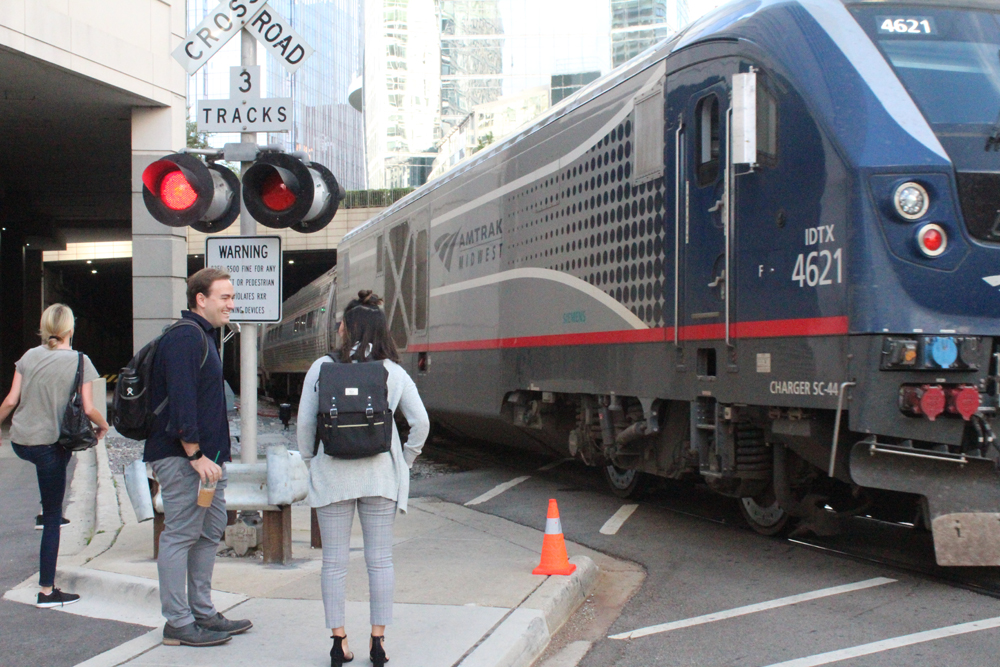
The Amtrak Inspector General’s 28-page report, “Safety and Security: Company is Taking Steps to Address its Risk of Train Strikes but Does Not Have a Comprehensive Risk Management Process,” covered fiscal years 2020 through 2023. During that period, Amtrak trains were involved in approximately 800 train strikes of vehicles or pedestrians, leading to 594 deaths and 279 injuries.
Most of the fatalities involved highway crossing collisions with vehicles and trespassers. The majority of injuries occurred on one day, June 27, 2022, when 146 passengers and crew aboard the eastbound Southwest Chief were injured after the train struck a dump truck and derailed at a rural crossing near Mendon, Mo. [See “Design of crossing contributed…” Trains News Wire, Aug. 2, 2023.]
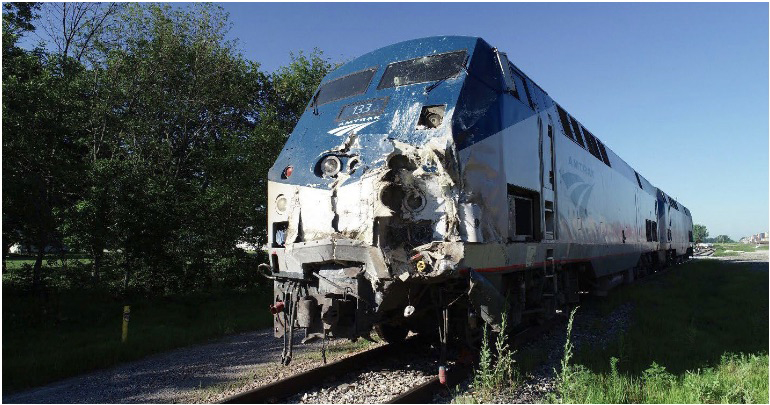
While acknowledging that most passenger train strikes occur on tracks of host railroads, which are responsible for safety assessment and implementation, the Inspector General found Amtrak could better identify and manage the risk of incidents and more broadly adopt key practices to improve risk management. The company often partners with Operation Lifesaver’s national outreach effort, and its representatives visit communities when service is poised to increase. Such proactive efforts preceded the start of the Chicago-St. Paul, Minn., Borealis, and test runs for the yet-to-launch Gulf Coast service between New Orleans and Mobile, Ala.
During the four-year audit, Amtrak launched a highway crossing “hazard index” which uses factors such as the type of warning device installation, traffic volume, and train speeds to categorize crossings based on the likelihood of train strikes. It also developed a grade-crossing safety manua,l and is exploring artificial intelligence tools and a near-miss reporting system to help better identify trespassing hot spots.
Even so, the report concluded that the company needed to implement a process that would systematically document, assess, and prioritize dealing with risks.
The Government Accountability Office study, “Improvements Needed to Federal Technical Assistance About Pedestrian Projects Related to Trespassing,” tracked grade-crossing enhancement programs from 2019 through 2023. With 1,900 incidents nationwide in 2023 alone, it found that increased funding and use by states of the Federal Highway Administration’s Railway-Highway Crossings Program primarily helped finance warning device upgrades and address overall safety risks, but the overall number of projects utilizing the program steadily declined from 1,626 to 866 during the four-year period.
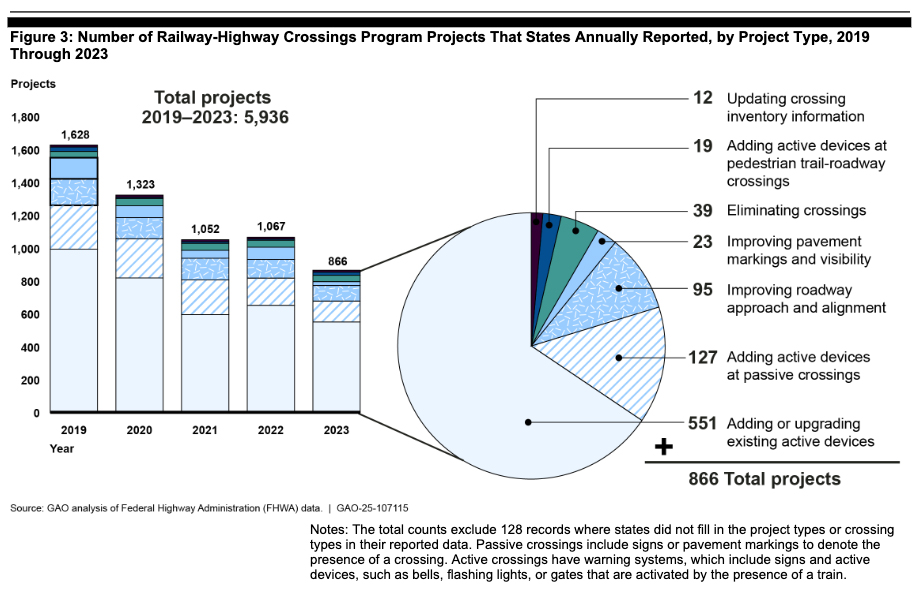
The drop was attributed to supply chain issues and a 25% increase in project costs by highway officials managing programs in six states the GAO investigated in depth: Alabama, Delaware, Florida, Indiana, Texas, and Washington.
Although the number of grade-crossing accidents has plateaued over the last several years, the share of incidents involving pedestrians has increased. Changes in 2021’s Infrastructure investment and Jobs Act increased potential federal reimbursement from 90% to 100% of eligible project costs, removed the 50% set-aside funding requirement to improve protective devices, and emphasized that projects designed to reduce fatalities and injuries of pedestrian trespassers at grade crossings are eligible for funding.
But the GAO found the Federal Highway Administration needed to provide more technical assistance materials, and update them to add information about the types of pedestrian projects related to trespassing that might be eligible for funding. This could include providing examples of noteworthy projects related to trespassing that would better position states to address rising pedestrian fatalities at grade crossings.
However, neither report attempted to specifically address suicide prevention efforts, an increasing focus at many commuter rail and transit agencies, as Federal Railroad Administration data confirming such events has recently become more definitive.
Share this article