

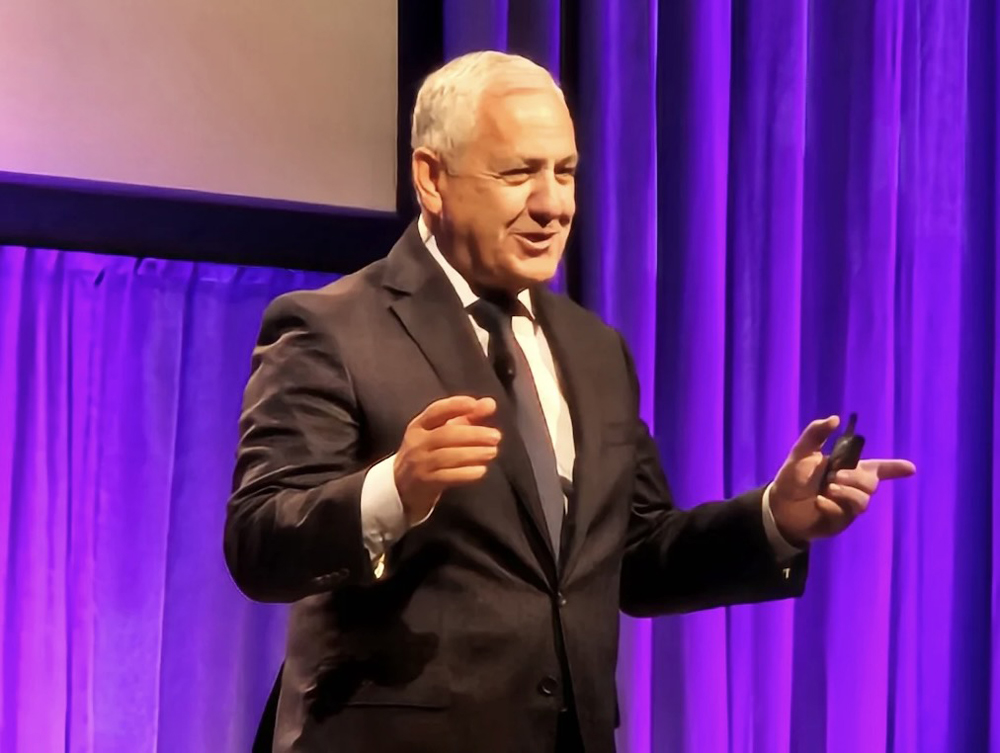
DENVER — Union Pacific CEO Jim Vena says his company will work through tariff shocks gripping the economy the same way it worked through the pandemic.
“I can’t control what governments do,” Vena said Monday (April 7) as keynote speaker at the annual conference of the American Short Line and Regional Railroad Association. “It’s noisy, it’s a son of a gun. But we can get through this the same way we got through the tech bubble and COVID.
“I’m very comfortable going through all this.”
Vena said that pursuant to tariffs, the United States needs to have the capacity to make the products that are needed for national defense. But, he emphasized that the fundamentals of running a railroad haven’t changed.
“We need to be efficient and watch the money. We need to go after products that are now in trucks and move them in different ways,” a feisty Vena declared.
“If you don’t like me, I don’t give a s—.”
Vena, a disciple of precision scheduled railroading who came out of retirement in 2023 to succeed Lance Fritz, has UP leading Class I railroads in most financial and performance categories. He said his company’s strategy is built around safety, service, asset utilization, cost control and people. He was quick to note that the railroad in 2024 saw a 22% reduction in injuries and 26% decline in accidents.
Vena said technology has helped UP reduce total walking by yard crews from about 6-7 miles a day several years ago to the current 2 miles per day.
Union Pacific works with more than 180 shortline and regional railroads, and Vena told the conference that the objective is the same: Customers want high levels of service. Up to one-quarter or more of UP’s traffic lanes are touched by a carrier other than UP. “We get 2 million cars from short lines or ports each year,” he said.
The top markets for UP via short lines are grain products, construction materials, and forest products, while industrial products are almost half of short lines’ business mix. Volume grew 4% over the previous year, with total carloads accounting for 25% of total volume among the Class I railroads.
UP has made two notable deals with short lines in the last five months. In December, it leased 28 miles of track in the Eugene, Ore.,, area to Genesee & Wyoming’s Central Oregon & Pacific Railroad [see “Central Oregon & Pacific will operate …,” Trains News Wire, Dec. 11, 2024]. In March, UP leased land and track in Kansas City, Mo., to Jaguar Transport Holdings, which will operate the new Kansas City West Bottoms Railroad [see “Union Pacific to lease 1.25 miles …,” News Wire, Feb. 20, 2025].
“That’s just the start,” said Vena. “I think we can grow our business by partnering with companies that can help us grow the biz, remove inefficiencies, and drive value to customers. When it comes to short lines, the baseline has to be that you do a better job than a Class I. The short line has to be much more efficient, costwise, than a Class I. But short lines can have a better relationship with a customer because they work in a community at the local level, and grow the business that way.”
While he was sanguine about tariffs and trade, Vena, who started railroading in Canada and is now a U.S. citizen, had sharp words for the Trump administration’s rhetoric where that country is concerned.
“You want to p— off a country? Tell them they’re the 51st state. Or call the prime minister a ‘governor.’ It just doesn’t go good. I still have a little place on a lake in British Columbia. It’s a great country. They’ll get over it. But it’s not good when you miss the point and call them something you shouldn’t call them.”
— This article originally appeared at FreightWaves.com.
Share this article