

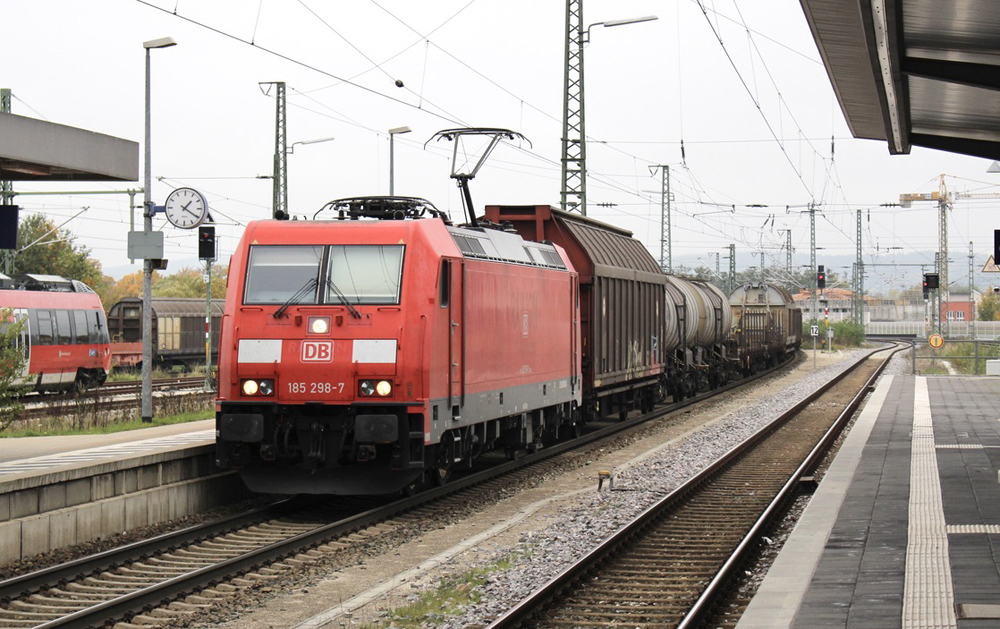
BERLIN — The head of the freight subsidiary of German national rail company Deutsche Bahn is calling for the end of single-carload freight operations, saying such traffic is not profitable.
“I cannot afford a permanent loss-making operation,” Sigrid Nikutta, CEO of DB Cargo, told DPA, the German Press Agency. “Either we succeed in making single-wagon transport financially viable in Germany, or we cannot continue to operate it in this form.”
Much of Europe’s rail freight is focused on unit transport of commodities, but carload freight remains significant for some commodities, such as steel and chemicals. Because this loose-car traffic is not believed to be economically feasible, it is subsidized by the German government. DB Cargo, which dominates such traffic, believes it does not receive sufficient government funding, and so is seeking an increase to the subsidy.
“I have clear guidelines — from Brussels, from Germany, and from the supervisory boards: DB Cargo must become profitable,” Nikutta said.
In the past, state-owned rail companies have often covered freight losses by transferring funds from other subsidiaries, but with those companies competing against private operators, the European Union considers this to be unfair government aid [see “European rail freight to see major changes …,” Trains News Wire, Jan. 2, 2024]. Under EU Commission rules, the company must be profitable by 2026, and it is coming off a loss of more than €350 million ($383 million) in 2024.
The company has undertaken cost-cutting moves, announcing a restructuring last year that includes elimination of 2,300 jobs and establishment of new business units. By 2029, DB Cargo aims to eliminate 5,000 of its 31,000 jobs.
At the same time, the freight operation is feeling the effects of an economic downturn, seeing a 10% to 15% decrease in volume in the first two months of 2025. And the tariffs imposed by President Donald Trump are likely to impact import and export traffic. “We are both at the beginning and the end of the supply chain,” Nikutta said, “and we are clearly feeling this.
If the company cannot reach profitability, it could face restructuring or repayments ordered by the EU Commission. But, because of its lack of profitability, it would be unable to make repayments itself or draw from other parts of DB. It would then have to take out loans.
— Updated April 10 at 11:45 a.m. to correct photo location.
Share this article