

Second of two parts
Two companies, Dreamstar Lines and Lunatrain, are seeking to revive U.S. interest in overnight train travel, noting the resurgence of such trips in Europe. Part one of this analysis (available here) looked at Dreamstar, which is focused on service between Los Angeles and San Francisco. Today, part two looks at Lunatrain, which recently announced its intent to develop operations in the Northeast and beyond.
Initial focus: the Northeast Corridor

A Trains News Wire conversation with Philadelphia-based Lunatrain founder and entrepreneur Mike Avena finds he intends to initially focus on multiple Boston-Washington opportunities where Amtrak already provides service. His vision for Lunatrain also involves building a new fleet of sleeping cars. “Dreamstar is seeking a luxury train — very high-end. We’re looking at something with broad appeal that everyone can afford. And it will have to be new, not retrofitted,” Avena says.
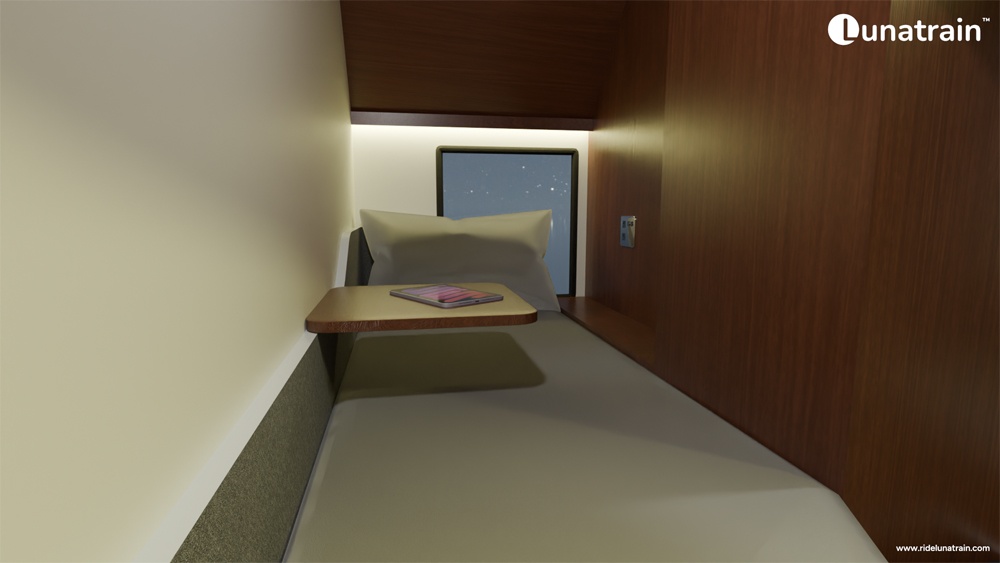
“Europe’s Nightjet mini-cabins are one benchmark,” he says, “an economical option compared to what’s available in the U.S. We’re really focused on a mini-cabin, a smaller accommodation for a solo traveler at a price that’s reasonable; unlike a roomette, you won’t be paying for two beds.” This sounds strikingly similar to 1950s-era Budd Slumbercoaches that Amtrak operated into the 1990s.There will also be larger, couchette-style compartments sold only to groups or families — not strangers, as is most often the case in Europe. ”Americans do like their privacy,” Avena surmises.
Early conceptual designs have advanced [see “Start-up Lunatrain plans …,” News Wire, Feb. 19, 2025]. Detailed engineering can be completed once a car shell is chosen. “There are a lot of good [shell] candidates out there,” he says, but the renderings on the company’s website clearly reflect Siemens’ Venture/Brightline coach design.
Phase I of Lunatrain’s business model will attempt to verify the market potential for U.S. night trains by getting feedback from press releases, “then going through another equity fundraising round in the near future to fund the construction of one prototype car,” Avena says. “We plan on building out some of the interior spaces that we envisioned and getting real customers into the space so they can touch and feel what the cabins would look like — knowing that we have the right product for our target market before we go out to investors. The project plan is based on taking bite-sized pieces, doing what we can to prove something early on.”
 What about the Lunatrain system map showing a Chicago-Nashville-Atlanta-Jacksonville-Miami route that approximates the path of Amtrak’s original Floridian? It is clearly too long to be considered “overnight” or necessarily appropriate for the cozy accommodations being described. Avena admits the map “is really 10 to 15 years into the future and relies on some planned infrastructure improvements, such as the [Virginia-North Carolina] S-Line corridor.”
He says Lunatrain has had preliminary discussions with CSX and Norfolk Southern and “knows what their requirements are to even start a conversation about insurance, safety, and crew qualifications. We do anticipate working closely with Amtrak; anything we do on the Northeast Corridor will have to be mutually beneficial.”
A history of overnight operations
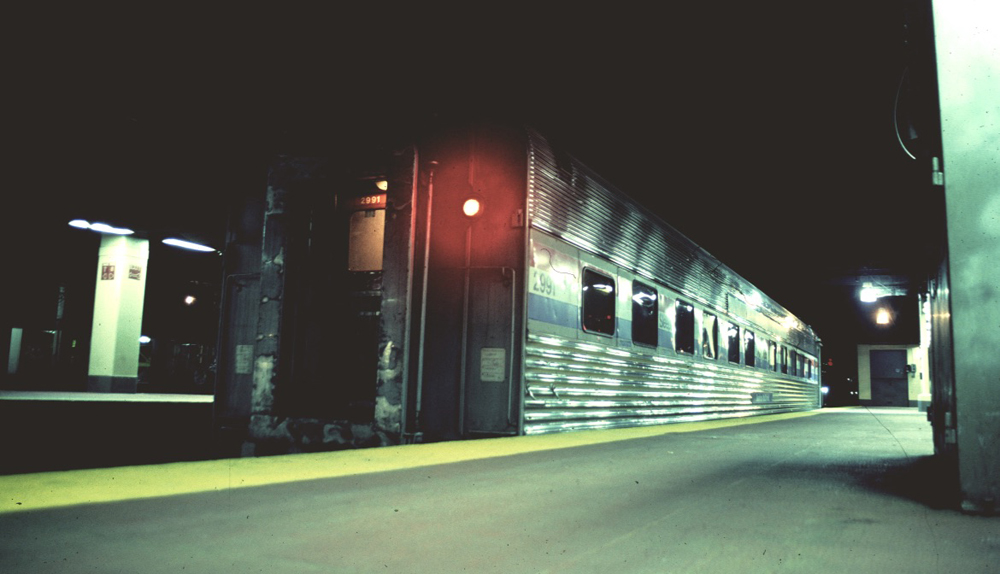
Cities between Boston and Washington, D.C., not only have the most overnight potential for easy implementation, but Amtrak and its predecessors have previously mined the market extensively.
As late as 1961, the Pennsylvania Railroad offered 11 Northeast Corridor-anchored city-pair runs that included intermediate sleeping car set-outs and pick-ups at New York, Baltimore, and Philadelphia, as well as coordination with other lines to and from off-corridor destinations like White River Junction, Vt., and Norfolk, Va. Pennsy’s Federal would morph into Amtrak’s Night Owl, which even had a “cutoff” New York-Washington “Executive Sleeper” parked at Penn Station before its nocturnal departure or after its overnight arrival from Washington. The Night Owl’s successor, the Boston-Newport News, Va., Twilight Shoreliner, launched during Amtrak’s 1990s product-line era, initially had a new Viewliner that ran the full route.
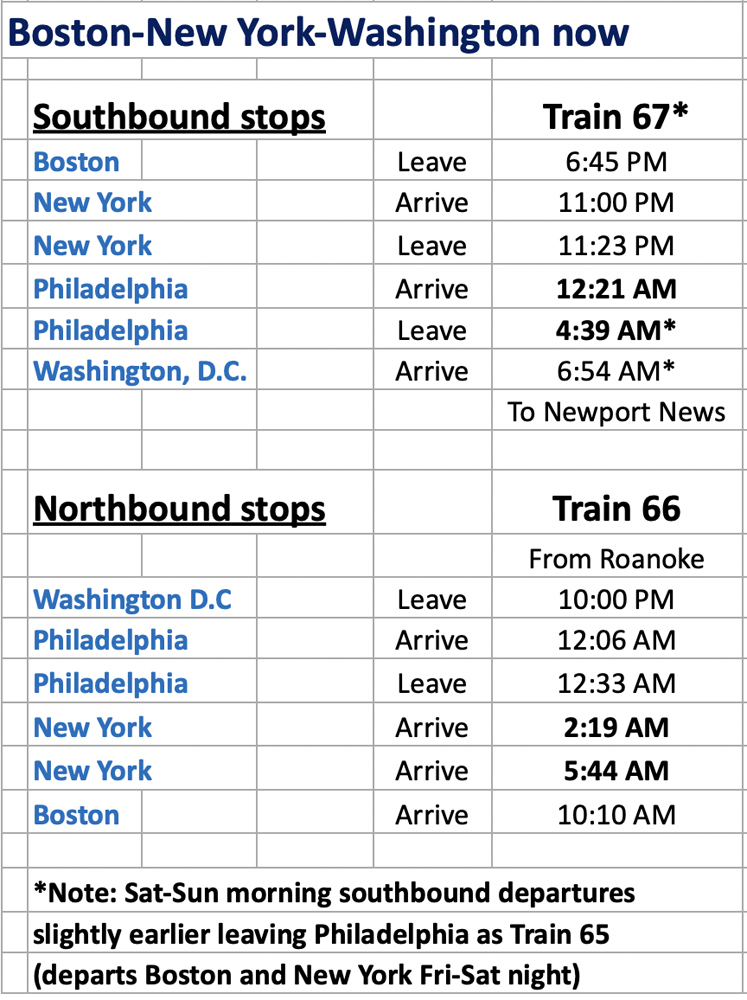 Currently, Boston-Washington running times for trains No. 65/67 southbound and No. 66 northbound have been lengthened with long layovers to accommodate overnight East River Tunnel closures [see table at right]. But they could still help Lunatrain test demand and pricing if Amtrak continues to overhaul Viewliner I sleepers stored when Viewliner II cars began arriving in 2017.
Elsewhere, Amtrak long-distance trains offer few dusk-to-dawn opportunities between the largest population centers, other than Washington-Atlanta southbound on the Crescent. Schedule lengthening negated its once-popular northbound counterpart, as well as the New York-Chicago westbound Lake Shore Limited. The westbound Floridian out of Washington theoretically qualifies, but an on-time departure from the Nation’s Capital after arriving from Miami remain elusive.
Should Avena forge a partnership with Amtrak and succeed in getting new sleeping cars built, a promising off-Northeast Corridor overnight route might be an Albany-Montreal extension of a New York-Albany Empire Service train on Canadian Pacific’s lightly-trafficked former Delaware & Hudson. The Montrealer attracted patronage on a route through Vermont before it got caught in a 1995 budget crunch, but its “Le Pub” car offered more lounge space than Lunatrain contemplates.
“I spent the last year talking to people in the industry to understand what we have to do to bring the concept to reality,” Avena says. “There are a lot of difficult challenges, but nothing that is totally insurmountable that we couldn’t overcome.”
Share this article