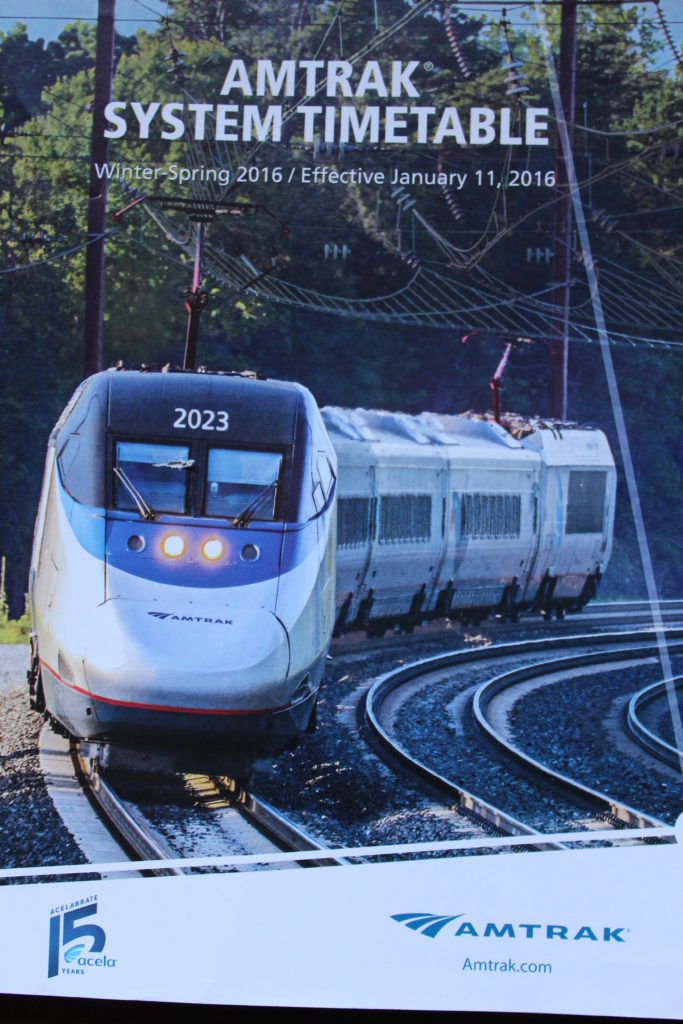
In a statement released this week, Amtrak says, “surveys have revealed that few customers want or use the printed System Timetable and expressed a preference to access information on-line.” Other reasons given include:
- Schedules, policies, and programs are ever-changing, and it’s impossible to keep the printed document up-to-date
- Reducing print is financially and environmentally responsible
- Individual route panels will continue to be printed for distribution aboard trains and at stations; these are also available on-line.
As late as the 2011-2012 Fall-Winter edition, Amtrak’s press run was 500,000. It dropped to 360,000 by 2013, and concluded with a 300,000 printing in what turned out to be the final printed timetable, which was issued on January 11, 2016.
While VIA Rail Canada still provides a pocket timetable which lists all of its routes, virtually all other forms of public transportation dropped paper versions long ago.
Periodically over its 45 year history, Amtrak has experimented with separate “National” and “Northeast” editions but has always returned to a national system timetable.
Over the last few years, the company has been more likely to tinker with schedule or service adjustments because these can easily be communicated electronically through booking channels. The Amtrak smartphone app, for example, provides station information with maps to show exact locations. In contrast, the timetable’s printed station list has been dumbed down to eliminate not only street addresses but zip codes.
Nevertheless, with elimination of this year’s National Train Day as well as most route- and train-specific advertising and promotion (unless a state or regional operating authority wants to pay for it), the latest move makes it more difficult for Americans who may not be familiar with all of Amtrak’s routes to find out exactly where passenger trains go and when they leave the nearest station.