

PIERRE, S.D. — South Dakota’s Senate has voted down a bill calling for support for introduction of Amtrak service in the state.
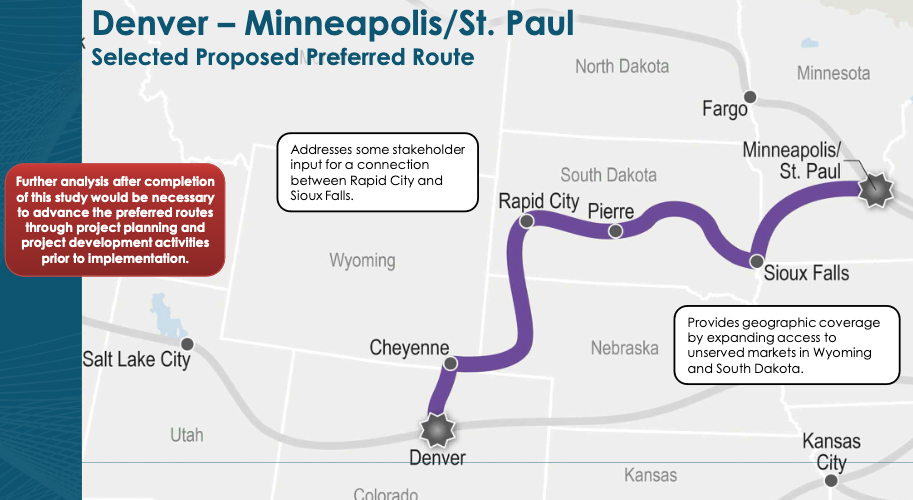
House Concurrent Resolution 6008 calls for state’s congressional delegation and the Trump administration to work for development of a route through the state connecting Denver and Minneapolis-St. Paul [see “South Dakota resolution …,” Trains News Wire, Feb. 17, 2025] That is one of 15 routes presented in the Federal Railroad Administration’s Long-Distance Study [see “Houston-New York service gets highest ranking …,” News Wire, Jan. 21, 2025].
The legislation introduced by Rep. Tim Goodwin (R-30th District) passed the House by a 49-21 vote on Feb. 19, and had cleared the Senate Transportation Committee by a 6-0 vote. But on Monday, March 3, the Senate voted it down by an 18-17 margin.
TV stations KSFY/KDLT report that Sen. Carl Perry (R-Aberdeen) argued, “Forty-eight other states have Amtrak. This links us to the rest of the continental U.S.” (Wyoming is the only other state in the 48 contiguous states without Amtrak service; Alaska and Hawaii are also not served.) But Sen. John Carley (R-Piedmont), after saying 90% federal funding has sometimes been available for Amtrak projects, argued, “They’ve measured that it costs almost $100 million per mile of line. That’s a big number. Even if you take 90% for federal coverage, that’s $10 million per mile to put a passenger rail service in.”
The resolution did not address funding for the project, which the FRA report estimated could have required up to $5.83 billion in infrastructure work.
Share this article