

MONTREAL — Canadian Prime Minister Justin Trudeau has announced plans to build a high speed rail line linking Toronto, Montreal, and Quebec City, calling it “the largest infrastructure project in Canadian history.”
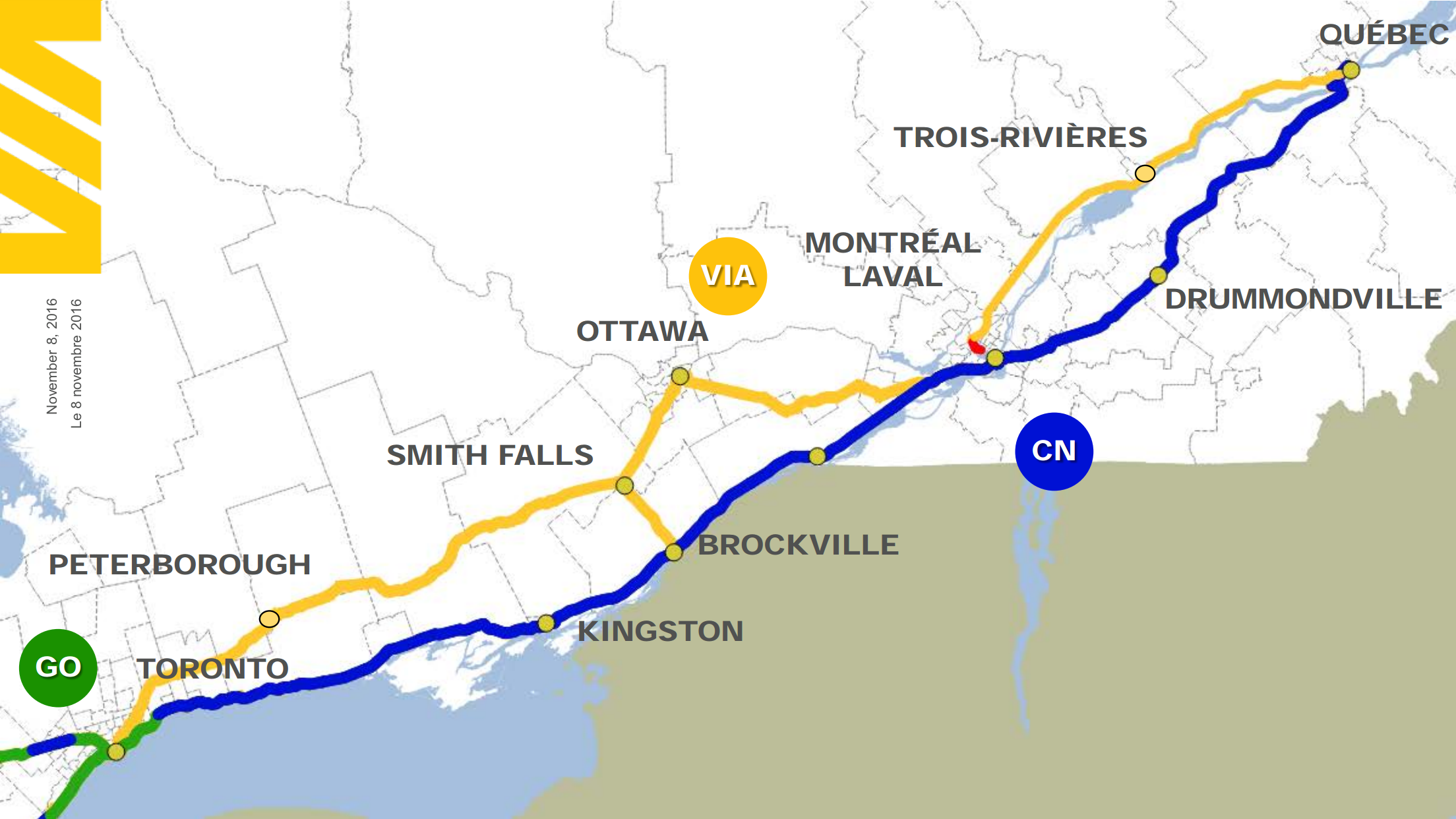
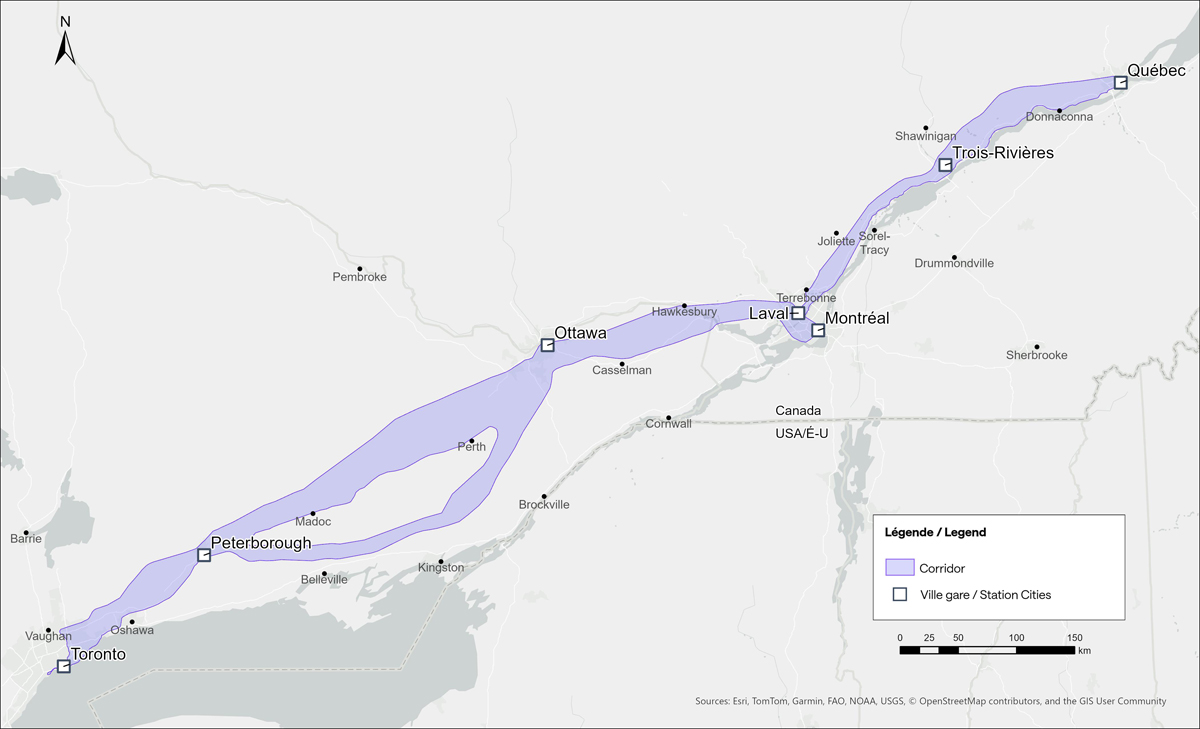
The 1,000-kilometer (620-mile) system, to be known as Alto, will have a top speed of 300 kilometers per hour (186 mph), with intermediate stops in Peterborough and Ottawa, Ontario, and Laval and Trois-Rivières, Quebec. The government has pledged Ca$3.9 billion ($2.74 billion U.S.) for design and development over the next six years.
Construction is not expected to begin until the design phase is complete, which could take four to five years. The CBC reports that construction funds will not be allocated until the end of the design period, which means a future government could modify or cancel the project. Canada will hold a federal election no later than Oct. 20 of this year; the latest CBC poll shows the Conservative Party with a significant but decreasing lead over Trudeau’s Liberal Party. Trudeau has already announced plans to step down as head of the Liberals; they will choose a new leader in March.
“Obviously, future governments will make their determinations about how they invest,” Trudeau said at press conference today (Feb. 19, 2025) in Montreal. “But this investment in Canadians, which starts right now, is going to be very difficult to turn back on.“
The announcement did not address the overall cost of the project, but Bloomburg reports government studies have suggested it could cost more than Ca$65 billion ($45.7 billion), while the CBC reports Transport Canada initially estimated the cost at up to Ca$80 billion ($56.2 billion).
Trudeau said in a press release that the high-speed system “will transform our economy – drastically shortening commute times for millions of Canadians, turbocharging economic growth, creating thousands of good-paying jobs, improving productivity, and reducing emissions. Montréal to Toronto in three hours – you can’t beat that.” Currently, that trip takes about 5½ hours.
The Cadence consortium — led by the infrastructure arm of Caisse de Depot et Placement du Quebec, manager of the province’s pension funds and builder of Montreal’s REM light rail system — has been selected to build the project,. The company and Alto still need to sign a contract setting out terms of the development phase. Others involved in Cadence are Air Canada, Keolis, SNCF Voyageurs (the operating subsidiary of France’s national railway company), as well as engineering firms Atkins Realis Group and Systra. The CBC says Cadence was informed it had been selected only within the last 24 hours.
“The Cadence consortium’s unparalleled expertise, synergy, and successful track record offer Alto, the Crown corporation with which we will develop this project, a trusted partner to bring this visionary project to life at the best possible cost,” Jean-Marc Arbuad, CEO of CDPQ Infra, said in a press release. “We thank everyone involved in the development of the proposal for their trust and professionalism over the last year. We look forward to working together to design, develop and deploy this fundamental project for all Canadians.“
Air Canada’s involvement sparked some controversy when it joined the Cadence group last year, given concerns over the company’s history of antipathy toward passenger rail and the possibility its involvement would provide access to VIA Rail Canada data that could provide it with a competitive advantage [see “Air Canada involvement …,” Trains News Wire, Aug. 8, 2024].
Cadence was one of three consortia to bid for the project; under bidding rules, the government now owns the rights to the ideas the two losing groups presented.
The project began life as a VIA Rail Canada proposal for “high frequency rail” — a passenger-only route serving the Toronto-Montreal-Quebec City corridor [see “VIA Rail Canada still studying …,” News Wire, May 29, 2019]. It gradually evolved into a government-led venture, with a recent shift to high speed [see “Canada’s High Frequency Rail could become high-speed project,” News Wire, Oct. 9, 2024].
Martin Imbleau, who had previously been announced as the head of VIA HFR, VIA Rail Canada’s affiliate for the high frequency project, was introduced as president and CEO of Alto.
“I’m firmly convinced that the way a project is developed is as crucial as the project itself,” Imbleau said. “Which is why we are developing it now, in collaboration with Cadence, relying on the best practices of the industry. We have assembled a unique group of talents, combining the know-how of a federal Crown corporation with the experience of a consortium of world-class private partners.”
— Updated at 11:125 a.m. CT to recast article, add additional details.