News analysis: Amtrak equipment sale reflects lack of emphasis on growth, revenue NEWSWIRE

News analysis: Amtrak equipment sale reflects lack of emphasis on growth, revenue NEWSWIRE

By Bob Johnston | October 22, 2018

| Last updated on November 3, 2020


Get a weekly roundup of the industry news you need.

Amtrak_P40s_Johnston
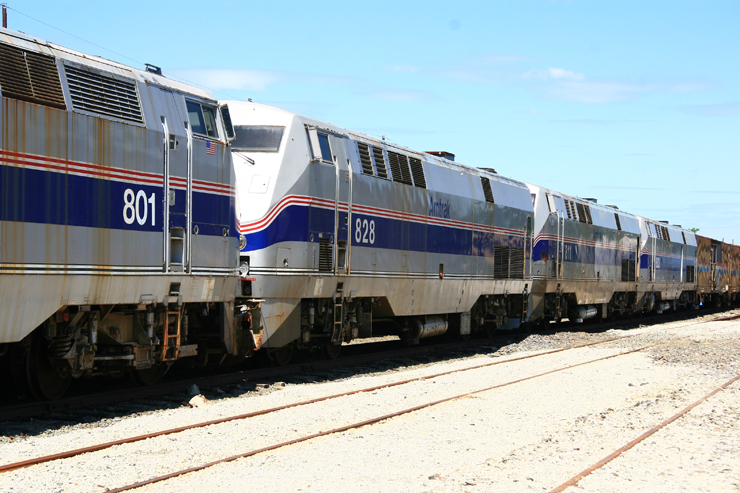
These P40 diesels, seen at Bear, Del., on June 7, 2010, are up for sale after being passed over for rehab.
Bob Johnston

BEECH GROVE, Ind. — Want to buy a 1954-vintage, ex-Santa Fe hi-level lounge? Or how about one of eight F40 or 12 P40 locomotives? Starting today through Nov. 2, Amtrak is offering prospective purchasers appointments to inspect 48 pieces of equipment for sale at its Indiana, Delaware, and Connecticut facilities. [See “Amtrak to sell Parlour Cars, locomotives as surplus,” Trains News Wire, Oct. 18, 2018.] Bids are due by Nov. 14.

Throughout Amtrak’s 47-year history, management has periodically thinned its fleet of equipment deemed too expensive to rehabilitate or maintain. But the short-term expediency, based solely on near-term needs, significantly constrained future ridership and revenue growth potential.

The first big purge occurred as the first Superliner order began to arrive in October 1979.  Because of a budget sharply reduced by the Carter administration, Amtrak cut the New York-Kansas City National Limited; New York-St. Petersburg, Fla., Champion; Washington, D.C.-Tri State, Ky., Hilltopper; Chicago-Miami/Tampa Floridian; Chicago-Seattle (via Billings, Mont.,) North Coast Hiawatha; and Chicago-Houston Lone Star. The company subsequently decided to convert just enough heritage dining cars, lounges, sleepers, and coaches to head-end power for its remaining single-level long-distance trains, rather than spend money it didn’t have to rehabilitate cars it might someday need.

Similarly, single-level coach-dome cars and all but one full-length dome were jettisoned at a Beech Grove sale in 1993 with the arrival of Superliner IIs, which allowed conversion of the City of New Orleans, Capitol Limited and Auto Train to Superliners.    

Now, Amtrak has decided to finally sell off long-stored F40 and P40 locomotives. They became surplus when more than 200 P42s began arriving in 1996 and express-business growth failed to materialize. (Three wreck-damaged P42s are also on the block.)

The Electro-Motive Division F40s, stored dead for more than a decade, are odd men out in a virtually all-General Electric diesel fleet. The 12 P40s, still in their turn-of-the-century phase IV paint scheme, were passed over in 2010 as being more expensive to repair than 15 800-series units chosen for rehabilitation as part of a $90.8 million economic stimulus program. With new fuel- and environmentally efficient Siemens Chargers on the prowl, it’s doubtful a vibrant market exists for these locomotives.

Eight heritage baggage cars displaced by new Viewliners, as well as five flat and material handling cars, are likewise expendable.

Amtrak_Parlour_Johnston
Passengers enjoy the Coast Starlight’s Pacific Parlour Car, a perk for those paying higher fares and therefore generating additional revenue, in 2009.
Bob Johnston

Inspections of the seven Horizon coaches and dinettes for sale will likely reveal why Amtrak has decided to see if states might be interested in paying to fix any ailments rather than keeping them on hand to handle peak-period passenger demand, thus generating more revenue.

But management’s decision to sell the five hi-level lounges, retired early this year from Coast Starlight Pacific Parlour Car service, precludes their future use to create an onboard environment designed to attract passengers willing to pay higher fares.

The fact that the Parlours are more expensive to maintain trumps any value they have at generating more revenue per passenger. That’s because Amtrak’s current management has demonstrated it has no interest in growing revenue unless it can be done with keyboard-driven fare sales on the internet. Management has also shown with the introduction of cold meal service that it lacks acumen for creating the kind of hospitality to improve the transportation experience.

Meanwhile, VIA Rail Canada continues to maintain and refurbish diners, sleepers, coaches, and lounges of a similar vintage built for Canadian Pacific by the Budd Co.

From a maintenance standpoint, the Parlour cars are clearly orphans after Amtrak retired 57 hi-level coaches and dining cars between 2003 and 2007 (according to David C. Warner and Elbert Simon’s “Amtrak By the Numbers”).

But that move, like previous fleet retirements in 1979 and 1993, also severely limited future route and revenue growth options; shop forces at Beech Grove have proven they can keep Amtrak’s aging fleet in shape for far less than buying new equipment if sufficient funds aren’t available. Unfortunately, the proposed Pacific Parlour Car sale is the latest iteration of Amtrak’s historical near-term only, short-sighted vision.


Share this article