

Normally the addition of a 3.5-mile stretch of second main line isn’t a cause for celebration. But when those 3.5 miles happen to be the final section of regular double track added to BNSF Railway’s 2,200-mile Southern Transcon, well, then it’s a major milestone.
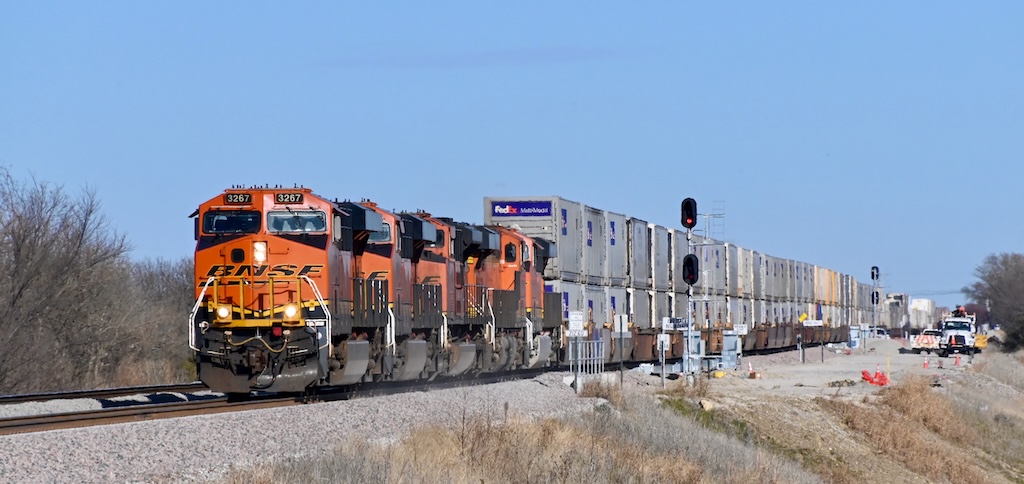
BNSF cut over the new trackage between Rose Hill and Mulvane, Kan., on Nov. 18 as the capstone to a 51-mile double-tracking project. Fittingly enough, the first train to roll over the new trackage on the Emporia Subdivision was a Z-symbol hotshot.
Intermodal is BNSF’s bread and butter. It’s also the primary reason that, back in 1992, Santa Fe CEO Rob Krebs committed to laying down a second main alongside the 512 miles of single track that then existed between Ellinor, Kan., and Belen, N.M.
Krebs saw those single-track gaps as a barrier to providing fast, frequent, and reliable domestic intermodal service for customers like UPS and J.B. Hunt. Krebs’ vision: Create a super railroad with bidirectional centralized traffic control, two main tracks, and universal crossovers spaced 10 miles apart all the way from Chicago to L.A.
Adding second main track year after year and decade after decade is a case study in persistence – not to mention confidence that traffic growth would justify the expense.
It’s also a tradition BNSF inherited from the Santa Fe. Krebs was standing on the shoulders of AT&SF leaders like Edward Ripley, Ernest Marsh, Fred Gurley, and John Reed, who pushed major improvement projects such as the Belen and Crookton cutoffs, as well as multiyear grade and curve reduction programs.
Double track was a focus early on for the Santa Fe. In 1910 Santa Fe began an effort to add a second main track from Dalies, N.M., to San Bernardino, Calif., just two years after completing the Belen Cutoff that freed the railroad’s freight trains from the operational headache of Raton’s 3.5% grades.
The rationale for the improvements, then and now, was to build a faster, more efficient, higher capacity railroad that could attract premium traffic to and from California.
Progress never moves in a straight line, though, so it’s no surprise that BNSF took a double-tracking breather four times.
After building 300.28 miles of second main between 1993 and 1999, BNSF hit the brakes. Wall Street took Krebs to task for what analysts considered lavish capital spending. Work resumed in 2003, and by the end of 2009 there were 196.15 additional miles of new second main in service, a figure that includes former sidings upgraded to main line standards.
The Great Recession prompted a pause in 2010. The Bakken crude oil boom forced BNSF to focus all of its capacity expansion efforts on the Northern Transcon from 2012 through 2014. Just 19.65 miles of second main were added on the Southern Transcon in 2015-16. Then BNSF got going again with the Emporia Sub project in 2019.
Along the way, BNSF also added sections of triple and quadruple track at crew change points and grades, all to allow priority trains to overtake slower freights.

Yes, the battle for on-time performance is typically won or lost in terminals. BNSF has continually expanded the anchor intermodal terminals served by the Southern Transcon or its Texas extensions. Logistics Park Chicago, Hobart in Los Angeles, and Alliance in Fort Worth, Texas, now all can handle more than a million lifts per year, putting them in a league of their own.
But what happens on the main line is important, too. And that’s particularly the case when BNSF and intermodal partner J.B. Hunt are going after premium truckload traffic with the new Quantum service launched in 2023. They’re guaranteeing 95% on-time performance for loads that have never touched rails before, and on schedules a day faster than traditional truckload intermodal.
Which brings us back to the Emporia Sub. When intermodal volume peaks midweek, it’s where the westbound and eastbound hotshot fleets meet. BNSF had been using a sort of directional running system in the area: Westbound and priority traffic stuck to the Emporia Sub, while a couple dozen eastbounds per day ran via Newton, Kan., on the Arkansas City Sub, a route that’s 90 minutes longer.
The double track has had an outsized operational impact because the Emporia Sub’s short passing sidings limited where trains could meet. Now BNSF gets a productivity and service boost from eliminating meets and bringing eastbound traffic back to the faster Emporia Sub.

The Southern Transcon’s remaining single track sections involve two big bridges. The first, 1.5 miles over the Missouri River at Sibley, Mo., is being taken care of, with a second span set to open in 2027. That leaves just 2.7 miles of single iron over the Salt Fork River at Alva, Okla., which at 45 trains per day is the lowest-density segment of the route. BNSF says traffic levels will determine when a second bridge goes up.
Nonetheless, it’s hard to understate the significance of what BNSF has accomplished in a world focused on the next quarterly earnings report. The Southern Transcon double-tracking is proof that persistence pays off in an industry where success requires long-term thinking – and sticking to it.
You can reach Bill Stephens at bybillstephens@gmail.com and follow him on LinkedIn and X @bybillstephens
Share this article