

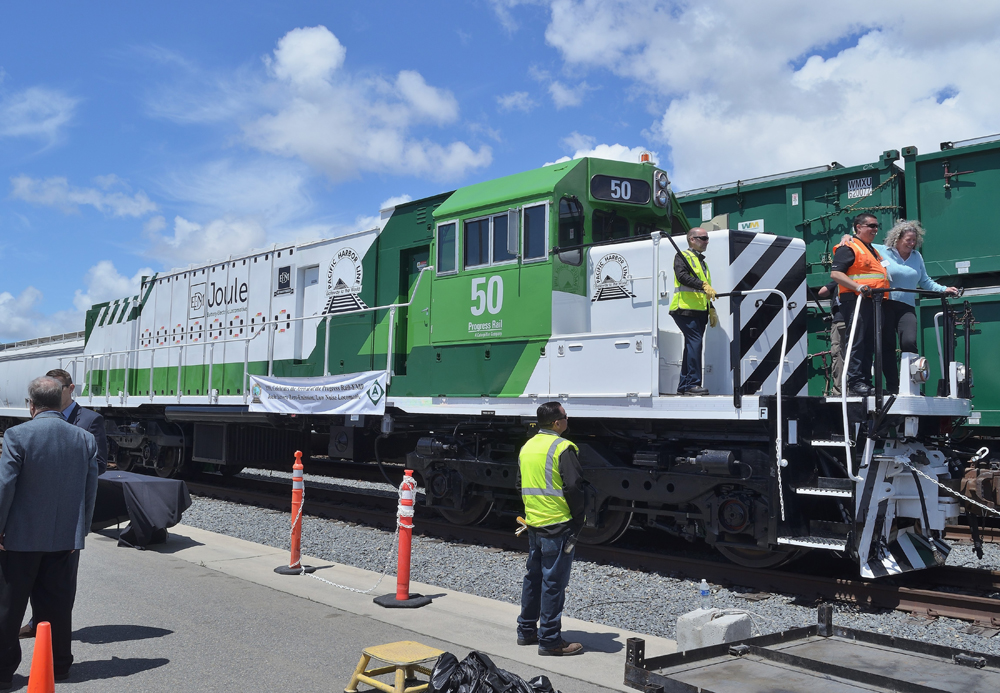
SACRAMENTO – The California Air Resources Board has scrapped its controversial rule that would have required the use of zero-emissions locomotives in the state beginning in 2030.
The board, or CARB as it’s known, informed the U.S. Environmental Protection Agency this week that it was withdrawing its requests to enforce zero-emissions rules covering trucks and locomotives.
The move comes a week before the inauguration of President-elect Donald Trump, who frequently criticized CARB’s regulatory efforts to fight climate change and improve the state’s air quality.
“Withdrawal is an important step given the uncertainty presented by the incoming administration that previously attacked California’s programs to protect public health and the climate and has said it will continue to oppose those programs,” CARB Chair Liane Randolph said in a statement on Tuesday.
Because CARB’s regulations are more strict than those imposed on the federal level, the agency requires waivers from the EPA in order to enforce them. CARB is no longer pursuing the waivers for the in-use locomotive rule or regulations that would have phased out diesel-powered trucks.
The CARB regulation, which went into effect last year but was on hold pending EPA approval, would have banned any locomotive that is 23 years or older from operating in California. The regulation set dates after which all locomotives with engines built after certain years must operate in a “zero emission configuration.”
Under the rule, railroads operating in California would have had to begin contributing to a spending account where money would be set aside for the acquisition of zero-emission locomotives.
The Association of American Railroads opposed the regulation and challenged it in federal court. The CARB regulation would mandate investments in locomotives that aren’t yet commercially viable while limiting the lifespans of more than 25,000 diesel-electric locomotives currently in use, the AAR said. The trade group also argues that the CARB regulation violates the Clean Air Act, would put some short line railroads out of business, and hurt the supply chain in California and beyond.
BNSF Railway has said that the CARB regulation threatened the viability of its proposed $1.5 billion Barstow International Gateway intermodal terminal.
“We are encouraged that CARB has pulled down their request for a waiver with the EPA,” CEO Katie Farmer said this morning at the Midwest Association of Rail Shippers conference. Farmer thanked those in attendance who wrote elected officials about what she called a “misguided regulation” and said the railway now has a path to move forward with its investment in Barstow, where it aims to gather container traffic from the ports of Los Angeles and Long Beach. At Barstow, the imported cargo would be sorted and transloaded into domestic containers at on-site facilities, then sent east on double-stack trains.
“I’m incredibly encouraged by the idea now that we can continue to have good dialogue with the state of California,” Farmer says. “We continually talk to the state of California about our investment at Barstow.”
The AAR welcomed CARB’s decision to abandon the locomotive rule.
“Railroads are pleased that the California Air Resources Board has withdrawn its authorization request for the ill-conceived in-use locomotive rule,” AAR spokeswoman Jessica Kahanek said in a statement. “As we move past this untenable proposal, railroads look forward to advancing their already strong sustainability profile and further reducing emissions in the years to come.”
Chuck Baker, president of the American Short Line and Regional Railroad Association, also hailed the demise of the CARB rule.
“The current Administration’s unwillingness to grant the waiver request and CARB’s subsequent withdraw alof the waiver request was the right outcome. As we have repeatedly shared, CARB’s In-Use Locomotive Act would have threatened the very existence of short lines in California and in other states where such a rule could have been copied,” Baker says. “While we are evaluating the immediate impact of this action on the rule in a California, we welcome the opportunity to continue to be the environmentally friendly mode of surface transportation and to work with CARB and other stakeholders to make freight rail even cleaner, without draconian actions that would eliminate the efficient and flexible service that short lines provide to the agriculture, industrial, and energy shippers driving the California economy.”
Note: Updated at 10:07 a.m. with comments from BNSF CEO Katie Farmer and at 4:45 p.m. Central with comment from ASLRRA. Trains Senior Editor David Lassen contributed to this report.
Share this article